Printable Ideentagebuch
Ihre besten Ideen festhalten, bewerten und weiterentwickeln
A structured journal for capturing creative ideas and evaluating their potential. Each page combines quick-rating fields for excitement, feasibility, effort, and impact with guided writing prompts to flesh out the concept. Turn fleeting thoughts into actionable plans.
Felder anpassen
Schalten Sie Felder ein oder aus. Klicken Sie auf den Stift zum Umbenennen oder fügen Sie eigene Felder hinzu.
Vorteile
Anleitung
Was ist dieses Journal?
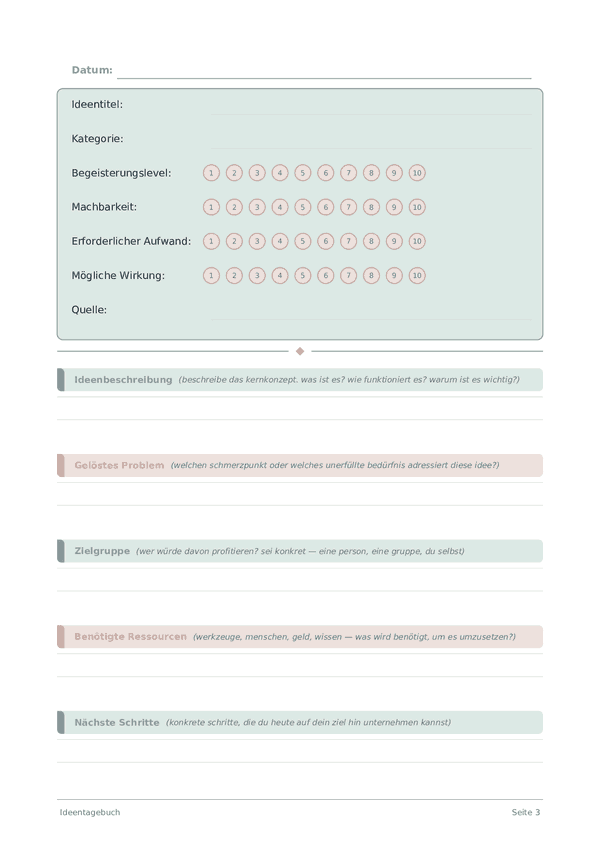
An Idea Journal is a hybrid capture tool that helps you evaluate and develop ideas systematically instead of letting them vanish. The top section lets you rate each idea on excitement, feasibility, effort required, and potential impact, along with a title, category, and source. The bottom section provides space to describe the idea in detail, define the problem it solves, identify the target audience, list needed resources, outline action steps, and note related ideas.
Great ideas are fragile — they appear at unexpected moments and disappear just as quickly if not recorded. But capturing ideas is only the first step. The real power of this journal is in the structured evaluation: by rating each idea against consistent criteria, you can objectively compare them later and decide which ones deserve your time and energy.
Carry this journal everywhere or keep it on your desk. When an idea strikes, fill in the top ratings immediately to capture your initial gut feeling. Then, when you have a quiet moment, flesh out the bottom section with details. Review your collected ideas monthly to spot patterns, combine related concepts, and choose the most promising ones to pursue.
Ausgefülltes Beispiel
So sieht ein typischer Eintrag aus, wenn er ausgefüllt ist:
Wie Sie jedes Feld ausfüllen
Oben auf jeder Seite befinden sich schnell ausfüllbare Felder (Bewertungen, Kontrollkästchen, Zahlen). Darunter ist ein linierter Bereich zum Schreiben. Hier erfahren Sie, was jedes Feld bedeutet:
Ideentitel
Gib deiner Idee einen klaren, einprägsamen Namen, den du später wiederfindest
Kategorie
Weisen Sie diesem Eintrag eine Kategorie zu (z. B. Essen, Transport, Unterhaltung). Einheitliche Kategorien machen Ihre Daten leicht analysierbar.
Begeisterungslevel
Wie begeistert bist du von dieser Idee? 1 = meh, 10 = kann nicht aufhören daran zu denken
Machbarkeit
Wie realistisch ist die Umsetzung? 1 = Mondschuss, 10 = könnte heute anfangen
Erforderlicher Aufwand
Wie viel Zeit, Energie und Ressourcen würde es kosten? 1 = minimal, 10 = enorm
Mögliche Wirkung
Wenn es funktioniert, wie groß ist der Gewinn? 1 = kleiner Erfolg, 10 = lebensverändernd
Quelle
Buch, Kurs, Video, Artikel, Person...
Ideenbeschreibung
Beschreibe das Kernkonzept. Was ist es? Wie funktioniert es? Warum ist es wichtig?
Gelöstes Problem
Welchen Schmerzpunkt oder welches unerfüllte Bedürfnis adressiert diese Idee?
Zielgruppe
Wer würde davon profitieren? Sei konkret — eine Person, eine Gruppe, du selbst
Benötigte Ressourcen
Werkzeuge, Menschen, Geld, Wissen — was wird benötigt, um es umzusetzen?
Nächste Schritte
Unterteilen Sie Ihr Ziel in konkrete nächste Schritte. Was genau werden Sie tun, wann und wie? Je konkreter, desto besser.
Verwandte Ideen
Ist diese Idee mit anderen verbunden? Kreuzbestäubung bringt Durchbrüche
Tipps für den Erfolg
Wann und wie oft schreiben
Capture ideas whenever they strike — this journal should be always accessible, not confined to a scheduled time. However, set a weekly 20-minute session to review, rate, and expand on ideas captured during the week. Many will seem less exciting on second look, and that is valuable filtering. Monthly, review all ideas from the past 30 days and select one or two to develop further or act on. The goal is not to have more ideas but to systematically surface the best ones.
Häufig gestellte Fragen
Wofür ist das Ideen-Journal gedacht?
Dieses Journal fängt flüchtige kreative Einfälle ein, bevor sie verblassen, und hilft dir, sie objektiv zu bewerten. Jede Seite hat einen Tracker oben für Titel, Kategorie und vier Bewertungen (Begeisterung, Machbarkeit, Aufwand, potenzielle Wirkung, jeweils 0-10), plus einen Schreibbereich für gelöstes Problem, Zielgruppe, benötigte Ressourcen, Handlungsschritte und verwandte Ideen. Es verwandelt verstreute Inspiration in ein strukturiertes Archiv.
Wie nutze ich die vier Bewertungsfelder (Begeisterung, Machbarkeit, Aufwand, Wirkung)?
Vergib jede Note auf einer 0-10-Skala direkt nach dem Festhalten der Idee. Begeisterung spiegelt deine intrinsische Motivation, die laut Amabile (2011, The Progress Principle, Harvard Business Review Press) das kreative Durchhalten vorhersagt. Machbarkeit und Aufwand schätzen die Kosten; potenzielle Wirkung den Nutzen. Ideen mit hoher Begeisterung und Wirkung bei moderatem Aufwand verdienen die erste Handlung. Bewerte nach einer Woche neu — anfänglicher Enthusiasmus verblasst oft.
Hilft das Aufschreiben von Ideen wirklich der Kreativität?
Ja. Csikszentmihalyi (1996, Creativity, HarperCollins) fand heraus, dass kreative Menschen Ideen systematisch festhalten und erneut betrachten, statt sich auf das Gedächtnis zu verlassen. Das Externalisieren befreit das Arbeitsgedächtnis für Kombination und Ausarbeitung — der Kernmechanismus hinter Innovation. Die strukturierten Felder (Quelle, Kategorie, Handlungsschritte) machen Ideen wieder auffindbar, sodass alte Einträge beim Durchsehen neue Verbindungen anregen.
Wie unterscheidet sich das von einer Notiz-App wie Notion oder Evernote?
Apps speichern Ideen; dieses Journal bewertet sie. Die festen Bewertungsskalen (0-10) erzwingen den Vergleich zwischen Ideen, und die strukturierten Prompts (gelöstes Problem, Zielgruppe, benötigte Ressourcen) verhindern die vagen Einzeiler, die die meisten digitalen Postfächer füllen. Papier reduziert zudem Kontextwechsel und Benachrichtigungslärm beim Ideenfinden. Nutze das Journal für Bewertung und Ausarbeitung, eine App für Speicherung, falls gewünscht.
Warum fragt die Vorlage nach der Quelle der Idee?
Das Quellenfeld (Buch, Gespräch, Beobachtung, Problem) macht Muster über Monate sichtbar. Du entdeckst, welche Umgebungen deine besten Ideen hervorbringen — ein Kernprinzip aus Csikszentmihalyis Flow-Forschung (1990, Flow, Harper). Das Tracking der Quelle anerkennt zudem Einflüsse ehrlich und hilft dir, fruchtbare Inputs gezielt aufzusuchen. Schreibe ein kurzes Tag wie "Podcast / Dusche / Kundengespräch" statt einer langen Quellenangabe.
Wie oft sollte ich vergangene Ideen-Einträge durchsehen?
Wöchentlich zum aktiven Festhalten, monatlich zur Mustersuche. Das Durchsehen nutzt den Spacing-Effekt, dokumentiert von Cepeda et al. (2006, Psychological Bulletin, 132(3), 354-380) — verteilte Wiederbegegnung stärkt das Erinnern und bringt unerwartete Kombinationen ans Licht. Markiere Einträge, die du verfolgen willst; archiviere oder streiche den Rest. Die meisten Ideen überleben die Durchsicht nicht — genau das ist der Sinn des Filters.
Was ist der häufigste Fehler beim Führen eines Ideen-Journals?
Den Titel zu notieren, ohne gelöstes Problem, Zielgruppe und Handlungsschritte auszufüllen. Eine Idee, die du in sechs Monaten nicht mehr klar formulieren kannst, ist praktisch verloren. Plane 3-5 Minuten pro Eintrag — genug, um sie wieder auffindbar zu machen, nicht so lang, dass die nächste Idee blockiert wird. Begeisterung allein verblasst schnell; die strukturierten Prompts erzwingen die Ausarbeitung, die eine nutzbare Idee von einem flüchtigen Gedanken unterscheidet.
Eignet sich das Journal für Gründer, Schriftsteller und Wissenschaftler gleichermaßen?
Ja — die Struktur ist fachneutral. Eine Gründerin nutzt Kategorie und Zielgruppe für Produkte; ein Romanautor für Storyideen; eine Forscherin für Hypothesen. Die Aufwand/Wirkungs-Bewertungen funktionieren als leichte Priorisierungsmatrix, ähnlich wie in Amabiles Forschung zur Arbeitsplatz-Kreativität beschrieben (2011, The Progress Principle, Harvard Business Review Press). Passe das Quellenfeld an deine Disziplin an.
Das könnte Ihnen auch gefallen
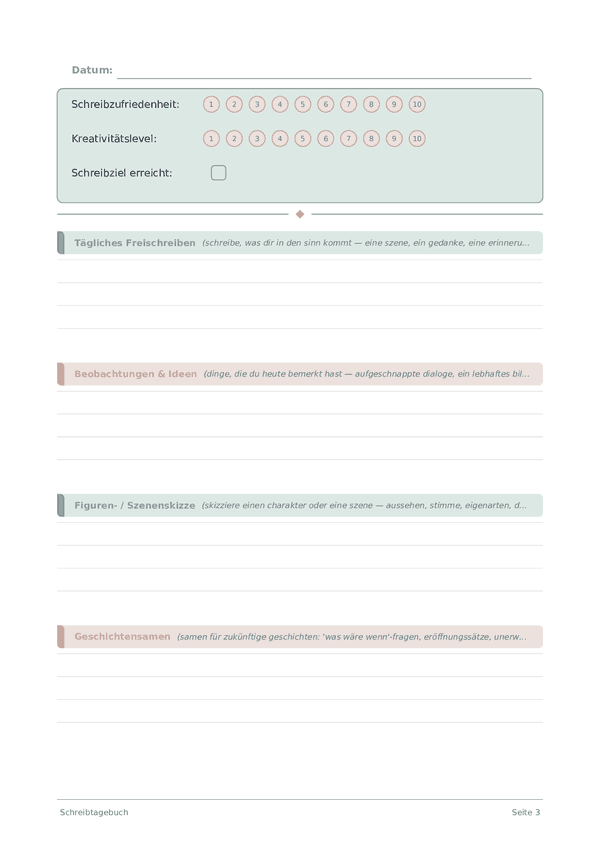
Schreibtagebuch
Tägliche kreative Schreibpraxis & Handwerksentwicklung
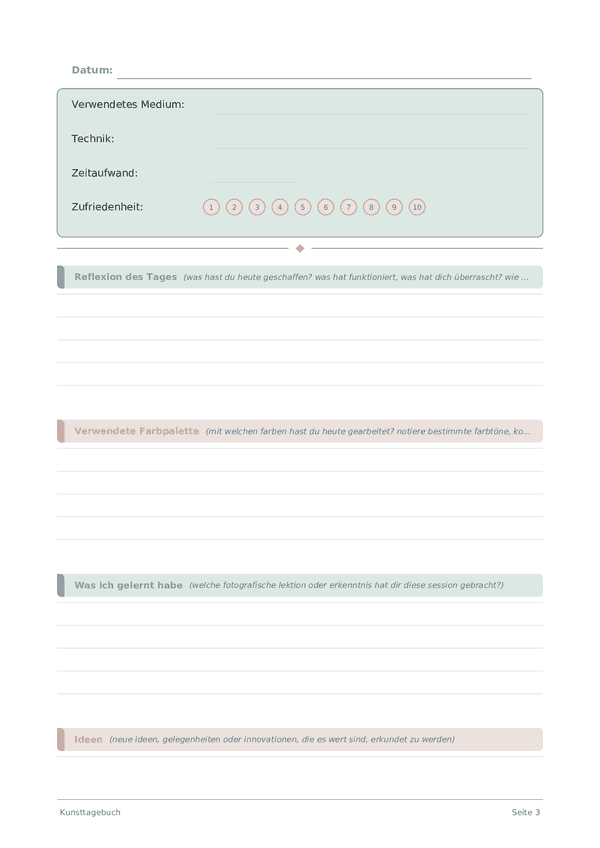
Kunsttagebuch
Dokumentieren Sie Ihren kreativen Prozess und künstlerisches Wachstum
Skizzenbuch-Tagebuch
Offene Punktraster-Seiten zum Skizzieren, Zeichnen und visuellen Entdecken

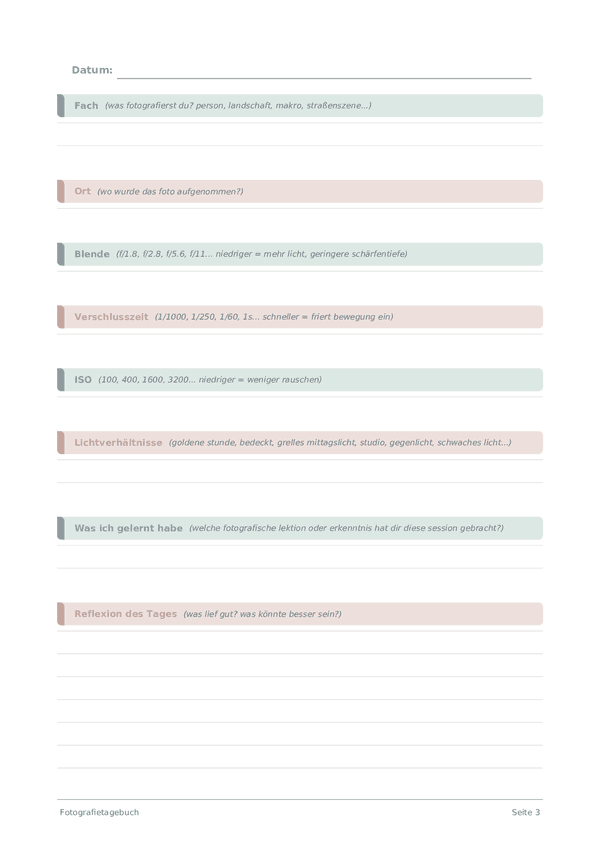
Fotografietagebuch
Shootings, Einstellungen und kreative Erkenntnisse nach jeder Session festhalten
Scrollen zum Zoomen, ziehen zum Bewegen