Printable Kunsttagebuch
Dokumentieren Sie Ihren kreativen Prozess und künstlerisches Wachstum
A structured art journal that combines quick session tracking with reflective writing. Log your medium, technique, time spent, and satisfaction for each creative session, then reflect on what you created, the colors you used, and what you learned. Perfect for artists, illustrators, and anyone exploring visual expression.
Felder anpassen
Schalten Sie Felder ein oder aus. Klicken Sie auf den Stift zum Umbenennen oder fügen Sie eigene Felder hinzu.
Vorteile
Anleitung
Was ist dieses Journal?
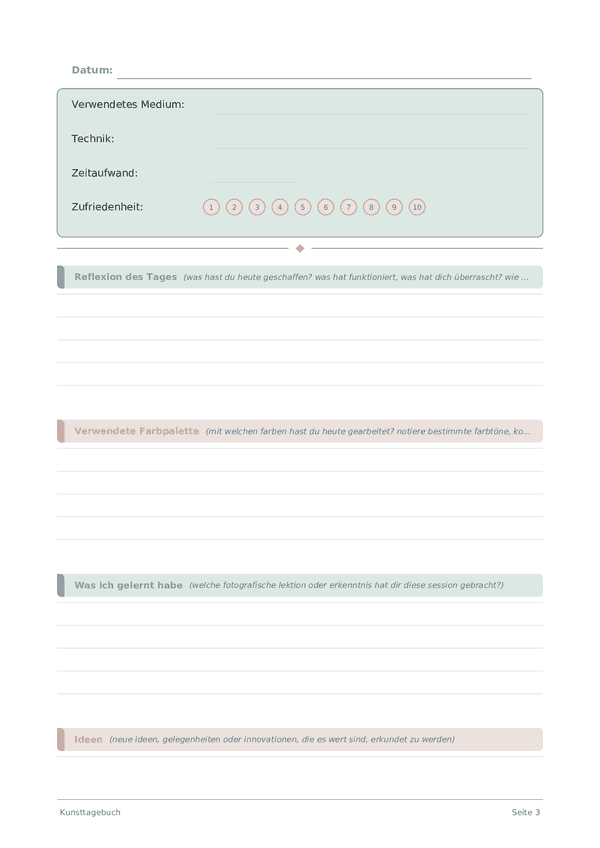
An Art Journal is a hybrid reflection tool for visual artists who want to grow intentionally. The top section tracks the medium used, technique practiced, time spent, and your satisfaction with the session. The bottom section provides space for written reflection, documenting your color palette, noting what you learned, and capturing ideas for future work. Together, they create a complete record of your artistic development.
Making art is inherently experiential, and much of what you learn in a session gets lost if you do not take a moment to articulate it. This journal bridges the gap between doing and understanding. When you write about why a certain color combination worked or why a technique felt awkward, you accelerate your learning in ways that practice alone cannot achieve.
Fill in the tracker immediately after each art session while the experience is still vivid. In the reflection section, write honestly about what went well and what frustrated you. Document the specific colors you mixed and the techniques you tried. Over months, this journal becomes an invaluable reference — a personal art education textbook written by the only teacher who knows exactly what you need to learn next: yourself.
Ausgefülltes Beispiel
So sieht ein typischer Eintrag aus, wenn er ausgefüllt ist:
Wie Sie jedes Feld ausfüllen
Oben auf jeder Seite befinden sich schnell ausfüllbare Felder (Bewertungen, Kontrollkästchen, Zahlen). Darunter ist ein linierter Bereich zum Schreiben. Hier erfahren Sie, was jedes Feld bedeutet:
Verwendetes Medium
Mit welchem Medium hast du heute gearbeitet? z.B. Aquarell, Öl, Bleistift, Kohle, Digital
Technik
Auf welche Technik hast du dich konzentriert oder damit experimentiert? z.B. Trockenpinsel, Lasieren, Kreuzschraffur
Zeitaufwand
Wie lange hast du gelernt?
Zufriedenheit
Wie zufrieden bist du mit der heutigen Session? (1=frustriert, 5=sehr zufrieden)
Reflexion des Tages
Blicken Sie ehrlich auf Ihren Tag zurück. Was lief gut? Was könnte besser sein? Es geht nicht um Urteile — es geht um Lernen und Wachstum.
Verwendete Farbpalette
Mit welchen Farben hast du heute gearbeitet? Notiere bestimmte Farbtöne, Kombinationen oder Entscheidungen, die sich richtig anfühlten
Was ich gelernt habe
Schreiben Sie eine neue Sache auf, die Sie heute gelernt haben. Es kann eine Tatsache sein, eine Fähigkeit, eine Erkenntnis über sich selbst oder eine Lebenslektion. Tägliches Lernen summiert sich zu Weisheit.
Ideen
Halten Sie Ihre Ideen fest, bevor sie verschwinden. Keine Idee ist zu klein oder albern. Manche der besten Durchbrüche beginnen als grobe, halb geformte Gedanken.
Tipps für den Erfolg
Wann und wie oft schreiben
Aim for two to three sessions per week, each 20 to 45 minutes. Daily practice is wonderful but can create pressure that kills spontaneity — art journaling thrives on desire, not obligation. Keep your journal accessible (on your desk, not in a drawer) so you can grab it whenever inspiration strikes. Once a month, flip through the entire journal without judgment, just noticing which pages pull your eye. This review often sparks new ideas and reminds you how far your visual vocabulary has come.
Häufig gestellte Fragen
Was verfolgt das Kunst-Journal?
Jede Seite protokolliert eine kreative Sitzung: verwendetes Medium, Technik, aufgewendete Zeit (bis 480 Minuten) und Zufriedenheit (0-10), mit acht linierten Zeilen zur Reflexion — Farbpalette, Gelerntes und Ideen. Es ist für Künstler, Illustratoren und alle, die visuelle Praxis dokumentieren. Anders als ein Portfolio erfasst es den Prozess: Entscheidungen, Fehler und kleine Entdeckungen, die sich über Monate zum Stil verdichten.
Wie nutze ich die Felder für Medium und Technik sinnvoll?
Sei konkret — "Aquarell, nass-in-nass" schlägt "Malen". Ericssons Rahmen der deliberate practice (Ericsson et al., 1993, Psychological Review, 100(3), 363-406) verlangt, die genau trainierte Fertigkeit zu benennen. Konkrete Medium/Technik-Einträge erlauben dir später Fragen wie: "Welche Technik bewerte ich am höchsten?" oder "Was habe ich nie probiert?" Nach drei Monaten wird das Feld zu einem Selbst-Curriculum deiner Stärken und Lücken.
Warum sollte ich nach jeder Sitzung die Zufriedenheit bewerten?
Die Bewertung schafft eine Rückkopplungsschleife zwischen Anstrengung, Bedingungen und Ergebnis. Csikszentmihalyi (1990, Flow, Harper) fand, dass Künstler, die Sitzungsqualität reflektieren, zuverlässiger in Flow-Zustände gelangen. Bewerte sofort danach — die Erinnerung schönt gute Sitzungen und löscht mittelmäßige. Über 4-6 Wochen zeigen sich Muster: hochbewertete Sitzungen teilen oft gemeinsame Bedingungen (Zeit, Länge, Medium, Stimmung), die du bewusst nachstellen kannst.
Verbessert ein Kunst-Journal wirklich meine Arbeit?
Reflexion plus deliberate practice — ja. Ericsson (2016, Peak, Houghton Mifflin Harcourt) zeigt, dass Künstler, die formulieren, was funktionierte und was nicht, schneller fortschreiten als jene, die nur produzieren. Das Feld "was ich gelernt habe" ist die Komponente der deliberate practice; der Zufriedenheits-Tracker das Feedback-Signal. Ohne Reflexion erzeugen Stunden Wiederholung statt Verbesserung — bestätigt in künstlerischen und sportlichen Bereichen.
Wie unterscheidet sich das von einem reinen Skizzenbuch?
Ein Skizzenbuch hält die Arbeit fest; dieses Journal hält den Prozess dahinter fest. Die strukturierten Felder zwingen, Medium, Technik und Palette zu benennen — eine metakognitive Gewohnheit, die laut Bjorks Forschung zu "desirable difficulties" (Bjork & Bjork, 2011, Psychology and the Real World, Worth Publishers) Behalten und Transfer stärkt. Beides lässt sich führen: skizzieren anderswo, hier protokollieren. Die 8-Zeilen-Reflexion ist die fehlende Schicht der meisten Skizzenbücher.
Was schreibe ich in den Abschnitt zur Farbpalette?
Liste die tatsächlich verwendeten Pigmente oder Hex-Codes (z.B. "Ultramarin, gebrannte Siena, Titanweiß"). Über 30-50 Einträge erkennst du deine gewohnte Palette und deine unerforschten Farben. So wird das Journal zur persönlichen Farbreferenzbibliothek. Notiere, welche Kombinationen funktionierten und welche schmutzig wirkten — das hält stillschweigendes Wissen fest, das Künstler sonst nur über Jahre durch Versuch und Irrtum aufbauen.
Wie oft soll ich journalen — jede Sitzung oder nur große Projekte?
Jede Sitzung, auch 10-Minuten-Sitzungen. Der Spacing-Effekt, dokumentiert von Cepeda et al. (2006, Psychological Bulletin, 132(3), 354-380), zeigt, dass häufige kurze Einträge seltene lange beim Behalten schlagen. Kurze Sitzungen sind außerdem dort, wo die meisten Mikroentdeckungen passieren — ein Pinseltrick, eine Mischfarbe, eine Lichtbeobachtung. Sie auszulassen verliert die granularen Daten, die später Mustersuche erst ermöglichen.
Ich bin kein "echter" Künstler — ist dieses Journal trotzdem nützlich?
Ja — das Journal ist für die Praxis, nicht für Titel. Dwecks Mindset-Forschung (Mindset, 2006, Random House) zeigt, dass der Fokus auf Prozess und Verbesserung (Growth Mindset) statt auf angeborenes Talent (Fixed Mindset) langfristige Fertigkeitsentwicklung vorhersagt. Die Zufriedenheitsbewertung und der "was gelernt"-Prompt messen Wachstum, nicht Output-Qualität. Anfänger profitieren am meisten, weil frühe Reflexion das Festsetzen schlechter Gewohnheiten verhindert.
Das könnte Ihnen auch gefallen
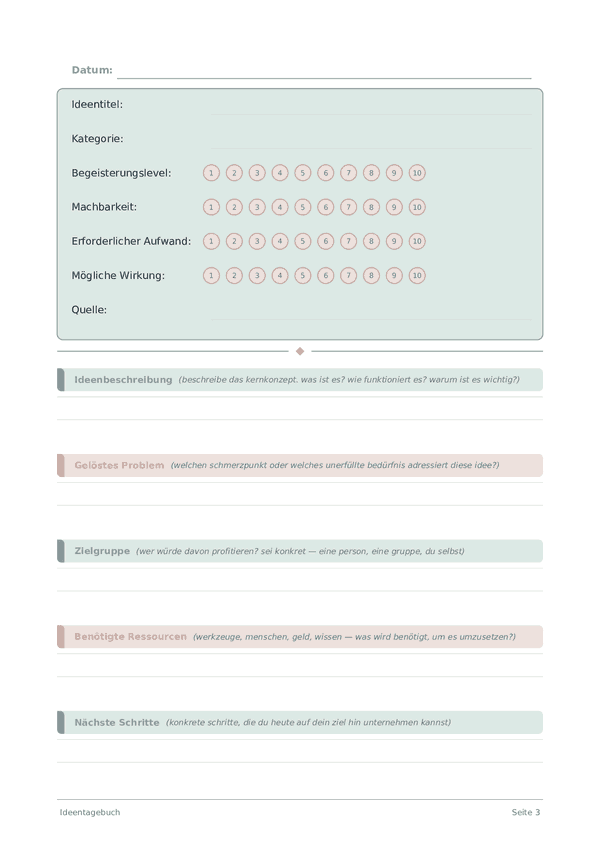
Ideentagebuch
Ihre besten Ideen festhalten, bewerten und weiterentwickeln
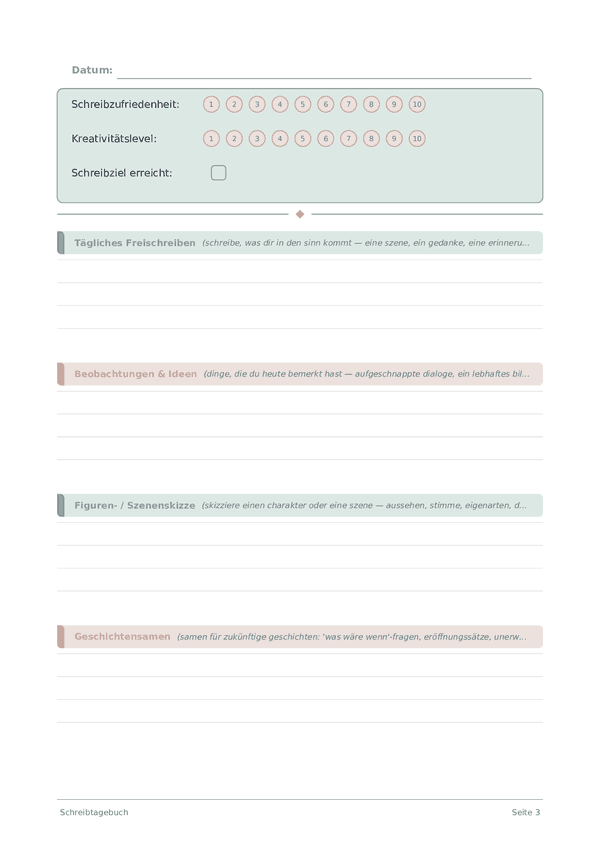
Schreibtagebuch
Tägliche kreative Schreibpraxis & Handwerksentwicklung
Skizzenbuch-Tagebuch
Offene Punktraster-Seiten zum Skizzieren, Zeichnen und visuellen Entdecken

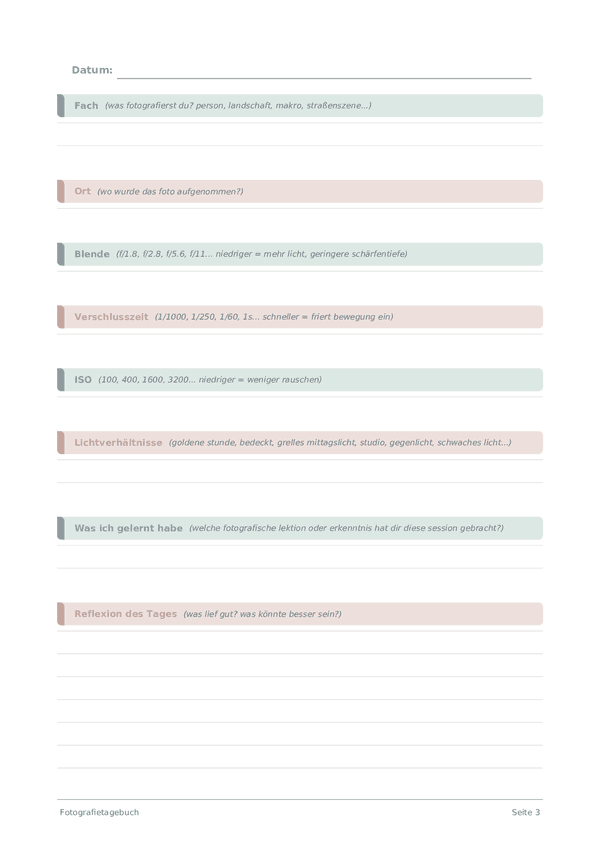
Fotografietagebuch
Shootings, Einstellungen und kreative Erkenntnisse nach jeder Session festhalten
Scrollen zum Zoomen, ziehen zum Bewegen