Printable Lerntagebuch
Tiefer lernen mit der Feynman-Technik
Apply the Feynman technique to every study session. Explain what you learned in plain words, surface knowledge gaps, spark new questions, and turn insights into concrete action — all in one daily entry.
Felder anpassen
Schalten Sie Felder ein oder aus. Klicken Sie auf den Stift zum Umbenennen oder fügen Sie eigene Felder hinzu.
Vorteile
Anleitung
Was ist dieses Journal?
A learning journal built on the Feynman technique is one of the most effective tools for deep understanding. The core idea is simple: if you cannot explain something in plain language, you do not truly understand it. Each entry challenges you to articulate what you learned, identify gaps, and plan concrete next steps — turning passive consumption into active mastery.
Every session begins by noting the topic, source, and time invested. Then you write what you learned as if explaining it to someone with no background in the subject. This act of simplification exposes fuzzy thinking and forgotten details far faster than re-reading notes ever could.
Finally, you record your confidence level, lingering questions, and specific action steps. Over weeks, your journal becomes a personal knowledge base that charts not just what you studied, but how deeply you understood it — and where you still need to dig deeper.
Ausgefülltes Beispiel
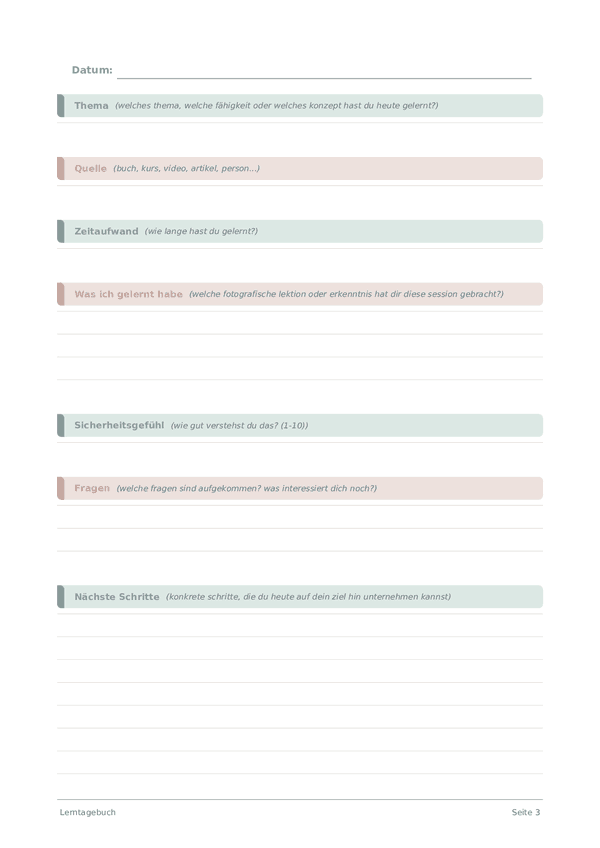
So sieht ein typischer Eintrag aus, wenn er ausgefüllt ist:
Wie Sie jedes Feld ausfüllen
Jeden Tag finden Sie mehrere beschriftete Abschnitte mit Zeilen zum Schreiben. Hier erfahren Sie, wofür jeder Abschnitt gedacht ist:
Thema
Welches Thema, welche Fähigkeit oder welches Konzept hast du heute gelernt?
Quelle
Buch, Kurs, Video, Artikel, Person...
Zeitaufwand
Wie lange hast du gelernt?
Was ich gelernt habe
Schreiben Sie eine neue Sache auf, die Sie heute gelernt haben. Es kann eine Tatsache sein, eine Fähigkeit, eine Erkenntnis über sich selbst oder eine Lebenslektion. Tägliches Lernen summiert sich zu Weisheit.
Sicherheitsgefühl
Wie gut verstehst du das? (1-10)
Fragen
Welche Fragen sind aufgekommen? Was interessiert dich noch?
Nächste Schritte
Unterteilen Sie Ihr Ziel in konkrete nächste Schritte. Was genau werden Sie tun, wann und wie? Je konkreter, desto besser.
Tipps für den Erfolg
Wann und wie oft schreiben
Write an entry after every study session or significant learning event — the same day, ideally within an hour, when recall is strongest. If you are in a course or structured program, daily entries keep pace with new material. For self-directed learners, three to four entries per week maintain momentum without burnout. Weekly, review your entries and rewrite key concepts from memory as spaced repetition. Monthly, identify which topics need revisiting based on your self-rated understanding scores.
Häufig gestellte Fragen
Was ist die Feynman-Technik und wie wendet das Journal sie an?
Die Feynman-Technik: ein Thema wählen, es in einfacher Sprache erklären, als unterrichtest du ein Kind, Lücken finden und verfeinern. Die Struktur des Journals spiegelt das wider — Themenfeld, Gelerntes in eigenen Worten, Vertrauensniveau zur Lückensuche, Fragenfeld für Unklares, Handlungsschritte zur Nachbearbeitung. Jeder Tageseintrag erzwingt den Kreislauf "erklären, finden, verfeinern" an einer einzelnen Lerneinheit.
Warum erklären "als ob ich ein Kind unterrichte"?
Eine Erklärung in eigenen Worten zu erzeugen, ist Abrufübung — der stärkste Lernmechanismus der Kognitionswissenschaft. Roediger und Karpicke (2006, Psychological Science, 17(3), 249-255) zeigten, dass Abruf dramatisch besseres Langzeitbehalten erzeugt als erneutes Lesen. Vereinfachung für ein Laienpublikum entlarvt die Wörter, die du nachplapperst, gegenüber den Ideen, die du wirklich verstehst. Das vierzeilige Feld ist der Arbeitsraum dafür.
Wie nutze ich das Vertrauensfeld, um Wissenslücken zu finden?
Bewerte dein Vertrauen zum heutigen Thema direkt nach dem Schreiben der Erklärung. Niedriges Vertrauen bei einem gerade "gelernten" Thema ist eine Warnung vor der Fluenz-Illusion — Material zu erkennen ist nicht dasselbe wie Erinnern oder Anwenden (Bjork & Bjork, 2011, Psychology and the Real World, Worth Publishers). Nutze diese niedrigen Werte, um Themen für verteilte Durchsicht im Handlungsschritt-Feld zu markieren.
Was kommt in den Fragenbereich?
Alles, was du in deiner Erklärung nicht beantworten konntest, plus Dinge, auf die dich das Material neugierig machte. Die drei Zeilen zwingen, deine Unwissenheit konkret zu benennen — "warum verursacht X Y?" statt "ich verstehe das nicht". Swellers Cognitive Load Theory (Educational Psychology Review, mehrere Arbeiten) zeigt, dass formulierte Fragen die extraneous load künftiger Lerneinheiten senken, weil du mit fokussierten Zielen ankommst.
Wie verbindet das Handlungsschritt-Feld Lernen und Übung?
Zwei Zeilen für das, was du tun wirst — verteilte Wiederholung, kleines Projekt bauen, ein durchgerechnetes Beispiel suchen, das Thema lehren. Ohne diesen Schritt bleibt Lernen passiv. Ericssons Rahmen der deliberate practice (Ericsson et al., 1993, Psychological Review, 100(3), 363-406) verlangt gezielte Anwendung, nicht nur Exposition. Die wirksamsten Schritte sind klein und zeitgebunden: "morgen Aufgabe 4.2 ohne Notizen neu lösen".
Wie oft sollte ich alte Lerneinträge durchsehen?
Nutze verteilte Intervalle — 1 Tag, 3 Tage, 1 Woche, 2 Wochen, 1 Monat. Cepeda et al. (2006, Psychological Bulletin, 132(3), 354-380) fanden, dass sich erweiternde Intervalle das Langzeitbehalten optimieren. Datum und Thema machen Einträge für die Durchsicht scanbar. Lies erst deine eigene Erklärung; kannst du sie ohne Notizen erweitern oder korrigieren, konsolidiert sich das Thema. Sonst kehre zur Quelle zurück.
Wie unterscheidet sich das von Anki oder einer Karteikarten-App?
Anki und SRS-Apps (abstammend aus Wozniaks SuperMemo, 1985) optimieren den faktischen Abruf über verteilte Wiederholung. Dieses Journal baut Verständnis über Erklärung und Reflexion auf — eine ergänzende, keine redundante Funktion. Nutze beides parallel: Journaleinträge bringen ans Licht, was du verstehst und was nicht; Karteikarten drillen die Fakten. Das Fragenfeld wird oft zur Quelle deiner besten Anki-Karten.
Funktioniert das Journal für technisches, sprachliches und geisteswissenschaftliches Lernen?
Ja — die Feynman-Technik ist vollständig fachneutral. Ingenieurinnen wenden sie auf Algorithmen und Beweise an; Sprachlernende auf Grammatikregeln und Idiome; Historikerinnen auf Kausalketten und Kontext. Oakley (2014, A Mind for Numbers, Tarcher) wendet eine ähnliche Klartext-Erklärung explizit auf MINT-Disziplinen an. Das Quellenfeld erfasst den Materialtyp, sodass fachübergreifende Muster über die Zeit sichtbar werden.
Das könnte Ihnen auch gefallen
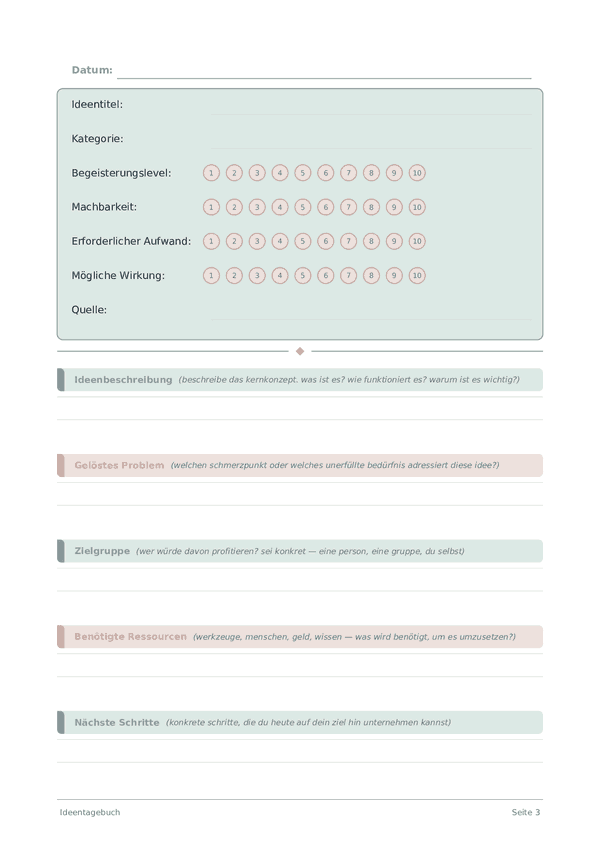
Ideentagebuch
Ihre besten Ideen festhalten, bewerten und weiterentwickeln
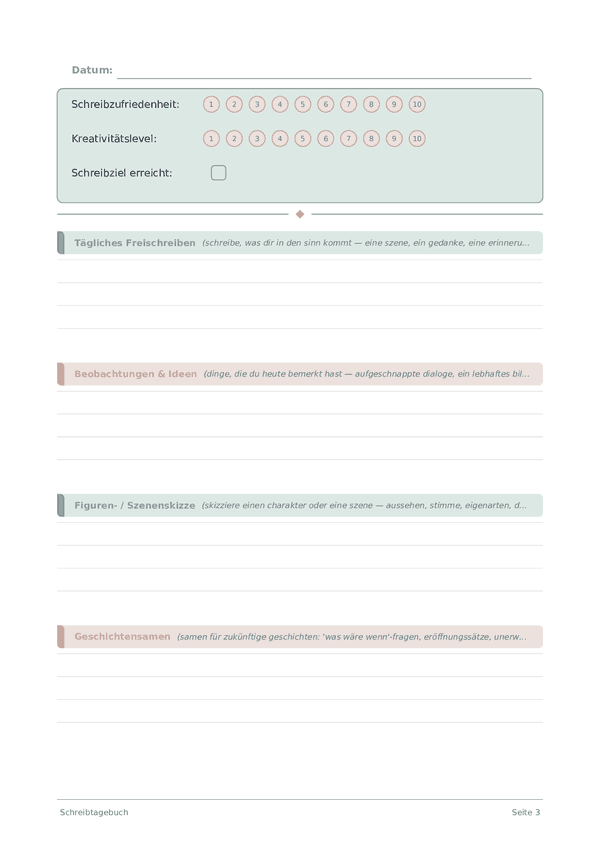
Schreibtagebuch
Tägliche kreative Schreibpraxis & Handwerksentwicklung
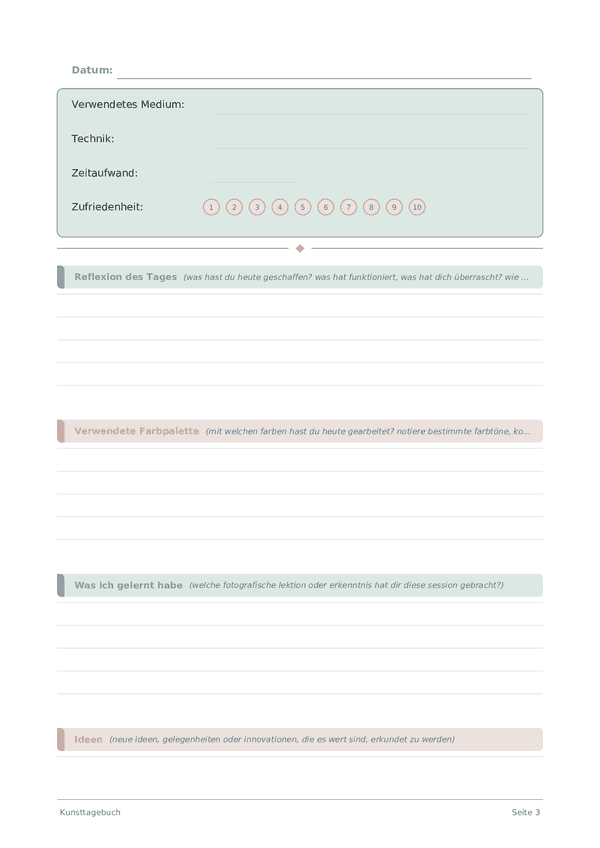
Kunsttagebuch
Dokumentieren Sie Ihren kreativen Prozess und künstlerisches Wachstum
Skizzenbuch-Tagebuch
Offene Punktraster-Seiten zum Skizzieren, Zeichnen und visuellen Entdecken

Scrollen zum Zoomen, ziehen zum Bewegen