Printable Achievement Journal
Celebrate wins and build unstoppable momentum
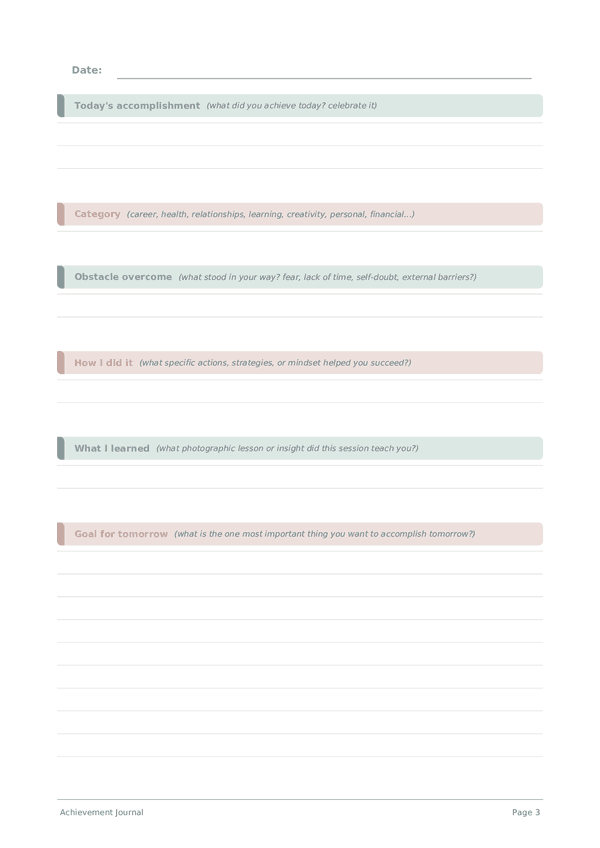
Your daily achievement log for documenting wins, understanding how you succeeded, and building a success mindset. Each entry captures what you accomplished, the category it belongs to, the obstacle you overcame, how you did it, what you learned, and your goal for tomorrow — turning every small victory into lasting confidence and momentum.
Customize fields
Toggle fields on or off. Click the pencil to rename, or add your own fields.
Benefits
How to Use
What is this journal?
An achievement journal is a daily practice for documenting your wins — big and small. Each entry records what you accomplished, the obstacles you overcame, and what you learned, creating a powerful archive of evidence that counteracts self-doubt and builds genuine confidence.
This journal is for anyone who tends to dismiss their accomplishments, downplay their wins, or focus on what went wrong rather than what went right. It is especially valuable for people with imposter syndrome, those in demanding careers, and anyone rebuilding confidence after a setback.
Research on self-efficacy — your belief in your ability to succeed — shows that the single most effective way to build it is by recognizing past successes. This journal creates a running record of proof that you are competent, resilient, and growing. On difficult days, reading back through past entries becomes a powerful reminder of what you are capable of.
Filled example
Here's what a typical entry looks like when filled in:
How to fill in each field
Each day you'll find several labeled sections with lines for writing. Here's what each section is for:
Today's accomplishment
Write something you achieved today, no matter how small. Acknowledging daily wins builds confidence and momentum.
Category
Assign a category to this entry (e.g., food, transport, entertainment). Consistent categories make your data easy to analyze.
Obstacle overcome
What stood in your way? Fear, lack of time, self-doubt, external barriers?
How I did it
What specific actions, strategies, or mindset helped you succeed?
What I learned
Write one new thing you learned today. It can be a fact, a skill, an insight about yourself, or a life lesson. Daily learning compounds into wisdom.
Goal for tomorrow
Set one intention for tomorrow. Writing it down tonight primes your brain to act on it. Keep it specific and achievable.
Tips for success
When and how often to write
Write every evening, capturing at least one achievement from the day \u2014 even on hard days when progress felt invisible. The entry takes 5\u20137 minutes. Weekly, re-read all seven entries and notice which category appeared most and which was absent. Monthly, write a summary of your top achievements and the skills that made them possible. When facing a challenge or self-doubt, re-read your past month \u2014 your own evidence of competence is the most powerful antidote to impostor syndrome.
Frequently Asked Questions
What sections does the Achievement Journal include, and why?
Each daily entry has six fields: accomplishment (3 lines), category (1 line), obstacle overcome (2 lines), how I did it (2 lines), what I learned (2 lines), and goal for tomorrow (2 lines). The structure asks not just what you achieved but how, turning success from a feeling into a transferable pattern. Goal for tomorrow keeps your momentum, applying Edwin Locke and Gary Latham's goal-setting research (2002, American Psychologist, 57(9)).
Why record how I did it, not just what I accomplished?
Knowing what you achieved without the how leaves you nothing to repeat on purpose. The how I did it field pins down the specific actions, strategies, or mindset behind a win, making success repeatable. Charles Duhigg's The Power of Habit (Random House, 2012) frames this as identifying the cue-routine-reward structure of successful behavior, which only shows up through deliberate reflection after the fact.
What counts as an accomplishment worth journaling?
Anything that took effort, overcame friction, or moved a goal forward, including small wins like finishing a hard conversation, hitting a workout, or shipping a small task. Daily entries train you to notice micro-progress. James Clear's Atomic Habits (Avery, 2018) makes the point that identity-shifting wins are usually small and frequent, not rare and dramatic. Don't wait for a 'big enough' achievement.
How is this different from a gratitude journal?
Gratitude journals list what you appreciate; achievement journals list what you did. Both build positive affect, but the achievement frame strengthens agency and self-efficacy, your sense that effort produces results. The how I did it and what I learned fields train a growth mindset by surfacing the methods behind outcomes, not just the outcomes themselves. Different mechanism, different long-term effect.
Which category labels work best for tracking achievements?
The journal suggests seven: career, health, relationships, learning, creativity, personal, financial. Stick to a fixed set so weekly review shows which life domains get consistent attention. Imbalances surface fast, and a month with zero relationship entries is a signal. Stephen Covey's 7 Habits of Highly Effective People (Free Press, 1989) calls this Quadrant II tracking: important non-urgent work that drives long-term life quality.
How long until the journal builds visible confidence?
Most users notice a confidence shift after three to four weeks of daily entries, once they have a documented record to scroll back through during low moments. The journal earns its keep during setbacks, when concrete proof of past obstacles overcome counteracts the recency bias that makes current difficulty feel uniquely hopeless. Confidence here is evidence-based, not affirmation-based.
Can I use this for performance reviews or job interviews?
Yes, and it's one of the journal's strongest practical uses. Six months of daily entries give you a concrete portfolio of accomplishments, obstacles overcome, and learned skills, organized by category. Most people badly underrepresent their work in reviews because they forget specifics; the journal fixes this. Filter by career category to assemble interview stories or annual review evidence in minutes, not days.
What's the most common mistake with an achievement journal?
Treating it as a vague feel-good exercise rather than a structured data tool. Skip the how I did it and what I learned fields and you lose the patterns that make wins repeatable. The other trap: comparing your accomplishments to other people's. The journal trains internal progress tracking against your own baseline. Greg McKeown's Essentialism (Crown Business, 2014) calls this protecting energy from comparative noise.
You Might Also Like
Scroll to zoom, drag to move