Printable Addiction Recovery Journal
Track your sobriety and build resilience daily
A structured daily companion for your recovery journey. Track sobriety milestones, monitor cravings and mood patterns, reflect on triggers and coping strategies, celebrate victories, and nurture your support network — all in one place.
Customize fields
Toggle fields on or off. Click the pencil to rename, or add your own fields.
Benefits
How to Use
What is this journal?
An addiction recovery journal is a comprehensive daily tool for supporting your journey out of addiction — any addiction. By tracking sobriety days, cravings, mood, and energy alongside detailed reflections on triggers, coping strategies, and support connections, you create a structured recovery practice that supplements professional treatment.
This journal is for anyone in recovery from substance addiction, behavioral addiction, or compulsive patterns. It is designed to work alongside 12-step programs, therapy, and other recovery frameworks. The structure provides both accountability and a safe space for the complex emotional landscape of recovery.
Clinical research on addiction recovery identifies daily journaling as a powerful relapse prevention tool. The process of writing about cravings and triggers activates the prefrontal cortex — the brain region responsible for impulse control — effectively strengthening the neural infrastructure you need most. Tracking support connections also reinforces the social bonds that are critical to sustained recovery.
Filled example
Here's what a typical entry looks like when filled in:
How to fill in each field
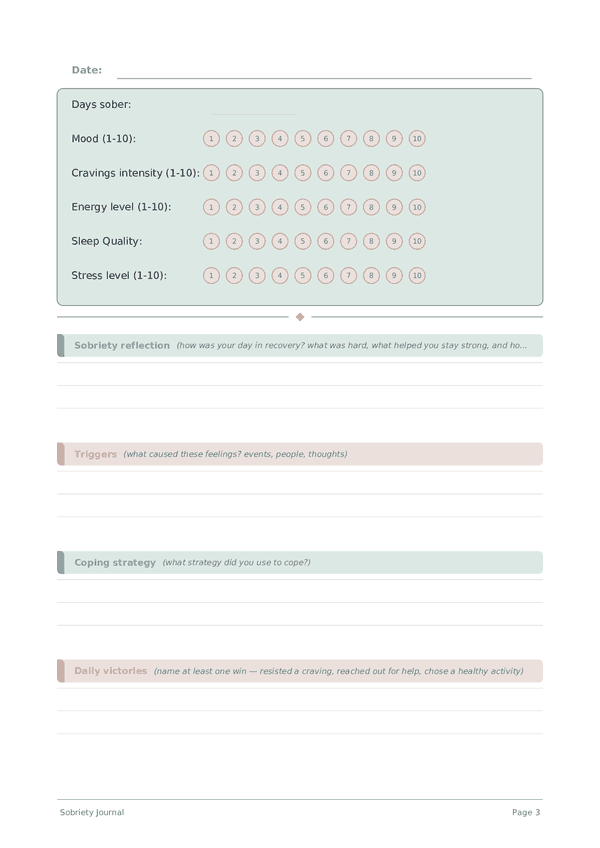
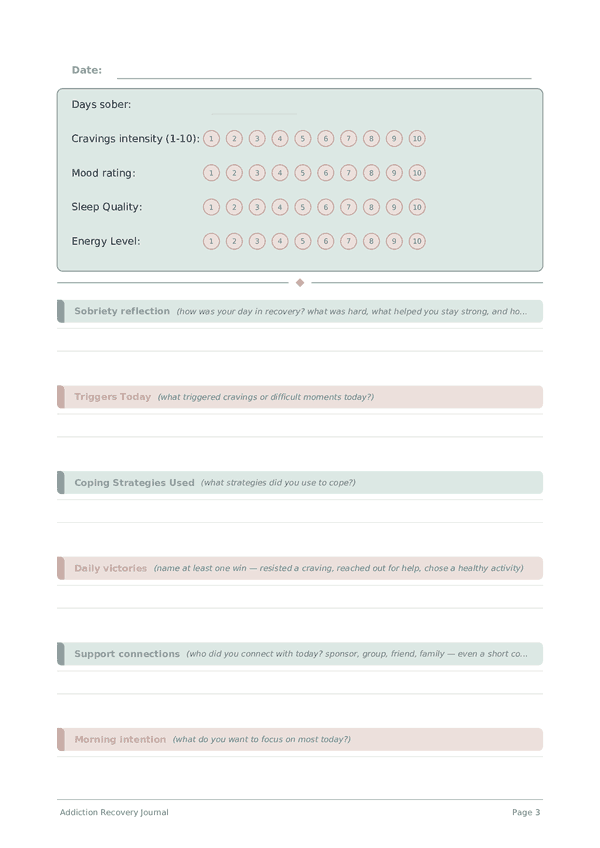
The top of each page has quick-fill fields (ratings, checkboxes, numbers). Below that is a lined section for writing. Here's what each field means:
Days sober
Record how many consecutive days you've been sober. Watching this number grow is a powerful motivator. If you reset, start counting again without shame.
Cravings intensity (1-10)
How strong are your cravings today? Rate 1 (barely noticeable) to 10 (overwhelming)
Mood rating
Rate your emotional state (1-10) to track your healing trajectory
Sleep Quality
Rate how restful your sleep was. 1 means terrible and restless, 5 means deep and refreshing. Quality matters as much as quantity.
Energy Level
How energized do you feel this morning? (1=exhausted, 5=fully charged)
Sobriety reflection
How was your day in recovery? What was hard, what helped you stay strong, and how are you feeling now?
Triggers Today
What triggered cravings or difficult moments today?
Coping Strategies Used
What strategies did you use to cope?
Daily victories
Name at least one win — resisted a craving, reached out for help, chose a healthy activity
Support connections
Who did you connect with today? Sponsor, group, friend, family — even a short conversation matters
Morning intention
What do you want to focus on most today?
What I'm grateful for today
List 1–3 things you're grateful for today. They can be big or tiny — a good meal, a kind word, sunshine. Gratitude journaling is one of the most scientifically supported well-being practices.
Tips for success
When and how often to write
Journal every day, ideally in the evening as part of your recovery routine. In early recovery, write twice daily if possible — morning intentions and evening reflection create bookends of accountability. Log every meeting, every support call, every craving and its resolution. Weekly, review your HALT patterns and identify which state triggered the most difficulty. Monthly, celebrate your progress by re-reading your earliest entries and seeing how far you have come.