Printable Sobriety Journal
Your daily companion for recovery and growth
Track sober days, rate mood and cravings, identify triggers, and reflect on your recovery journey. This hybrid journal combines quick daily metrics with guided writing prompts used in addiction recovery programs. Daily journaling is proven to support long-term sobriety, emotional processing, and relapse prevention.
Customize fields
Toggle fields on or off. Click the pencil to rename, or add your own fields.
Benefits
How to Use
What is this journal?
A sobriety journal is a daily companion for tracking your recovery journey with honesty and self-compassion. By logging your sobriety count, mood, cravings, and stress alongside reflective writing about triggers, coping strategies, and victories, you build both accountability and a powerful record of your strength.
This journal is for anyone on the path of sobriety — whether you are in your first week or your fifth year. Recovery is not a destination but a daily practice, and this journal supports that practice by creating space for the difficult emotions, the celebrations, and everything in between.
Addiction recovery research consistently shows that daily self-monitoring is one of the strongest predictors of long-term sobriety. Writing about cravings reduces their intensity, tracking triggers builds self-awareness that prevents relapse, and recording daily victories — no matter how small — reinforces the neural pathways of your recovery identity.
Filled example
Here's what a typical entry looks like when filled in:
How to fill in each field
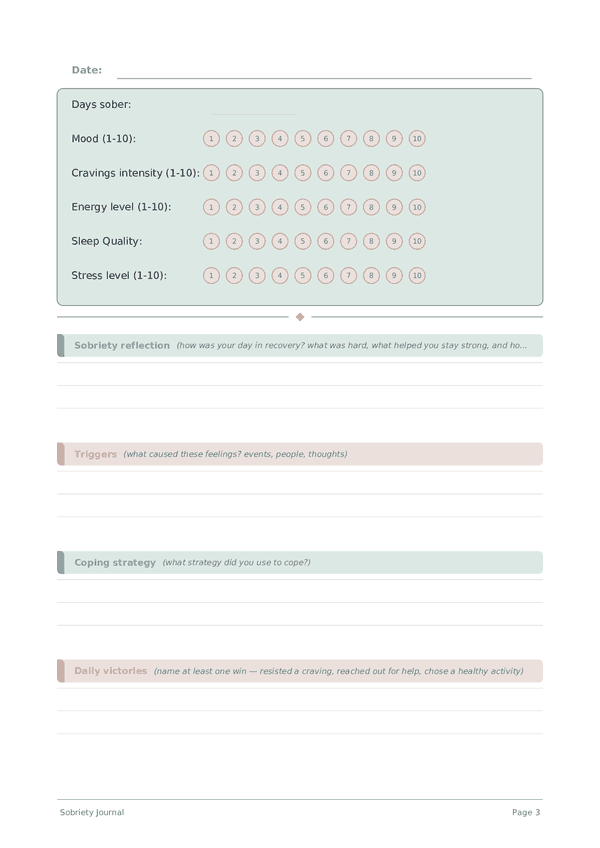
The top of each page has quick-fill fields (ratings, checkboxes, numbers). Below that is a lined section for writing. Here's what each field means:
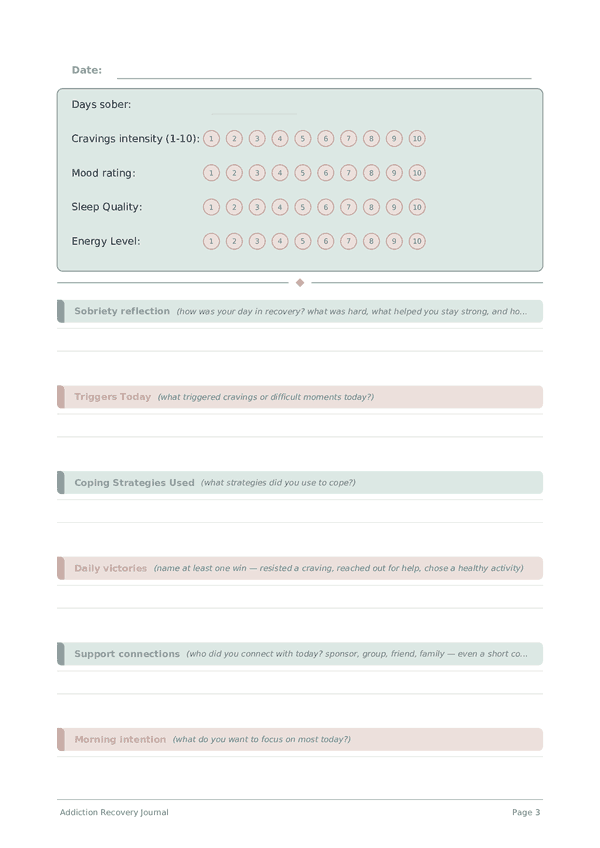
Days sober
Record how many consecutive days you've been sober. Watching this number grow is a powerful motivator. If you reset, start counting again without shame.
Mood (1-10)
Rate your overall emotional state for the day. 1 means very low or depressed, 10 means exceptionally happy and positive. Don't overthink — go with your gut feeling.
Cravings intensity (1-10)
How strong are your cravings today? Rate 1 (barely noticeable) to 10 (overwhelming)
Energy level (1-10)
Rate your physical and mental energy level. 1 means exhausted and drained, 10 means fully energized and alert. This helps you identify what activities boost or drain your energy.
Sleep Quality
Rate how restful your sleep was. 1 means terrible and restless, 5 means deep and refreshing. Quality matters as much as quantity.
Stress level (1-10)
Rate your stress on a scale of 1–10. Over time, you'll identify your stress patterns and which coping strategies work best.
Sobriety reflection
How was your day in recovery? What was hard, what helped you stay strong, and how are you feeling now?
Triggers
Identify what caused your emotional reactions — events, people, thoughts, environments. Recognizing triggers gives you the power to prepare for or avoid them.
Coping strategy
What strategy did you use to cope?
Daily victories
Name at least one win — resisted a craving, reached out for help, chose a healthy activity
What I'm grateful for today
List 1–3 things you're grateful for today. They can be big or tiny — a good meal, a kind word, sunshine. Gratitude journaling is one of the most scientifically supported well-being practices.
Support connections
Who did you connect with today? Sponsor, group, friend, family — even a short conversation matters
Tips for success
When and how often to write
Fill in the tracker every evening without exception — consistency is the backbone of recovery journaling. On high-craving days, write in the journal as soon as the urge hits; the act of writing creates a pause between impulse and action. Weekly, review your craving patterns to identify your highest-risk day and time. In early sobriety (first 90 days), daily journaling is non-negotiable. After that, maintain at least 5 entries per week and always journal on difficult days.
Frequently Asked Questions
What is the Sobriety Journal designed to track?
It tracks consecutive sober days plus six daily metrics (mood, cravings intensity, energy, sleep quality, stress) rated 1-10, along with reflection prompts for triggers, coping strategies, daily victories, gratitude, and support connections. NIDA (2020, Principles of Drug Addiction Treatment, 3rd ed.) lists self-monitoring as a core relapse-prevention skill. This is a tracking aid, not a replacement for clinical treatment; consult a licensed addiction specialist for diagnosis and care.
How do I fill in the cravings intensity rating?
Rate the strongest craving you felt that day on a 0-10 scale: 0 = no urge, 5 = noticeable but manageable, 10 = overwhelming. NIAAA Rethinking Drinking materials recommend logging cravings within hours of when they happen for accuracy. Pair each high score with the trigger field: environment, emotion, or person. Two to four weeks of data usually reveals patterns clinicians use during Motivational Interviewing (Miller & Rollnick, 2023, Guilford Press).
Can this journal replace formal addiction treatment?
No. Substance use disorder is a recognized medical condition per DSM-5-TR (American Psychiatric Association, 2022) and ICD-11 (WHO, 2022) requiring evidence-based care: medications (buprenorphine, naltrexone, acamprosate), psychotherapy, and often peer support. This journal is a complementary self-monitoring tool used alongside treatment. If you are in crisis or unsure where to start, call SAMHSA's National Helpline 1-800-662-HELP (4357), free and confidential, 24/7.
Does daily journaling actually support long-term sobriety?
Self-monitoring is a foundational part of cognitive-behavioral relapse prevention, validated in Cochrane reviews of psychosocial interventions for substance use. NIDA (2020, Principles of Drug Addiction Treatment) identifies daily tracking of triggers and coping responses as effective when paired with counseling. Journaling alone is not a cure; it works best alongside therapy, medication when indicated, and peer support such as AA, SMART Recovery, or licensed treatment programs.
How is this different from sobriety counter apps?
Apps display streak numbers; this hybrid template captures the why behind each day: paper reflection on triggers, coping strategy used, and support connections, which CBT models emphasize. Writing by hand may deepen emotional processing during recovery work. The tradeoff: no automatic reminders or push notifications. Many in recovery use both, an app for counting days and this journal for the reflective Motivational Interviewing-style content their counselor reviews.
Is the journal appropriate during early recovery and withdrawal?
Early recovery often involves acute withdrawal that can be medically dangerous; alcohol and benzodiazepine withdrawal especially require supervised detox per ASAM criteria. Use this journal only after medical stabilization, ideally with your treatment team's input. The mood, sleep, cravings, and stress ratings help clinicians spot deterioration. If withdrawal symptoms worsen or you have suicidal thoughts, contact emergency services or SAMHSA's helpline 1-800-662-HELP immediately.
How often should I complete entries to see useful patterns?
Daily, ideally at the same time; morning is recommended in NIDA's Principles of Drug Addiction Treatment (2020) for setting intention. Two to four weeks of consistent entries typically reveals trigger patterns and high-risk times that inform a relapse-prevention plan, consistent with the cognitive-behavioral framework (Marlatt & Donovan model widely used in addiction medicine). Missed days are normal; resume without self-criticism rather than abandoning the tool.
What is the support connections log used for?
Record who you spoke with each day: sponsor, therapist, family, peer-support meeting. Social connection is a protective factor cited in SAMHSA's TIP 35 (Enhancing Motivation for Change in Substance Use Disorder Treatment, 2019) and in Twelve-Step Facilitation literature. Reviewing this field weekly helps spot isolation, a documented relapse risk. If your log stays empty several days running, treat it as a signal to contact your sponsor, counselor, or SAMHSA's helpline.
You Might Also Like
Scroll to zoom, drag to move