Printable Quit Smoking Journal
Daily tracking and reflection for your smoke-free journey
Combine daily tracking with reflective journaling to support your quit smoking journey. Rate cravings, mood, stress, and energy each day, then write about triggers, coping strategies, and personal victories. Research shows that writing down goals and tracking progress significantly increases success rates in smoking cessation.
Customize fields
Toggle fields on or off. Click the pencil to rename, or add your own fields.
Benefits
How to Use
What is this journal?
A quit smoking journal is a daily support tool for your journey to becoming smoke-free. By tracking your smoke-free status, cravings, mood, and stress alongside reflective writing about triggers and what helped, you build a personalized quit strategy based on real data from your own experience.
This journal is for anyone in the process of quitting smoking — whether you are on day one or day one hundred. Quitting is not a single event but a daily practice that requires self-awareness, strategy, and self-compassion. This journal provides all three.
Smoking cessation research identifies self-monitoring as one of the most effective behavioral strategies for quitting. People who track their cravings and triggers are 2x more likely to successfully quit long-term. The journaling component adds emotional processing that reduces the stress response — one of the primary drivers of relapse — while the daily format creates accountability without pressure.
Filled example
Here's what a typical entry looks like when filled in:
How to fill in each field
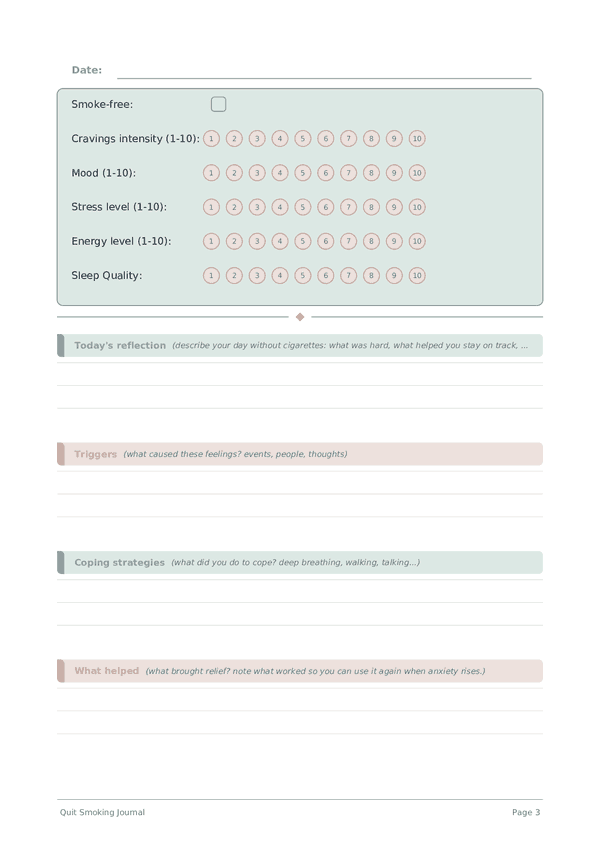
The top of each page has quick-fill fields (ratings, checkboxes, numbers). Below that is a lined section for writing. Here's what each field means:
Smoke-free
Check this off for each day you don't smoke. Visualizing your streak of smoke-free days strengthens your resolve.
Cravings intensity (1-10)
How strong are your cravings today? Rate 1 (barely noticeable) to 10 (overwhelming)
Mood (1-10)
Rate your overall emotional state for the day. 1 means very low or depressed, 10 means exceptionally happy and positive. Don't overthink — go with your gut feeling.
Stress level (1-10)
Rate your stress on a scale of 1–10. Over time, you'll identify your stress patterns and which coping strategies work best.
Energy level (1-10)
Rate your physical and mental energy level. 1 means exhausted and drained, 10 means fully energized and alert. This helps you identify what activities boost or drain your energy.
Sleep Quality
Rate how restful your sleep was. 1 means terrible and restless, 5 means deep and refreshing. Quality matters as much as quantity.
Today's reflection
Look back at your day honestly. What went well? What could be better? This isn't about judgment — it's about learning and growing.
Triggers
Identify what caused your emotional reactions — events, people, thoughts, environments. Recognizing triggers gives you the power to prepare for or avoid them.
Coping strategies
What did you do to cope? Deep breathing, walking, talking...
What helped
What brought relief? Note what worked so you can use it again when anxiety rises.
Accomplishments
What did you get done today? List completed tasks and progress made
Tips for success
When and how often to write
Journal every evening for the first 30 days without exception — this is the critical window where habits form and cravings peak. Log cravings in real-time during the day (even a quick note on your phone to expand later). After the first month, maintain daily entries for at least 3 months total. The craving tracker loses urgency around month 2-3, and that is actually the most dangerous time — keep writing. After 3 months, shift to weekly check-ins to guard against complacency.
Frequently Asked Questions
What does the Quit Smoking Journal track each day?
A smoke-free checkbox plus five 1-10 ratings (cravings intensity, mood, stress, energy, sleep quality), with reflective prompts on triggers, coping strategies, what helped, and accomplishments. The structure follows the smoking cessation self-monitoring described in the U.S. Surgeon General's report Smoking Cessation: A Report of the Surgeon General (2020). It supports, rather than replaces, evidence-based quit methods like nicotine replacement, varenicline, or counseling.
How do I track withdrawal-driven mood and stress swings?
Rate mood and stress at the same time daily. Morning is common since nicotine withdrawal symptoms peak in the first week and typically subside within 2-4 weeks per the U.S. Surgeon General (2020, Smoking Cessation report). Note in the reflection whether ratings track to specific triggers (coffee, post-meal, driving) or to general withdrawal. Persistent severe mood symptoms warrant a call to your clinician, since depression risk rises during cessation.
Is journaling enough to quit smoking on its own?
Journaling alone has modest effects. The U.S. Surgeon General (2020, Smoking Cessation: A Report of the Surgeon General) and CDC Tips From Former Smokers materials show that combining behavioral support with FDA-approved pharmacotherapy (nicotine replacement, varenicline, bupropion) roughly doubles quit success vs. willpower alone. Use this journal alongside a quitline (1-800-QUIT-NOW in the US), your physician, or NHS Stop Smoking Services for the strongest evidence-based combination.
What is the cravings intensity rating used for?
It tracks urge strength on a 0-10 scale across the day's strongest moment. Cravings typically peak within the first week of cessation and decline over 4-12 weeks, per the U.S. Surgeon General (2020, Smoking Cessation report). Pairing each rating with the trigger (place, emotion, person, time) builds a personal map clinicians use in cognitive-behavioral cessation counseling. Falling ratings over weeks are a documented sign of neuroadaptation.
How is this different from a quit smoking app?
Apps automate streaks, money saved, and health-recovery milestones; this paper template captures reflective content (triggers, coping strategies used, what specifically worked) that mirrors cognitive-behavioral cessation counseling described in U.S. Surgeon General materials (2020). The tradeoff is no notifications. Many quitters use both, with the journal serving as a record their physician or NHS Stop Smoking advisor can review for personalized adjustments to NRT or counseling.
Can I use it if I'm tapering with nicotine replacement?
Yes. NRT (patches, gum, lozenges) is recommended by the U.S. Surgeon General (2020, Smoking Cessation report) and UK NHS Stop Smoking Services as first-line support. The checkbox marks fully smoke-free days; the reflection captures NRT timing and remaining cravings. Share this data with your prescriber so dosing can be adjusted. Always follow your clinician's NRT protocol; do not self-titrate based on journal entries alone.
What if I slip and smoke one cigarette - should I reset everything?
A single slip is not a full relapse, and CDC and U.S. Surgeon General (2020) cessation materials emphasize that most quitters require multiple attempts before lasting cessation. Leave the smoke-free checkbox blank for that day, then write fully about what triggered it and what you'd do differently. Resume the next day. If slips become frequent, contact your quitline or clinician, since your support plan may need adjustment.
How long should I keep using the journal after I quit?
Relapse risk stays elevated for at least 12 months after the quit date. The U.S. Surgeon General (2020, Smoking Cessation: A Report of the Surgeon General) documents that most relapses occur within the first three months. Daily entries during weeks 1-12 are highest yield; transition to weekly check-ins through month 12. Keep tracking longer if you encounter major stressors, which are documented relapse triggers.
You Might Also Like
Scroll to zoom, drag to move