Printable Grief Journal
Navigate loss with compassion and courage
A structured companion for the grief journey. Each day you track the intensity of your grief and sleep, write freely about what you feel, honour memories, and practise small acts of self-care. Research shows that directed expressive writing — combining emotional release with meaning-making — supports long-term healing far better than unguided journaling alone.
Customize fields
Toggle fields on or off. Click the pencil to rename, or add your own fields.
Benefits
How to Use
What is this journal?
A grief journal is a gentle daily companion for navigating the landscape of loss. By tracking grief intensity and sleep alongside writing about feelings, memories, and letters to the person you have lost, you create a sacred space where grief can be witnessed, honored, and gradually integrated into your life.
This journal is for anyone moving through grief — the loss of a loved one, a pet, a relationship, a career, or any significant loss that has reshaped your world. Grief does not follow a timeline, and this journal does not ask it to. It simply creates space for whatever is true today.
Bereavement research has moved beyond the outdated "five stages" model to recognize that grief is not linear but wavelike — coming and going with varying intensity. Writing through grief has been shown to reduce complicated grief symptoms, improve physical health markers, and help mourners find meaning in loss. This journal supports the natural rhythm of your grief while ensuring you do not grieve in isolation.
Filled example
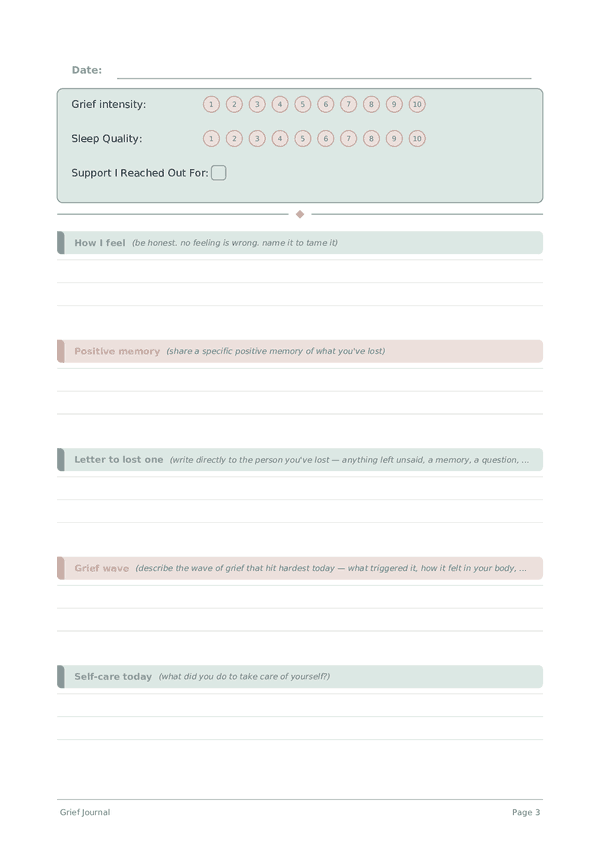
Here's what a typical entry looks like when filled in:
How to fill in each field
The top of each page has quick-fill fields (ratings, checkboxes, numbers). Below that is a lined section for writing. Here's what each field means:
Grief intensity
How intense is your grief right now? Rate from 1 (quiet ache) to 10 (overwhelming wave)
Sleep Quality
Rate how restful your sleep was. 1 means terrible and restless, 5 means deep and refreshing. Quality matters as much as quantity.
Support I Reached Out For
Did you call, text, or talk to someone — a friend, sponsor, family, or counselor?
How I feel
Describe how you feel right now in your own words. There are no wrong answers. Simply putting feelings on paper reduces their emotional charge.
Positive memory
Share a specific positive memory of what you've lost
Letter to lost one
Write directly to the person you've lost — anything left unsaid, a memory, a question, or simply 'I miss you'
Grief wave
Describe the wave of grief that hit hardest today — what triggered it, how it felt in your body, how long it lasted
Self-care today
What did you do to take care of yourself?
What I'm grateful for today
List 1–3 things you're grateful for today. They can be big or tiny — a good meal, a kind word, sunshine. Gratitude journaling is one of the most scientifically supported well-being practices.
Tips for success
When and how often to write
There is no "right" frequency for grief journaling — write when you need to. In acute grief (the first weeks and months), daily writing provides essential release. As grief becomes integrated, write whenever a wave hits or a memory surfaces. Always journal on significant dates: birthdays, anniversaries, holidays. Over time, you may notice the journal shifts from processing pain to preserving connection — both are healthy and valuable.
Frequently Asked Questions
What does the Grief Journal track and write about each day?
It logs grief intensity (1–10), sleep quality (1–10), and whether you reached out for support, plus seven lines of free writing with prompts: feelings, a memory, a letter to your lost loved one, a grief wave description, self-care, and gratitude. This combination of tracking plus expressive writing draws on Pennebaker's expressive-writing research foundation. It is a coping aid, not therapy — seek a licensed grief counselor if grief overwhelms daily functioning.
How do I write a letter to my lost loved one productively?
Address them by name, write as if they are reading, and include what you wish you'd said, current updates, or unresolved feelings. Continuing-bonds writing is a recognized grief intervention in contemporary bereavement practice, distinct from a 'closure' model. Keep entries short — even three sentences count. If grief feels stuck or intensifies past 6–12 months (per ICD-11 prolonged grief disorder criteria, WHO 2022), consult a grief specialist.
Can journaling replace grief counseling?
No. ICD-11 (WHO, 2022) recognizes prolonged grief disorder as a clinical condition when intense grief persists beyond 6 months and impairs functioning; DSM-5-TR (American Psychiatric Association, 2022) similarly defines prolonged grief disorder. Journaling supports day-to-day processing and gives you data to share with a therapist. If grief disrupts work, relationships, or includes thoughts of self-harm, contact a licensed counselor or, in crisis, the 988 Suicide & Crisis Lifeline in the US.
What is a grief wave and how do I describe it?
A grief wave is a sudden, intense surge of grief — often triggered by a song, place, anniversary, or sensory cue — that subsides within minutes to hours. In your entry, capture the trigger, body sensation (chest tightness, tears, exhaustion), and duration. Tracking waves over weeks reveals personal triggers, a recognized technique in continuing-bonds bereavement work. Pattern data helps you anticipate hard days and plan support accordingly.
How is this different from a regular blank notebook?
A blank notebook offers unstructured release. This template combines tracking (intensity, sleep, support) with directed prompts — memory, letter, grief wave, self-care — that draw on expressive-writing protocols. Pennebaker's research foundation, widely cited in grief and trauma literature, found that directed writing combining emotional disclosure with meaning-making produced more durable benefits than unguided venting alone. The template's structure mirrors that protocol on a daily timescale.
Is it normal to rate grief intensity at 10 weeks or months in?
Yes. Acute grief is highly variable; intensity can spike around anniversaries, holidays, or unrelated stressors well beyond initial loss. ICD-11 (WHO, 2022) and DSM-5-TR (American Psychiatric Association, 2022) flag prolonged grief disorder only when intense grief plus functional impairment persists past 6–12 months. The journal helps you and a clinician distinguish normal waves from a pattern needing specialist care — bring trends to a grief counselor.
What if writing about the loss makes me feel worse?
Temporary distress during expressive writing is documented in Pennebaker's research foundation and is generally followed by relief; however, if entries consistently worsen your state, intensify intrusive thoughts, or trigger dissociation, pause the writing prompts and use only the tracking sections. This pattern can signal complicated grief or trauma needing professional help. A licensed grief counselor or trauma therapist can adapt expressive techniques safely for you.
How often and how long should I use the Grief Journal?
Daily during acute grief (the first 3–6 months), shifting to weekly as intensity stabilizes. ICD-11 (WHO, 2022) prolonged grief disorder criteria measure persistence past 6 months, so review your intensity ratings around that mark with a clinician if they remain consistently high. Anniversaries and holidays often warrant returning to daily entries temporarily. There is no fixed endpoint — use it as long as it helps.
You Might Also Like
Scroll to zoom, drag to move