Printable Addiction Recovery Journal
Track your sobriety and build resilience daily
A structured daily companion for your recovery journey. Track sobriety milestones, monitor cravings and mood patterns, reflect on triggers and coping strategies, celebrate victories, and nurture your support network — all in one place.
Customize fields
Toggle fields on or off. Click the pencil to rename, or add your own fields.
Benefits
How to Use
What is this journal?
An addiction recovery journal is a comprehensive daily tool for supporting your journey out of addiction — any addiction. By tracking sobriety days, cravings, mood, and energy alongside detailed reflections on triggers, coping strategies, and support connections, you create a structured recovery practice that supplements professional treatment.
This journal is for anyone in recovery from substance addiction, behavioral addiction, or compulsive patterns. It is designed to work alongside 12-step programs, therapy, and other recovery frameworks. The structure provides both accountability and a safe space for the complex emotional landscape of recovery.
Clinical research on addiction recovery identifies daily journaling as a powerful relapse prevention tool. The process of writing about cravings and triggers activates the prefrontal cortex — the brain region responsible for impulse control — effectively strengthening the neural infrastructure you need most. Tracking support connections also reinforces the social bonds that are critical to sustained recovery.
Filled example
Here's what a typical entry looks like when filled in:
How to fill in each field
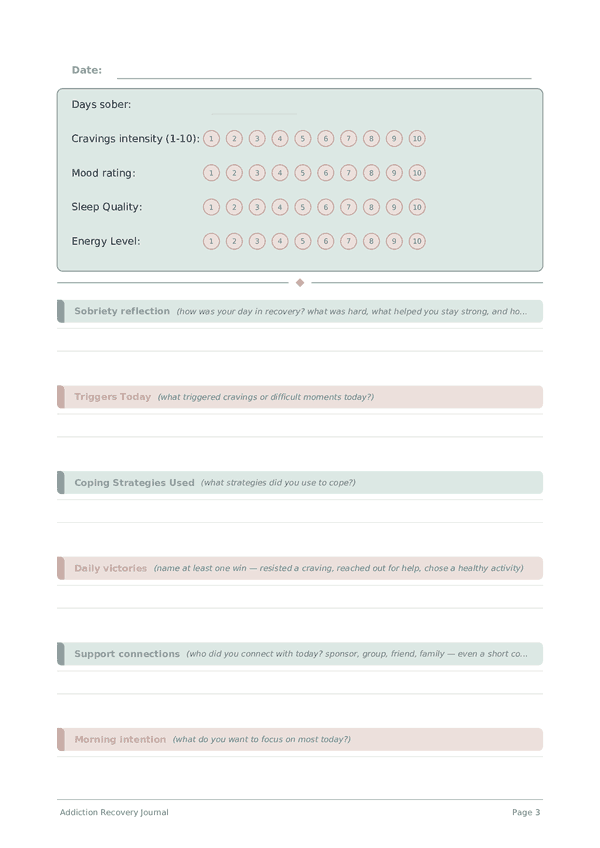
The top of each page has quick-fill fields (ratings, checkboxes, numbers). Below that is a lined section for writing. Here's what each field means:
Days sober
Record how many consecutive days you've been sober. Watching this number grow is a powerful motivator. If you reset, start counting again without shame.
Cravings intensity (1-10)
How strong are your cravings today? Rate 1 (barely noticeable) to 10 (overwhelming)
Mood rating
Rate your emotional state (1-10) to track your healing trajectory
Sleep Quality
Rate how restful your sleep was. 1 means terrible and restless, 5 means deep and refreshing. Quality matters as much as quantity.
Energy Level
How energized do you feel this morning? (1=exhausted, 5=fully charged)
Sobriety reflection
How was your day in recovery? What was hard, what helped you stay strong, and how are you feeling now?
Triggers Today
What triggered cravings or difficult moments today?
Coping Strategies Used
What strategies did you use to cope?
Daily victories
Name at least one win — resisted a craving, reached out for help, chose a healthy activity
Support connections
Who did you connect with today? Sponsor, group, friend, family — even a short conversation matters
Morning intention
What do you want to focus on most today?
What I'm grateful for today
List 1–3 things you're grateful for today. They can be big or tiny — a good meal, a kind word, sunshine. Gratitude journaling is one of the most scientifically supported well-being practices.
Tips for success
When and how often to write
Journal every day, ideally in the evening as part of your recovery routine. In early recovery, write twice daily if possible — morning intentions and evening reflection create bookends of accountability. Log every meeting, every support call, every craving and its resolution. Weekly, review your HALT patterns and identify which state triggered the most difficulty. Monthly, celebrate your progress by re-reading your earliest entries and seeing how far you have come.
Frequently Asked Questions
What does the Addiction Recovery Journal capture daily?
It logs sobriety days, four ratings on a 1-10 scale (cravings intensity, mood, sleep quality, energy), and seven written prompts including morning intention, recovery reflection, triggers, coping strategies used, daily victories, support connections, and gratitude. This structure mirrors the self-monitoring framework in NIDA's Principles of Drug Addiction Treatment (2020). It supports, and does not replace, formal care from a licensed addiction professional.
How do I write a useful morning intention?
Make it specific, behavioral, and tied to a risk you expect that day: 'Decline the after-work invitation,' 'Call my sponsor before the family dinner.' Implementation intentions of the if-then form have evidence in behavior-change research and align with the relapse-prevention planning described in NIDA (2020, Principles of Drug Addiction Treatment, 3rd ed.). Vague intentions like 'stay strong' produce less follow-through than concrete situational plans.
How is this journal different from a 12-step workbook?
AA and Twelve-Step Facilitation workbooks structure progress through 12 specific steps (Alcoholics Anonymous World Services, Big Book methodology). This journal is step-agnostic: it captures daily metrics and reflection useful in any framework, whether AA, SMART Recovery, CBT, or medication-assisted treatment. Many people use both, a 12-step workbook for the program's structure and this template for daily craving and mood data their counselor reviews between sessions.
Will this journal cure my addiction?
No. There is no 'cure' framework for substance use disorder, which DSM-5-TR (American Psychiatric Association, 2022) classifies as a chronic, relapsing condition managed across the lifespan. Effective management combines medication where indicated (FDA-approved buprenorphine, naltrexone, acamprosate), psychotherapy, and peer support. Journaling helps with self-awareness and clinician communication. For treatment access in the US, call SAMHSA's National Helpline 1-800-662-HELP (4357), confidential and free.
What evidence supports tracking cravings and mood together?
Negative affect is among the strongest documented relapse precipitants in addiction medicine, addressed in cognitive-behavioral relapse prevention models taught in SAMHSA TIP 35 (Enhancing Motivation for Change in Substance Use Disorder Treatment, 2019). Logging cravings alongside mood helps reveal the affective triggers behind urges. Cochrane reviews of CBT for substance use disorders support the underlying self-monitoring approach when used with structured therapy, not as a standalone intervention.
How do I use the triggers field productively?
Note the situation, who was present, the emotion that preceded the craving, and your physical state (hungry, tired, lonely, the HALT acronym used in many recovery programs). After two weeks, review for repeating patterns: same person, same place, same time of day. Bring this trigger list to your counselor; it informs the relapse-prevention plan central to NIDA's Principles of Drug Addiction Treatment (2020, 3rd edition).
What if I relapse — should I keep journaling?
Yes. Relapse is part of the recognized disease course in DSM-5-TR (American Psychiatric Association, 2022) and ICD-11 (WHO, 2022), not a personal failure. Resume entries the next day, because the data on what preceded the lapse becomes the most valuable trigger map you'll have. Contact your treatment provider promptly. If you're without one, SAMHSA's helpline 1-800-662-HELP (4357) connects you to local services 24/7.
How long until I see useful patterns from this journal?
Two to four weeks of consistent daily entries usually generates enough data to identify trigger themes, high-risk times, and effective coping strategies, a timeframe consistent with cognitive-behavioral therapy practice in addiction settings. NIDA (2020, Principles of Drug Addiction Treatment) recommends continuous monitoring across at least 90 days for early recovery, since relapse risk is highest in the first three months. Bring trends to your counselor.
You Might Also Like
Scroll to zoom, drag to move