Printable ADHD Journal
Your structured daily companion for focus, calm, and momentum
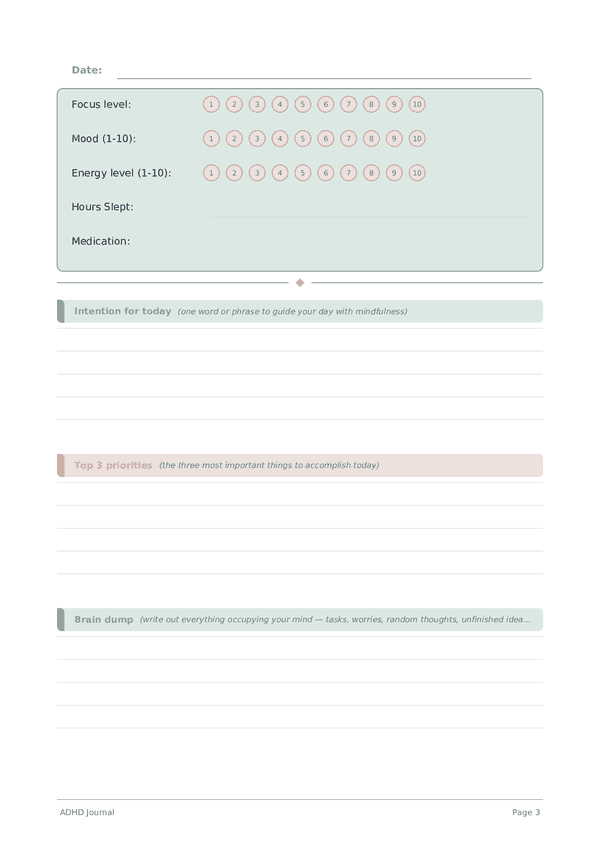
A daily journal designed specifically for people with ADHD. Each page helps you cut through the mental noise — track your focus and energy, capture the brain dump, set a clear intention, and prioritise what actually matters. Built around neurodivergent needs: minimal structure, maximum clarity.
Customize fields
Toggle fields on or off. Click the pencil to rename, or add your own fields.
Benefits
How to Use
What is this journal?
An ADHD journal is a daily support tool designed specifically for the ADHD brain. By tracking focus, mood, energy, and medication alongside writing about intentions, priorities, and brain dumps, you externalize the mental clutter and create a system that works with your neurology rather than against it.
This journal is for adults and teens with ADHD — diagnosed or suspected — who struggle with executive function, focus, time blindness, and emotional regulation. It is built to be quick and low-friction, because an elaborate journaling system that requires too much executive function defeats its own purpose.
ADHD coaching research shows that external accountability systems dramatically improve follow-through for ADHD brains. The brain dump section is particularly powerful — getting racing thoughts onto paper frees up working memory that ADHD brains need for task execution. Tracking patterns in focus and energy helps identify optimal windows for different types of work, turning self-knowledge into a productivity advantage.
Filled example
Here's what a typical entry looks like when filled in:
How to fill in each field
The top of each page has quick-fill fields (ratings, checkboxes, numbers). Below that is a lined section for writing. Here's what each field means:
Focus level
How well can you concentrate right now? Rate from 1 (scattered) to 10 (laser focus)
Mood (1-10)
Rate your overall emotional state for the day. 1 means very low or depressed, 10 means exceptionally happy and positive. Don't overthink — go with your gut feeling.
Energy level (1-10)
Rate your physical and mental energy level. 1 means exhausted and drained, 10 means fully energized and alert. This helps you identify what activities boost or drain your energy.
Hours Slept
Write how many hours you actually slept (not just time in bed). Tracking this alongside mood and energy often reveals powerful connections.
Medication
Record medications taken, including name and dosage. Consistent tracking helps you and your doctor evaluate treatment effectiveness.
Intention for today
One word or phrase to guide your day with mindfulness
Top 3 priorities
The three most important things to accomplish today
Brain dump
Write out everything occupying your mind — tasks, worries, random thoughts, unfinished ideas. Free up space
Today's reflection
Look back at your day honestly. What went well? What could be better? This isn't about judgment — it's about learning and growing.
Tips for success
When and how often to write
Write twice daily: a 2-minute evening entry (what worked today, what didn\u2019t, tomorrow\u2019s top 3) and a 1-minute morning check-in (energy level, medication, today\u2019s anchor task). Keep the journal next to where you actually sit — if it requires getting up to find it, ADHD friction will win. Weekly, spend 10 minutes reviewing patterns: which days were productive and why, which strategies helped, which times of day were your cognitive peaks. This journal works best when it is short, consistent, and immediately accessible.
Frequently Asked Questions
Why is this journal designed specifically for ADHD instead of general productivity?
ADHD brains struggle with working-memory overload, time perception, and starting friction. This template answers with deliberately minimal structure: five tracker items (focus, mood, energy, hours slept, medication) and four prompts (intention for today, top 3 priorities, brain dump, reflection). Fewer fields, a clearer hierarchy, and an explicit brain dump section target the executive-function challenges that derail standard productivity systems for neurodivergent users.
What is a brain dump and why is it central to this journal?
A brain dump is unstructured offloading of every thought, task, and worry onto paper. For ADHD brains, holding multiple open loops in working memory creates cognitive overload and decision paralysis. David Allen's Getting Things Done (Penguin, 2001; revised 2015) built his entire methodology around capture for this reason. The brain dump field gives you a daily release valve before you set priorities clearly.
Why only three top priorities and one intention?
ADHD often produces 20-item to-do lists that paralyze rather than guide. Limiting yourself to three priorities and one daily intention forces ruthless selection that matches working-memory limits. Greg McKeown's Essentialism (Crown Business, 2014) and Stephen Covey's 7 Habits of Highly Effective People (Free Press, 1989) both argue for radical narrowing, which matters most when the brain generates more 'urgent' items than any day can hold.
Is this journal a replacement for ADHD medication or therapy?
No. ADHD is a neurodevelopmental condition; this journal is a supportive self-management tool, not a treatment. The medication tracker field exists to help you and your clinician see how meds correlate with focus and mood, not to replace clinical care. Please consult a qualified psychiatrist or ADHD specialist for diagnosis and treatment; use the journal alongside professional support, not instead of it.
How is this different from a regular planner or bullet journal?
Standard planners assume neurotypical executive function: that you'll remember to check them, prioritize consistently, and resist hyperfocus drift. This template's tracker takes under two minutes, the brain dump clears the 'too overwhelmed to plan' state, and the single intention bypasses choice paralysis. The structure is deliberately spare because cluttered pages themselves trigger ADHD avoidance.
Why track medication and hours slept alongside focus and mood?
ADHD focus varies sharply with sleep and medication timing, patterns you can't see without recorded data. Weekly review of medication adherence, hours slept, and the three 1-10 ratings reveals which combinations produce your best focus days. Share patterns with your prescriber for medication adjustments. This is observation, not self-diagnosis: only a qualified clinician interprets the data for treatment decisions.
How long until the journal helps me see my best work windows?
Most ADHD users see clear focus and mood patterns after two to three weeks of consistent tracker entries. Cross-reference focus level ratings with time of day, hours slept, and medication timing. Cal Newport's Deep Work (Grand Central, 2016) recommends scheduling demanding tasks in your highest-focus window. For ADHD, that window may be narrow, but data finds it where guesswork can't.
What's the most common mistake ADHD users make with this journal?
Trying to fill it perfectly every day, then abandoning it after a missed week. The journal is built for imperfect use: skip a day, fill only the tracker, write a one-line brain dump. Gretchen Rubin's The Four Tendencies (Harmony, 2017) and James Clear's Atomic Habits (Avery, 2018) both warn that perfectionism kills habits faster than slips. Aim for showing up, not completion.
You Might Also Like
Scroll to zoom, drag to move