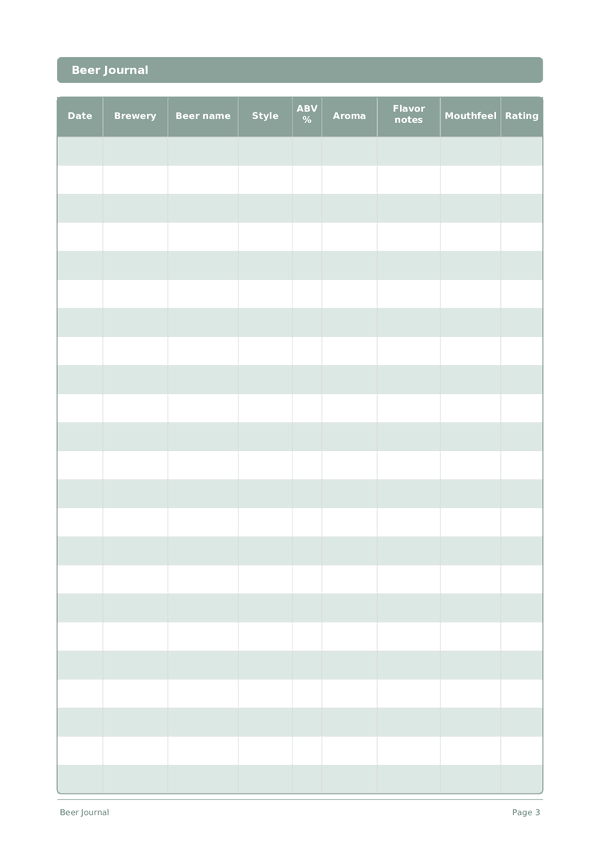
Printable Beer Journal
Track and rate every craft beer you try
A structured tasting log to record every craft beer you encounter — brewery, beer name, style, ABV, aroma, flavor notes, mouthfeel, and your personal rating. Build a personal database of beers you love, discover patterns in your taste preferences, and always remember what you ordered at that amazing taproom.
Customize fields
Toggle fields on or off. Click the pencil to rename, or add your own fields.
Benefits
How to Use
What is this journal?
A beer journal is a tasting log for documenting your explorations of craft beer and beyond. By recording brewery, style, ABV, and detailed notes on aroma, flavor, and mouthfeel, you develop your palate and build a personal reference that guides you toward the styles and breweries you love most.
This journal is for beer enthusiasts who want to be more intentional about their tasting — from craft beer newcomers exploring IPA styles to experienced tasters pursuing rare barrel-aged stouts. It is also valuable for homebrewers who want to study what makes their favorite commercial beers exceptional.
Beer appreciation, like wine, deepens through deliberate tasting and recording. The Cicerone certification program emphasizes that writing tasting notes is the single most effective way to train your palate. By tracking aroma, flavor, and mouthfeel separately, you learn to isolate and identify the individual components that make a beer memorable or forgettable.
Filled example
Here's what a typical entry looks like when filled in:
| Date | Brewery | Beer name | Style | ABV % | Aroma | Flavor notes | Mouthfeel | Rating |
|---|---|---|---|---|---|---|---|---|
| 2025-03-04 | Tree House Brewing | Julius | New England IPA | 6.8 | Tropical fruit explosion — mango, passion fruit, tangerine peel. Slight pine resin. | Juicy mango and peach dominate. Soft citrus bitterness that does not linger. Slight dank hop character in the background. Finishes clean and fruity. | Pillowy soft, medium body, moderate carbonation, creamy | 9 |
| 2025-03-04 | Weihenstephan | Hefe Weissbier | Hefeweizen | 5.4 | Classic banana and clove. Fresh bread dough. Hint of vanilla. | Banana bread with clove spice. Light wheat sweetness. Refreshing and balanced with a clean, dry finish. Effervescent. | Light-medium body, high carbonation, refreshing, slightly creamy from the wheat | 8 |
| 2025-03-04 | Founders Brewing | KBS (Kentucky Breakfast Stout) | Imperial Stout (Bourbon Barrel-Aged) | 12.2 | Rich dark chocolate, espresso, bourbon vanilla, oak, faint maple sweetness. | Decadent — dark chocolate truffle, espresso, caramel, bourbon warmth. Roasted malt backbone. Dried fruit in the background. Long, warming finish. | Full, viscous, low carbonation, warming alcohol, velvety | 9 |
How to fill in each field
Each page is a table with columns. Fill in one row per entry. Here's what each column is for:
Date
Write today's date. This anchors your entry in time and helps when reviewing entries later.
Brewery
Beer name
Style
ABV %
Aroma
Flavor notes
Mouthfeel
Rating
Overall rating of the experience
Tips for success
When and how often to write
Log each new beer you try — the table format makes it fast enough to fill in at the bar or brewery. For homebrewers, log every batch with detailed recipe parameters. Aim for 2-4 entries per week if you are actively exploring styles. During brewery visits or festivals, jot quick ratings and expand notes afterward. Monthly, review your entries to map which styles, regions, and breweries consistently score highest on your personal scale.
Frequently Asked Questions
How should I describe a beer's style accurately — what if I don't know the BJCP category?
Start with the label's stated style, then cross-reference the Beer Judge Certification Program (BJCP) Style Guidelines (current edition, 2021), which organize nearly 100 categories from American IPA to Berliner Weisse. The Brewers Association also publishes annual Beer Style Guidelines used in the Great American Beer Festival. If unsure, note the closest match plus a question mark. Over time, style literacy compounds, and your patterns of misidentification become a useful learning signal.
What's the right way to record aroma, flavor notes, and mouthfeel separately?
BJCP scoresheets evaluate aroma, appearance, flavor, mouthfeel, and overall impression as distinct dimensions for a reason: they shift independently. Aroma: hops (pine, citrus, tropical), malt (bread, caramel, chocolate), fermentation (banana, clove, peppery). Flavor: bitterness intensity, malt sweetness, off-flavors (diacetyl, DMS). Mouthfeel: body weight, carbonation, alcohol warmth, dryness. The Cicerone Certification Program trains evaluators in this exact separation; mixing them dilutes the data's value.
How should I read and record ABV — and what does it predict about the beer?
ABV (alcohol by volume) is printed on most US craft labels per federal labeling rules. BJCP Style Guidelines (2021) anchor styles to ABV ranges: session beers under 4.5%, standard 4.5-6%, strong 6-9%, very strong 9% and up. Tracking ABV against your rating reveals tolerance patterns; many drinkers consistently prefer 5-7% and find higher ABV palate-fatiguing. ABV also correlates with body and sweetness perception via residual sugars, useful when comparing across styles.
How do I separate a brewery I love from a beer I love?
Log brewery and beer name in separate columns on purpose. After 30-50 entries, sort mentally by brewery: does Brewery X consistently score 8 or higher, or only one flagship release? The Brewers Association tracks over 9,000 US craft breweries, so brewery-level loyalty without specific-beer data wastes purchasing opportunities. Finding a brewery whose entire range scores well is exceptionally valuable; it signals consistent house yeast, water profile, and process discipline.
How does this paper journal compare to apps like Untappd?
Untappd is excellent for social discovery and quick check-ins but biases your ratings via visible community averages before you taste. BJCP and Cicerone-style evaluation calls for deliberate, unbiased sensory analysis, easier on paper with no notification pings. Apps also encourage one-line reactions, whereas separate aroma, flavor, and mouthfeel columns force fuller evaluation. Use both: app for cellar inventory and social, journal for the analytical record that develops your palate over years.
Is this journal suitable for non-craft beer, cider, mead, or non-alcoholic beer?
Yes. The columns (brewery, name, style, ABV, aroma, flavor, mouthfeel, rating) work for any fermented beverage. BJCP guidelines include cider and mead categories with their own descriptors. Non-alcoholic craft beer is a growing segment per Brewers Association annual reports; log it identically. The Master Brewers Association of the Americas covers all malt-based beverages technically. The journal's principle of repeatable sensory observation holds across category labels.
How often should I revisit older entries, and what should I look for?
Monthly review helps you detect palate evolution. The Cicerone Certification Program emphasizes that taste perception itself changes with exposure; beers rated 6 a year ago may now score 8 as you learn the style. Sort by rating and style: are you trending toward hop-forward, malt-forward, or sour styles? Brewers Association data shows IPAs dominate craft volume, but personal preference often diverges. Annual review surfaces your stylistic identity beyond marketing narratives.
Common mistakes that undermine tasting accuracy?
First, rating from the bottle without proper glassware; aroma volatiles need surface area, per BJCP judging protocol. Second, eating spicy or strongly flavored food right before. Third, halo bias from hyped brewery names. Fourth, scoring after one sip, when flavor and finish need 2-3 sips minimum. Fifth, ignoring off-flavors out of politeness; the Cicerone Off-Flavor Kit specifically trains identification of diacetyl, acetaldehyde, DMS, and lightstruck character.
You Might Also Like
Scroll to zoom, drag to move