Printable Wine Journal
Document wine tasting experiences
Record wines you taste with region, grape variety, rating, and tasting notes. Build a personal wine reference to remember favorites and discover preferences.
Customize fields
Toggle fields on or off. Click the pencil to rename, or add your own fields.
Benefits
How to Use
What is this journal?
A wine journal is a tasting log for recording your explorations of wine with structure and detail. By tracking the wine's origin, grape, pairing, and your sensory observations of sight, aroma, and taste, you develop your palate and build a personal reference that guides future selections.
This journal is for wine enthusiasts at any level — from curious beginners learning to distinguish grape varieties to experienced tasters refining their vocabulary. It removes the intimidation from wine appreciation by providing a simple framework for describing what you see, smell, and taste.
Wine education research shows that the single most effective way to develop your palate is systematic tasting with written notes. The act of translating sensory experience into words forces you to pay closer attention and creates reference points that make each subsequent tasting more informed. Over time, your journal becomes a personalized wine guide that no app or critic can replicate.
Filled example
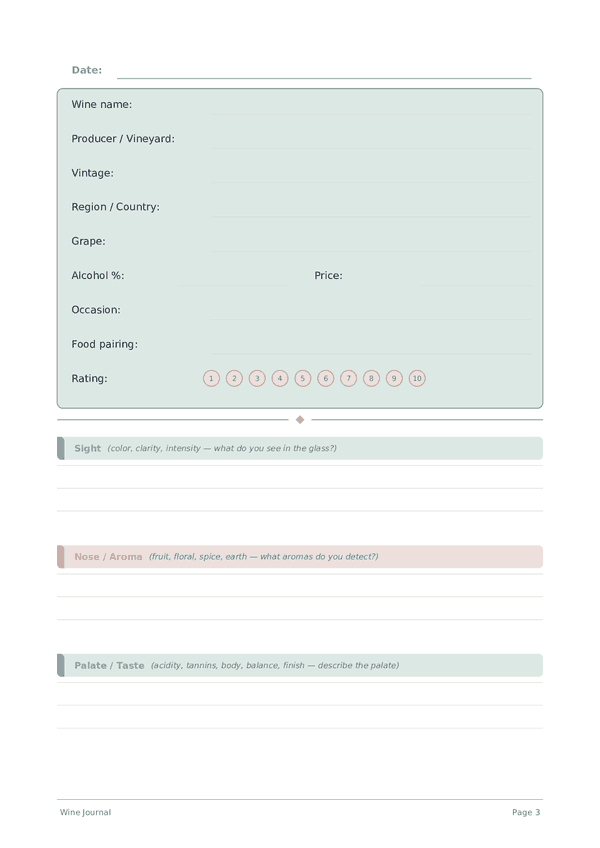
Here's what a typical entry looks like when filled in:
How to fill in each field
The top of each page has quick-fill fields (ratings, checkboxes, numbers). Below that is a lined section for writing. Here's what each field means:
Wine name
Full name of the wine as it appears on the label
Producer / Vineyard
Winery or producer name — who made this wine?
Vintage
Year the grapes were harvested — e.g. 2019, 2021
Region / Country
Where is it from? e.g. Bordeaux, France or Napa, USA
Grape
Grape variety or blend — Cabernet Sauvignon, Merlot, Chardonnay...
Alcohol %
Alcohol percentage as shown on the label — e.g. 13.5%
Price
How much did you pay? Bottle price in your local currency
Occasion
Work, casual, date night, party, gym, travel, special event...
Food pairing
What did you eat with it, or what would pair well? Cheese, steak, pasta...
Rating
Your overall score for this wine: 1 = unpleasant, 10 = exceptional
Sight
Color, clarity, intensity — what do you see in the glass?
Nose / Aroma
Fruit, floral, spice, earth — what aromas do you detect?
Palate / Taste
Acidity, tannins, body, balance, finish — describe the palate
Overall impressions
Would you buy again? Overall thoughts on this wine
Tips for success
When and how often to write
Write an entry for every new wine you taste — capture your notes during or immediately after tasting, while sensory details are sharp. If you attend a tasting event, bring the journal and write brief notes for each pour, then expand your favorite entries later that evening. Aim for at least 2-3 entries per week if you are actively building your palate. Monthly, re-read your entries to track how your preferences and vocabulary have evolved.
Frequently Asked Questions
How do I structure a tasting note using the sight, aroma, taste, and notes sections?
Follow the WSET Systematic Approach to Tasting (SAT, Level 3, current edition): start with sight — color intensity and hue; then aroma — primary fruit, secondary winemaking, tertiary aging notes; then taste — sweetness, acidity, tannin, alcohol, body, flavour intensity, finish length; finish with overall conclusions in notes. Court of Master Sommeliers (Deductive Tasting Method) follows the same sequence. The journal's four prompts map directly to SAT pillars.
What should I write in the region and grape variety fields beyond the obvious?
Record the appellation (e.g., Barolo DOCG, Sancerre AOC) rather than just the country, because OIV (International Organization of Vine and Wine, 2023, State of the World Vine and Wine Sector) catalogs over 1,400 geographical indications. For grape, note whether it is single-varietal or a blend with approximate percentages. WSET Level 2 study materials emphasize that region-grape pairing predicts style more reliably than producer alone, helping you map preferences across future tastings.
How should I use the 1-10 wine rating consistently across many bottles?
Wine Spectator and Decanter both publish on 100-point scales, but for personal use the Court of Master Sommeliers recommends a simple, repeatable framework. Anchor your own scale: 6 = sound but unmemorable, 7-8 = enjoyable, 9 = excellent within style, 10 = truly exceptional. Rate to the wine's own style — a great Beaujolais and a great Barolo can both earn 9. Rerate occasionally to recalibrate as your palate changes.
What food pairing notes are worth recording — and why?
Record the dish, key ingredients, and whether the pairing enhanced, matched, or clashed. WSET teaches that acidity pairs with fat, tannin with protein, sweetness with sweetness; documenting outcomes builds a personal pairing library faster than reading rules. UC Davis Viticulture & Enology research on phenolics confirms tannin-protein interaction is measurable, not subjective. Note the occasion field too — special-occasion wines benefit from contextual memory cues for future reference.
How does this journal differ from apps like Vivino or CellarTracker?
Apps rely on crowdsourced ratings that can bias your perception before you taste. Writing your own notes first — as WSET SAT methodology requires — develops independent palate calibration. Decanter and Vinous columnists consistently advise tasting blind or untainted by scores. The journal's physical format also encourages slower, deliberate observation. You can still cross-reference apps afterward, but the primary record stays your own untainted impression.
Should I record alcohol percentage and price — what's the analytical value?
Yes. The OIV (2023, State of the World Vine and Wine Sector) reports rising average alcohol across major regions due to climate change, so tracking ABV reveals style drift across vintages. Price-to-quality ratio is your most actionable metric: tag wines where your rating exceeds price expectations as 'repeat buys.' WSET Level 3 specifically asks candidates to assess quality-price ratio, treating it as a learnable skill, not an opinion.
How many wines should I journal before patterns in my preference emerge?
Most WSET and Court of Master Sommeliers educators suggest 50-100 deliberate tastings before clear preference patterns settle. Tag entries by region, grape, and rating, then review monthly: do you consistently rate Mosel Riesling above New Zealand Sauvignon Blanc? Is your tannin tolerance growing? The journal's structured fields make this retrospective analysis possible, whereas memory alone reliably distorts past impressions after about three months.
Common mistakes to avoid when writing tasting notes?
First, vague descriptors — 'nice' or 'smooth' carry no analytical value; use WSET's Lexicon of aroma families (citrus, stone fruit, tropical, etc.). Second, halo bias — letting price or producer reputation shape your rating before tasting. Third, skipping the sight assessment, which signals age and varietal. Fourth, comparing across styles using one absolute score. Finally, judging hastily — Court of Master Sommeliers protocols allow at least three minutes per wine.
You Might Also Like
Scroll to zoom, drag to move