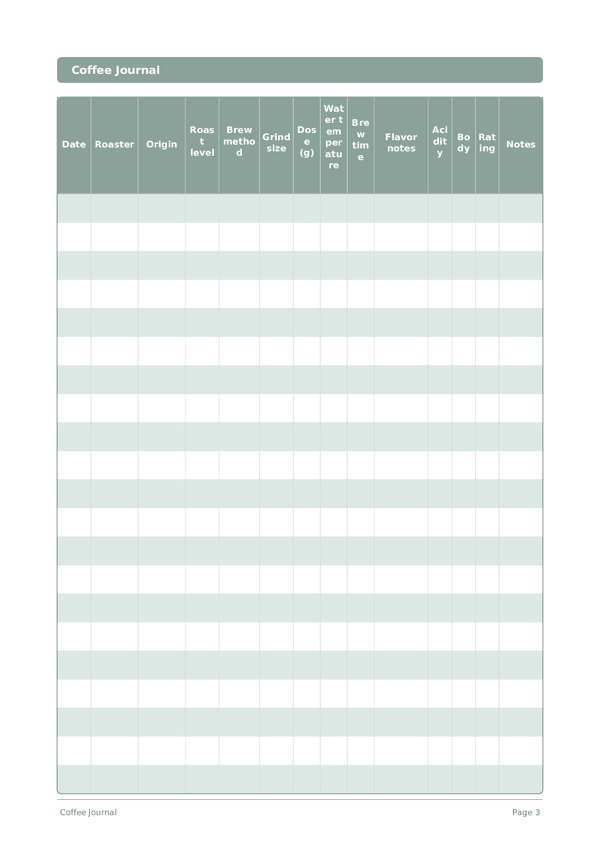
Printable Coffee Journal
Track brews, dial in parameters, and develop your palate
Log every cup with precision: origin, roast level, brew method, grind size, dose, water temperature, brew time, and tasting notes. Build a personal database of brews to refine your technique and discover what makes the perfect cup.
Customize fields
Toggle fields on or off. Click the pencil to rename, or add your own fields.
Benefits
How to Use
What is this journal?
A coffee journal is a structured tasting and brewing log for documenting your coffee explorations. By recording roaster, origin, brew parameters, and detailed flavor notes, you develop your palate and optimize your brewing technique — turning your morning cup from a routine into a craft.
This journal is for coffee lovers who want to go deeper — from home brewers dialing in their pour-over technique to enthusiasts exploring single-origin beans from different regions. Whether you brew with an espresso machine, AeroPress, French press, or pour-over, tracking your variables is the path to consistently excellent coffee.
Specialty coffee professionals emphasize that the difference between good and exceptional coffee often comes down to small adjustments in grind size, water temperature, and brew time. Without records, you cannot replicate your best cups or diagnose your worst. This journal transforms coffee brewing from guesswork into deliberate practice.
Filled example
Here's what a typical entry looks like when filled in:
| Date | Roaster | Origin | Roast level | Brew method | Grind size | Dose (g) | Water temperature | Brew time | Flavor notes | Acidity | Body | Rating | Notes |
|---|---|---|---|---|---|---|---|---|---|---|---|---|---|
| 2025-03-04 | Onyx Coffee Lab | Ethiopia Yirgacheffe, Gedeb station | Light | V60 pour-over | Medium-fine (18 on Comandante) | 18g | 96C | 3:15 | Bright blueberry, jasmine, honey sweetness, clean citrus finish | High, sparkling | Light-medium, tea-like | 9 | Best cup from this bag yet. The slightly coarser grind compared to yesterday reduced astringency. Bloom for 45 seconds was key. |
| 2025-03-04 | Onyx Coffee Lab | Ethiopia Yirgacheffe, Gedeb station | Light | AeroPress | Medium (20 on Comandante) | 15g | 92C | 2:00 | Muted blueberry, more chocolate, heavier body, less floral | Medium, rounded | Medium, syrupy | 7 | Same beans, different method. AeroPress brings out body but loses the delicate florals. Prefer V60 for this origin. |
How to fill in each field
Each page is a table with columns. Fill in one row per entry. Here's what each column is for:
Date
Write today's date. This anchors your entry in time and helps when reviewing entries later.
Roaster
Origin
Roast level
Brew method
Grind size
Dose (g)
Water temperature
Brew time
Flavor notes
Acidity
Body
Rating
Overall rating of the experience
Notes
Add any additional context or thoughts. This catch-all column is for anything that doesn't fit elsewhere but might be useful later.
Tips for success
When and how often to write
Log every brew that you want to learn from — aim for at least one entry per day if you brew at home. The table format makes this fast: 30 seconds to fill in the parameters, another 30 for flavor notes. When dialing in a new bean, log every attempt until you hit the target flavor profile. Review your logs weekly to identify which variables had the most impact. Over months, your data builds a personal brewing reference that no blog or YouTube video can match.
Frequently Asked Questions
How do I dial in espresso parameters using the dose, grind, temp, and time columns?
The Specialty Coffee Association (SCA, Brewing Standards) defines extraction yield 18-22% and TDS 1.15-1.35% as the Gold Cup target for filter; espresso targets vary by recipe. Hold dose constant (e.g., 18g), then adjust grind finer for faster shots or coarser for slower. Log one variable change at a time across consecutive rows. After 10-15 entries, the links between grind, time, and flavor become clear — the same method Q Grader training (Coffee Quality Institute) formalizes.
What's the right way to record flavor notes — should I use the Coffee Taster's Flavor Wheel?
Yes. The SCA Coffee Taster's Flavor Wheel (2016, revised with World Coffee Research Sensory Lexicon) gives you a shared vocabulary that moves from broad categories (fruity, nutty, floral) to specific descriptors (blackberry, almond, jasmine). Start broad on early entries, then get specific as your palate develops. Q Grader cupping protocols require descriptors from this lexicon. Pair flavor notes with the acidity and body fields — together they form the core sensory dimensions of the SCA cupping form.
How should I rate acidity, body, and overall score consistently?
The SCA cupping form rates each attribute on a 6-10 scale; 6 = good, 7 = very good, 8 = excellent, 9-10 = outstanding. For acidity, separate quality (bright vs. sharp) from intensity. Body refers to mouthfeel weight, not flavor strength. Keep your overall score within one point of the average of the attributes — outliers usually signal halo bias. Q Grader training stresses calibration through repeated reference samples.
Why log origin and roast level separately — they're related, aren't they?
Origin and roast interact but are independent variables. World Coffee Research's Arabica Variety Atlas documents that the same variety from Ethiopia or Colombia shows distinct flavor lineage, while roast level dictates how much of that origin character survives. Light roasts preserve origin acidity; dark roasts shift flavors toward roast-driven notes. Tracking both lets you separate 'I like Ethiopia' from 'I like light roasts' — a distinction most casual drinkers blur together.
What water temperature should I record, and does it really matter?
SCA Brewing Standards specify 93-96°C (200-205°F) for the best extraction of filter coffee. Lower temperatures underextract — sour, weak; higher temperatures risk bitterness. Research in Food Research International (e.g., studies on brewing temperature and extraction yield) confirms temperature drives extraction kinetics alongside grind and contact time. If you brew below 90°C, expect dialing-in to push toward finer grinds or longer times. Record the actual temperature, not the kettle setting if they differ.
How does this paper journal differ from coffee apps like Filtru or Beanconqueror?
Apps automate timers and recipe storage but pull your attention away from the cup. Paper requires deliberate observation, which Q Grader sensory training (CQI) treats as the foundational skill — instruments cannot replace calibrated tasting. Ten rows per page also let you compare consecutive brews side by side, which is harder to scan on small screens. Use the app for stopwatch precision if you like, but record your sensory data here for focused reflection.
How many entries before I can identify my actual preferences?
World Coffee Research and SCA educators broadly suggest 30-50 deliberate cuppings before patterns emerge — preferred origins, roast levels, brew methods. Hold one variable constant per week (e.g., same beans, varying grind) to isolate its effect. Review the rating column monthly: do your 8+ scores cluster on Ethiopia naturals, Colombian washed, or specific roasters? The table format makes this longer-term scan possible — your own palate becomes the database.
What common dialing-in mistakes should I avoid recording badly?
First, changing multiple variables between brews — you lose isolation. Second, rating without smelling first; aroma drives 70-80% of flavor perception (basic olfaction research summarized in Food Chemistry literature). Third, ignoring water mineral content, which the SCA Water Quality Handbook (2009) shows materially affects extraction. Fourth, vague flavor notes — 'nutty' is less useful than 'almond, milk chocolate.' Finally, scoring before the cup cools; many flavors only emerge below 60°C.
You Might Also Like
Scroll to zoom, drag to move