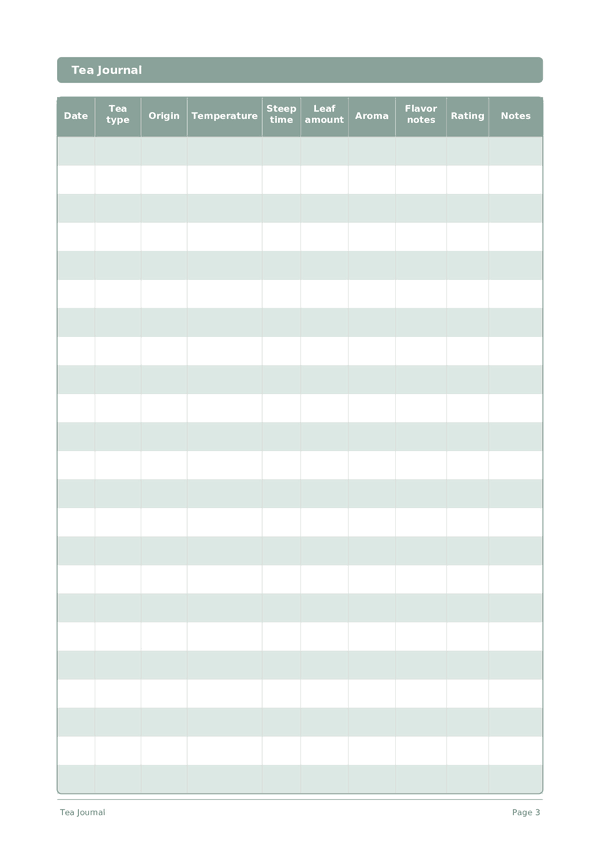
Printable Tea Journal
Track every cup — from leaf to last sip
A structured log for tea enthusiasts who want to deepen their tasting practice. Record brewing parameters, aroma, flavor notes, and ratings to build a personal reference of your favorite teas. Whether you explore single-origin loose-leaf or seasonal herbals, this journal helps you brew better with every session.
Customize fields
Toggle fields on or off. Click the pencil to rename, or add your own fields.
Benefits
How to Use
What is this journal?
A tea journal is a tasting and steeping log for documenting your exploration of tea. By recording tea type, origin, steeping parameters, and detailed sensory notes, you deepen your appreciation of one of the world's most nuanced beverages and learn to brew each tea at its best.
This journal is for tea enthusiasts who want to move beyond tea bags into the rich world of loose-leaf tea — from delicate white teas and complex oolongs to robust pu-erhs and fragrant jasmine greens. It is equally valuable whether you practice gongfu cha or Western-style brewing.
Tea masters emphasize that the same leaf can produce dramatically different cups depending on water temperature, steeping time, and leaf-to-water ratio. This journal helps you find the optimal parameters for each tea and track how teas evolve across multiple infusions — a journey that transforms tea drinking from a casual habit into a mindful practice with centuries of wisdom behind it.
Filled example
Here's what a typical entry looks like when filled in:
| Date | Tea type | Origin | Temperature | Steep time | Leaf amount | Aroma | Flavor notes | Rating | Notes |
|---|---|---|---|---|---|---|---|---|---|
| 2025-03-04 | Oolong — Tieguanyin | Anxi, Fujian, China | 90 | 30s / 45s / 60s / 90s | 7g / 100ml gaiwan | Orchid, fresh cream, hint of roasted grain | 1st steep: bright floral, buttery. 2nd: orchid deepens, light honey. 3rd: toasted grain emerges, mineral finish. 4th: gentle, sweet, lingering. | 8 | Excellent Tieguanyin — opened beautifully over 4 steeps. The leaves unfurled into full, intact leaves. Best at 2nd and 3rd steep. Gongfu style brings out complexity. |
| 2025-03-04 | Green — Gyokuro | Uji, Kyoto, Japan | 60 | 90s / 60s / 30s | 5g / 60ml kyusu | Intense umami, seaweed, sweet grass, ocean breeze | 1st steep: rich umami bomb, sweet marine, buttery. 2nd: lighter, more vegetal, asparagus. 3rd: delicate, sweet, refreshing. | 9 | This Gyokuro is exceptional. Low temperature is essential — anything above 65C brings bitterness. The umami is almost broth-like. Paired well with mild white fish for lunch. |
How to fill in each field
Each page is a table with columns. Fill in one row per entry. Here's what each column is for:
Date
Write today's date. This anchors your entry in time and helps when reviewing entries later.
Tea type
Origin
Temperature
Record your basal body temperature. Temperature shifts help track ovulation and overall cycle health.
Steep time
Leaf amount
Aroma
Flavor notes
Rating
Overall rating of the experience
Notes
Add any additional context or thoughts. This catch-all column is for anything that doesn't fit elsewhere but might be useful later.
Tips for success
When and how often to write
Log each tea session as you brew — the table format is designed for quick capture while the kettle cools. If you drink 2-3 teas daily, log the one you want to remember or improve. When exploring a new tea type (say, transitioning from black to pu-erh), log every session for at least two weeks to build baseline understanding. Monthly, review your entries to see which teas you rated highest and which brewing parameters consistently produce your best cups.
Frequently Asked Questions
What water temperature should I record for green, oolong, black, and pu-erh tea?
The Specialty Tea Institute and major tea-growing references converge on broad ranges: green 70-80°C, white 75-85°C, oolong 85-95°C, black and pu-erh 95-100°C. Studies in the Journal of Agricultural and Food Chemistry on catechin extraction confirm temperature drives polyphenol release — too hot extracts bitterness, too cool yields thin tea. Record the actual temperature, not just the kettle's setting, since spouts and gaiwans cool water by 5-10°C in transit.
How long should I steep different tea types, and how do I log multiple infusions?
Specialty Tea Institute guidelines suggest green 1-3 min, black 3-5 min, oolong 1-5 min (lengthening per infusion), pu-erh 30s-3 min in gongfu style. Quality loose-leaf supports 3-7 infusions; log them as separate rows with steep time '30s, 45s, 1m'. Research in Food Chemistry on tea infusion kinetics shows compound extraction shifts across infusions — early steeps release amino acids, later ones tannins. Sequential rows make this evolution visible.
What aroma vocabulary should I use in the aroma column?
Borrow from established sensory work: floral (jasmine, orchid), grassy (fresh-cut, spinach), nutty (chestnut, almond), earthy (forest floor, damp wood), smoky, marine, honeyed, mineral. The Specialty Tea Institute teaches dry-leaf aroma, wet-leaf aroma after rinse, and infusion aroma as three distinct evaluations. Research in Food Chemistry on tea volatiles (linalool, geraniol, methyl jasmonate) backs these categories chemically. Be specific — 'floral' alone loses analytical value over hundreds of entries.
How precise should leaf amount be — and why does it matter so much?
Record grams per 100ml of water, not just teaspoons, since leaf density varies widely between flat green leaves and rolled oolong. Specialty Tea Institute brewing parameters typically center on 2-3g per 200ml Western style, 5-7g per 100ml gongfu. The ratio drives extraction strength independently of steep time — too much leaf with a short steep mimics weak tea from too little leaf and a long steep. A small kitchen scale earns its place quickly here.
Is this journal suitable for herbal infusions, matcha, and bagged teas — not just loose-leaf?
Yes. The columns work for any infusion: tea type captures matcha, herbal, rooibos, or chamomile; temperature, steep time, and leaf amount still apply. Matcha entries log whisk style instead of steep time. Bagged tea is fine to record — the ITF (International Tea Federation) tracks bagged volumes as the global majority of tea consumption. The journal's value lies in repeatable observation, not snobbery about format.
How is logging tea different from logging coffee or wine?
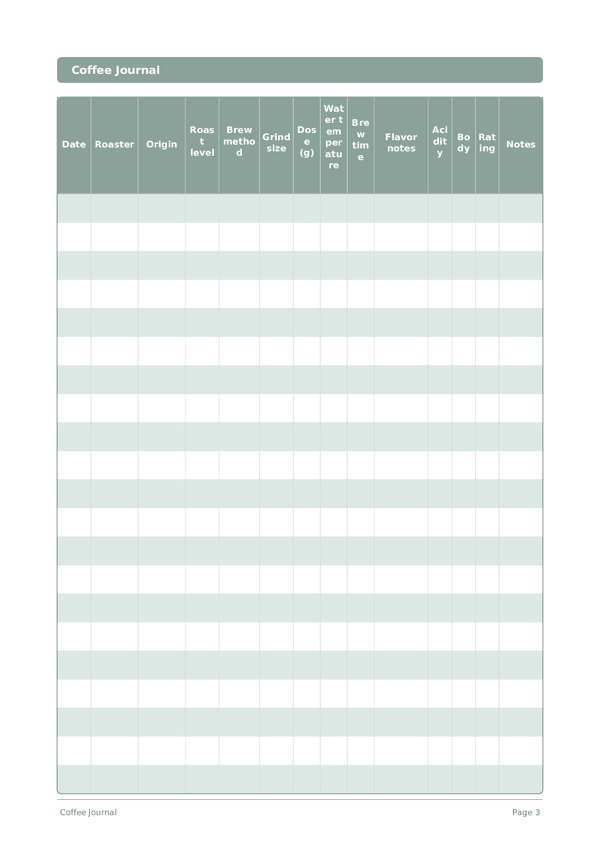
Tea is unusual in supporting multiple infusions from one leaf charge, so a single 'session' may fill several rows. Unlike wine, tea parameters (temperature, time, ratio) are actively variable, more like coffee. Unlike coffee, caffeine and L-theanine ratios shift the experience cognitively — research in Food Chemistry documents L-theanine's calming amino acid profile. Reserve the notes column for non-sensory context: time of day, mood, food paired.
How many sessions before I find my preferred origins and tea types?
Plan on 30-50 logged sessions before clear patterns emerge. Filter your entries by tea type and rating column: do your 8+ scores cluster on Dan Cong oolong, Darjeeling first flush, or Yunnan black? Origin matters too — Specialty Tea Institute coursework draws terroir parallels to wine. After 50 sessions, you can also pin down which steep parameters consistently underperform, so your brewing improves alongside your purchasing decisions.
Common mistakes that ruin tea journal data quality?
First, eyeballing leaf amount instead of weighing — that kills the ratio variable. Second, logging only the first infusion when you brewed several. Third, vague aroma like 'nice smell' — use ITF or Specialty Tea Institute descriptor families. Fourth, rating immediately, when many teas reveal complexity in the cooling liquor. Fifth, ignoring water source — research in Food Chemistry shows mineral content meaningfully alters extraction, just as with coffee.
You Might Also Like
Scroll to zoom, drag to move