Printable Birdwatching Journal
Record every bird sighting with species, habitat, and behavior
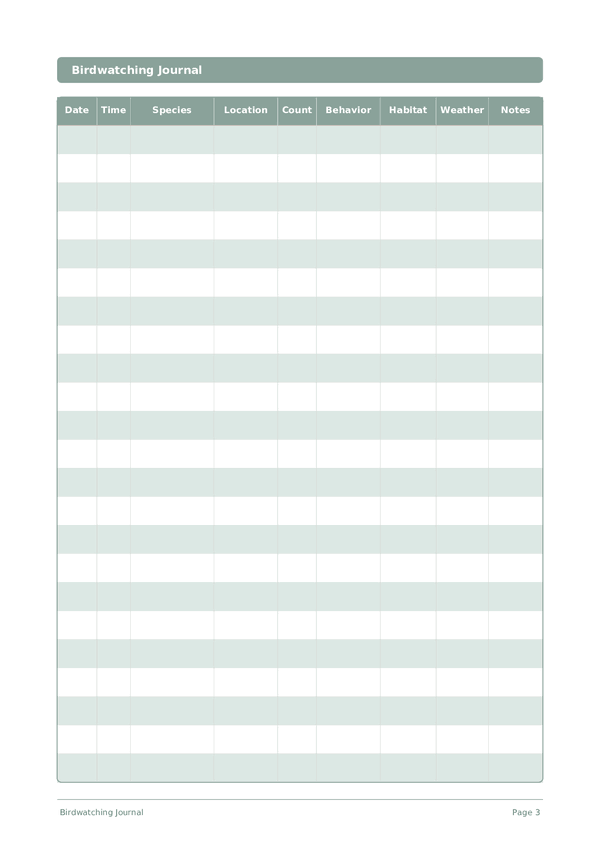
A structured field log designed for birders of all levels. Capture species, location, count, behavior, habitat, and weather conditions for every sighting. Build a detailed life list, track seasonal migrations, and spot long-term patterns in bird activity across different habitats.
Customize fields
Toggle fields on or off. Click the pencil to rename, or add your own fields.
Benefits
How to Use
What is this journal?
A birdwatching journal is a structured observation log for recording every bird you spot in the field. By documenting species, location, behavior, and habitat conditions, you build a personal birding database that tracks your growing knowledge and reveals patterns in bird activity across seasons and locations.
This journal is for birders at every level — from backyard bird feeders to dedicated listers pursuing life lists. It is equally valuable whether you are learning to identify your first ten species or tracking rare migrants at a known hotspot.
Citizen science research has shown that personal birding records contribute significantly to understanding bird populations and migration patterns. Beyond contributing to collective knowledge, the practice of careful observation and recording trains your eyes and ears to detect subtle differences — the skill that separates casual observers from skilled birders.
Filled example
Here's what a typical entry looks like when filled in:
| Date | Time | Species | Location | Count | Behavior | Habitat | Weather | Notes |
|---|---|---|---|---|---|---|---|---|
| 2025-03-04 | 7:15 | Northern Cardinal | Riverside Park, feeder area | 2 | Male singing from top of oak; female foraging below feeder | Suburban park, mixed deciduous, near water | Overcast, 8C, calm | Bright red male very vocal — territorial song. Pair seems resident. |
| 2025-03-04 | 7:30 | Black-capped Chickadee | Riverside Park, willow grove | 4 | Active foraging flock moving through willows, hanging upside down on twigs | Willow grove near river bank | Overcast, 8C, calm | Mixed with Tufted Titmice. Very active and vocal — "chick-a-dee-dee-dee" calls. |
| 2025-03-04 | 8:05 | Great Blue Heron | Riverside Park, river shallows | 1 | Standing motionless in ankle-deep water, hunting. Struck once — missed. | River shallows, rocky bottom, overhanging willows | Overcast, mist clearing, 9C | Same individual as last Tuesday? Same spot. Patient hunter. Stood for 20 min without moving. |
| 2025-03-04 | 8:20 | Red-tailed Hawk | Above Riverside Park, soaring | 1 | Soaring in wide circles, gaining altitude, then heading east | Open sky above park and fields | Cloud breaking, thermals starting | Light morph adult. Beautiful contrast against grey sky. All songbirds went quiet. |
How to fill in each field
Each page is a table with columns. Fill in one row per entry. Here's what each column is for:
Date
Write today's date. This anchors your entry in time and helps when reviewing entries later.
Time
Record the time of the measurement or event. Consistent timing makes data comparable and reveals time-of-day patterns.
Species
Name of the fish species caught
Location
Where was the photo taken?
Count
Behavior
Habitat
Weather
Sunny, cloudy, rain, wind — current conditions
Notes
Add any additional context or thoughts. This catch-all column is for anything that doesn't fit elsewhere but might be useful later.
Tips for success
When and how often to write
Log every birding outing immediately, whether it is a dedicated trip or a casual backyard observation. Fill in one row per species sighted per session. Weekly birders should review their log monthly to track species diversity trends. During migration seasons (spring and fall), daily logging is especially valuable. At the end of each year, review your complete log to calculate your annual species count and compare it to previous years.
Frequently Asked Questions
What fields make a sighting useful for citizen science?
Cornell Lab of Ornithology's eBird protocol requires species, date, time, location, count, and habitat — every column this journal provides. Adding behavior and weather raises scientific value further. Audubon Society field protocols ask for the same minimum set. Your printed log can be transcribed into eBird later, contributing usable records to the migration and abundance datasets researchers analyze.
Should I record common or scientific species names?
Either works if you're consistent. Cornell Lab and eBird accept common English names matched to standardized lists; iNaturalist and the IOC World Bird List use scientific binomials for unambiguous identification. For mixed-language birding or rare species, write both — 'American Robin (Turdus migratorius).' The species column is wide (22 units) precisely to allow this dual notation when needed.
How specific should the habitat column be?
Specific enough that a stranger could find the same microhabitat. RSPB and Audubon recording guidelines distinguish broad biomes from microhabitats — 'deciduous forest edge, mid-canopy' beats 'forest.' Habitat resolution drives the analytical value of long-term records: it lets you correlate species presence with vegetation type, water proximity, and disturbance level when you review patterns later.
What counts as a useful behavior note?
Behaviors that signal ecological role: feeding (and on what), singing, calling, courting, nesting, foraging height, mobbing, migrating. Cornell's Birds of the World accounts catalog behaviors by species — your notes feed the same vocabulary. Skip vague entries like 'active.' Specific verbs like 'gleaning insects from oak bark' make entries searchable and reveal habitat use that count totals alone cannot.
How is this different from the Merlin or eBird app?
Merlin identifies species; eBird logs checklists. Both depend on phone battery and screen attention, which can break the stillness birds reward. This paper log frees your eyes and ears, lets you sketch field marks Merlin can't capture, and produces a permanent record independent of account changes. Many serious birders use both: app in the moment, paper for permanence.
How does weather affect what I'll see?
Strongly. RSPB and Cornell Lab field guidance note that overcast mornings can extend dawn-chorus activity, fronts trigger fallouts during migration, and high winds suppress songbird detection. Logging the weather column alongside species lets you correlate over time — eventually you'll recognize which conditions in your local patch produce the best birding hours.
How long until patterns appear in my log?
Roughly one full year. Annual cycles need 12 months to surface — first arrivals, peak migration, breeding, departure. With 14 rows per page, weekly birders fill a page each season. Cornell Lab's eBird data shows multi-year personal lists meaningfully improve detection skill year over year. Migration timing becomes predictive after two to three annual cycles.
Is this journal suitable for complete beginners?
Yes. Beginners benefit most from structure: fields like count and behavior train the disciplined attention that separates birders from glancers. Cornell Lab's Bird Academy materials recommend logging from day one even if you only identify three common species per outing. The notes column accommodates uncertain IDs — write 'sparrow, streaked breast, pine grove' until you can confirm later.
You Might Also Like
Scroll to zoom, drag to move