Printable Garden Journal
Plan, track, and learn from every growing season
A structured daily log for gardeners. Record weather, watering, fertilizing, plant activities, harvests, and pest observations — all in one place. Build a season-by-season knowledge base that helps you grow more successfully each year.
Customize fields
Toggle fields on or off. Click the pencil to rename, or add your own fields.
Benefits
How to Use
What is this journal?
A garden journal is a daily log for tracking weather conditions, plant care activities, and observations in your garden. By recording what you planted, watered, harvested, and noticed, you build a seasonal record that becomes more valuable each year — revealing what works in your specific soil, climate, and microenvironment.
This journal is for gardeners of all types — from balcony container growers to homesteaders with acres. Whether you grow flowers, vegetables, herbs, or a mix of everything, consistent journaling transforms your garden from a series of annual experiments into a cumulative body of knowledge.
Master gardeners consistently cite their journals as their most valuable tool. The garden journal captures information that no book or website can provide: what grew well in your specific conditions, when your microclimate's last frost actually occurs, which pest strategies worked in your soil, and the exact timing that produced your best harvests. Over years, this data becomes irreplaceable.
Filled example
Here's what a typical entry looks like when filled in:
How to fill in each field
The top of each page has quick-fill fields (ratings, checkboxes, numbers). Below that is a lined section for writing. Here's what each field means:
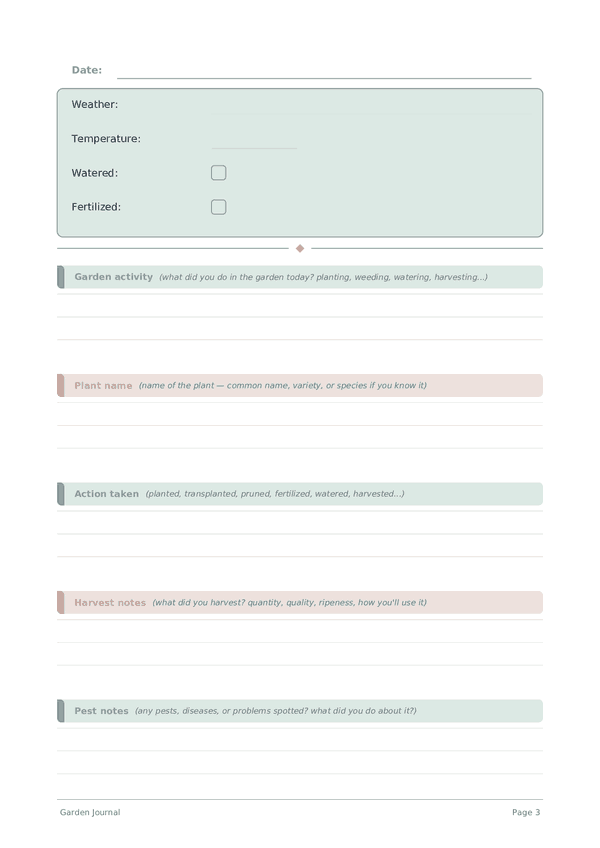
Weather
Sunny, cloudy, rain, wind — current conditions
Temperature
Record your basal body temperature. Temperature shifts help track ovulation and overall cycle health.
Watered
Did you water your garden or specific plants today?
Fertilized
Did you apply fertilizer or soil amendments to your plants today?
Garden activity
What did you do in the garden today? Planting, weeding, watering, harvesting...
Plant name
Name of the plant — common name, variety, or species if you know it
Action taken
Planted, transplanted, pruned, fertilized, watered, harvested...
Harvest notes
What did you harvest? Quantity, quality, ripeness, how you'll use it
Pest notes
Any pests, diseases, or problems spotted? What did you do about it?
Observations
General garden observations — growth progress, weather effects, soil condition, wildlife
Tips for success
When and how often to write
During the growing season, write a brief entry every day or every other day \u2014 even just noting weather, watering, and any visible changes. Weekly, do a deeper walkthrough and record plant health, new growth, and pest activity. At season\u2019s end, review the full log and write a summary of what worked, what failed, and what to change. In the off-season, revisit your journal monthly when planning next year\u2019s garden.
Frequently Asked Questions
What should I write in a garden journal each day?
The Royal Horticultural Society recommends logging weather, temperature, watering, fertilizing, and any action taken on specific plants — exactly the tracker and lined-prompt structure here. Add pest sightings and harvest notes when relevant. Daily entries don't need length; one or two lines plus the checkboxes for watered and fertilized are enough to build a usable seasonal record.
Why track weather and temperature alongside garden tasks?
Plant performance is weather-driven. USDA Cooperative Extension materials emphasize correlating temperature, rainfall, and frost dates with plant outcomes to refine local practice. The tracker section places weather and temperature beside watered and fertilized checkboxes precisely so you can spot, for example, that overwatering coincided with cool cloudy weeks — a pattern invisible without daily logging.
How do USDA plant hardiness zones fit in here?
USDA Plant Hardiness Zones define average winter minimums by region and guide perennial selection. The journal doesn't print a zone but expects you to know yours — write it inside the cover. Then log first frost, last frost, and unusual temperature swings in your daily tracker. Over years your records refine the official zone with a microclimate-accurate version for your exact garden.
What goes in the pest notes prompt?
Species (or best guess), affected plants, severity, weather context, and any intervention. RHS pest guidance recommends recording first sighting dates each season — aphids on the same week each May reveal predictable pressure. Avoid jumping to broad sprays; log first, identify, then act. Doug Tallamy's 'Bringing Nature Home' (Timber Press, 2007) reminds gardeners many caterpillars are ecosystem assets, not pests.
How is this different from a gardening app?
Apps push generic reminders based on your location. This journal records what actually happened in your soil, your microclimate, your hands. The harvest notes and observations prompts capture qualitative information — taste, vigor, disease pressure — that no app collects. Many experienced gardeners use both: an app for plant ID and frost alerts, paper for the season-spanning narrative.
How long until the journal pays off?
One full growing season produces useful comparisons; three seasons start revealing reliable patterns. RHS and American Horticultural Society educational materials both stress that gardening is a multi-year discipline — what fails one year may thrive the next due to weather. Reviewing past entries before each spring planting is when the journal's value compounds most visibly.
Should beginners track every plant or just the garden overall?
Start with overall daily tracker plus three or four priority plants you actually care about — tomatoes, roses, whatever motivates you. The lined section's plant name field accommodates focused entries without forcing every species. Royal Horticultural Society beginner guidance warns against over-tracking that leads to abandonment. Coverage breadth grows naturally as the habit holds.
How does logging harvests change next season's planning?
Yields show ROI. If your zucchini produced 14 fruits and your peppers two, next spring's bed allocation shifts accordingly. American Horticultural Society publications recommend tracking quantity and quality (taste, storage life) together. Over three seasons the harvest notes column becomes the single most consulted page when designing the next year's beds and seed orders.
You Might Also Like
Scroll to zoom, drag to move