Printable Nature Journal
Observe, wonder, and connect with the natural world
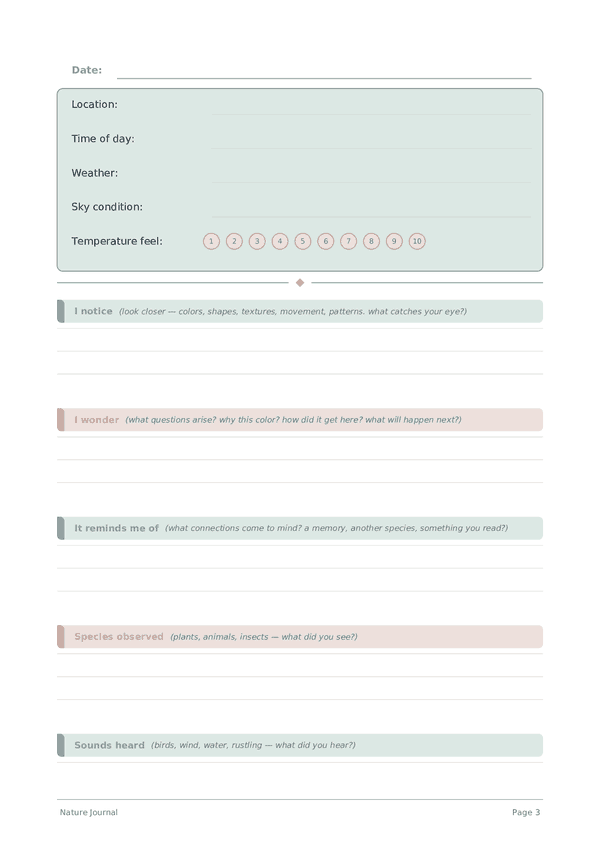
A structured nature journal inspired by the John Muir Laws method of "I Notice, I Wonder, It Reminds Me Of." Each page combines quick environmental data — location, weather, sky conditions, and temperature — with guided observation prompts that train you to see nature more deeply. Record species, sounds, and sketches alongside your reflections to build a personal field record over time.
Customize fields
Toggle fields on or off. Click the pencil to rename, or add your own fields.
Benefits
How to Use
What is this journal?
A nature journal is a daily observation practice that trains you to see the natural world with fresh, attentive eyes. By recording what you notice, what you wonder about, and what species you observe, you develop the naturalist's art of careful attention that transforms any outdoor moment into a discovery.
This journal is for nature lovers, aspiring naturalists, environmental educators, and anyone who wants to slow down and actually see the world around them. You do not need to be an expert — the practice of noticing and wondering is itself the skill being developed.
Environmental education research shows that regular nature journaling increases ecological awareness, scientific thinking skills, and reported connection to the natural world. The practice of writing "I notice" and "I wonder" — championed by naturalist John Muir Laws — bypasses the need for expert knowledge and activates genuine curiosity, making every outdoor experience richer and more meaningful.
Filled example
Here's what a typical entry looks like when filled in:
How to fill in each field
The top of each page has quick-fill fields (ratings, checkboxes, numbers). Below that is a lined section for writing. Here's what each field means:
Location
Where was the photo taken?
Time of day
Morning, afternoon, evening, night
Weather
Sunny, cloudy, rain, wind — current conditions
Sky condition
What does the sky look like right now? Describe clouds, clarity, or weather
Temperature feel
How does the temperature feel on your skin? Describe it in your own words
I notice
Look closer — colors, shapes, textures, movement, patterns. What catches your eye?
I wonder
What questions arise? Why this color? How did it get here? What will happen next?
It reminds me of
What connections come to mind? A memory, another species, something you read?
Species observed
Plants, animals, insects — what did you see?
Sounds heard
Birds, wind, water, rustling — what did you hear?
Sketch & notes
Quick sketch of your observation — no drawing skills needed, just shapes and labels
Tips for success
When and how often to write
Bring your journal every time you step outdoors with intention \u2014 whether it is a park walk, a forest hike, or sitting in your backyard. Write for 15\u201320 minutes while observing. Aim for at least twice a week to build a continuous seasonal record. Review entries monthly to notice phenological patterns like when certain birds appear, when wildflowers bloom, and when insects emerge. Over a year, your journal becomes a personal field guide for your area.
Frequently Asked Questions
What is the 'I Notice, I Wonder, It Reminds Me Of' method?
It is a structured observation framework popularized by naturalist John Muir Laws for slowing perception in the field. 'I Notice' trains specific sensory recording. 'I Wonder' generates open questions without demanding answers. 'It Reminds Me Of' forges associative memory. The three prompts move you from passive looking to active inquiry, which is why this journal places them at the heart of every page.
How does this support Attention Restoration Theory?
Kaplan (1995, Journal of Environmental Psychology, 15(3), 169-182) proposed that natural settings restore directed attention through soft fascination. The structured prompts here channel that fascination into recordable observation rather than mind-wandering. Filling the eight lines under 'I Notice' enacts the very mode Kaplan describes, effortless engagement with environmental detail, turning a walk into a measurable restorative session.
Do I need drawing skill to use the sketch section?
No. The sketch section exists for memory anchoring, not art. Roger Tory Peterson and modern field-guide authors emphasize that quick labeled diagrams, even stick figures with arrows, outperform polished drawings for ID recall. Note proportions, colors, and a single distinguishing feature. Cornell Lab of Ornithology's field-sketch guidance treats marks as data, not aesthetics. Three minutes per sketch is plenty.
How is this different from a regular nature journal book?
Most blank nature notebooks leave you staring at a page. This template imposes the Laws-method prompts plus a five-item environmental tracker (location, time, weather, sky, temperature feel), so every entry is comparable across visits. The structure shortens activation time, useful on cold or windy outings, while still preserving open lined space for personal observation.
Why log species observed and sounds heard separately?
Visual and acoustic detection sample different parts of an ecosystem. Cornell Lab of Ornithology's eBird and Merlin Sound ID treat them as complementary data streams; many species are heard far more often than seen. Splitting the fields trains you to listen actively, not just look. Over months, sound logs reveal seasonal singers and dawn-chorus shifts a sight-only journal would miss.
Can nature journaling reduce stress?
Evidence supports it. Hunter, Gillespie and Chen (2019, Frontiers in Psychology, 10) showed cortisol drops with 20-minute nature contact. Ulrich et al. (1991, Journal of Environmental Psychology, 11(3), 201-230) documented faster stress recovery in natural settings. Structured journaling adds mindful attention, which Kaplan associated with restoration. The combination is supportive practice, not clinical treatment; consult a clinician for diagnosed anxiety.
How often should I journal to see benefits?
White et al. (2019, Scientific Reports, 9, article 7730) identified 120 minutes per week in nature as the well-being threshold. Three to four entries weekly, 20-40 minutes each, hits that target. iNaturalist contributor data also shows observation skill compounds with frequency; your tenth entry catches details your second missed. Consistency outperforms long but rare sessions.
Is this journal usable in any season or biome?
Yes. The prompts are biome-agnostic: an urban park bench, alpine meadow, or city windowsill all produce valid 'I Notice / I Wonder' entries. Doug Tallamy's 'Bringing Nature Home' (Timber Press, 2007) argues sustained local observation matters more than dramatic locations. Winter and rainy seasons often produce sharper journals because fewer stimuli force closer looking at what remains.
You Might Also Like
Scroll to zoom, drag to move