Printable Business Journal
Daily business planning and progress journal
Keep your business on track with daily goal-setting, metric tracking, and strategic reflection. Capture decisions, ideas, and lessons to accelerate growth.
Customize fields
Toggle fields on or off. Click the pencil to rename, or add your own fields.
What is this journal?
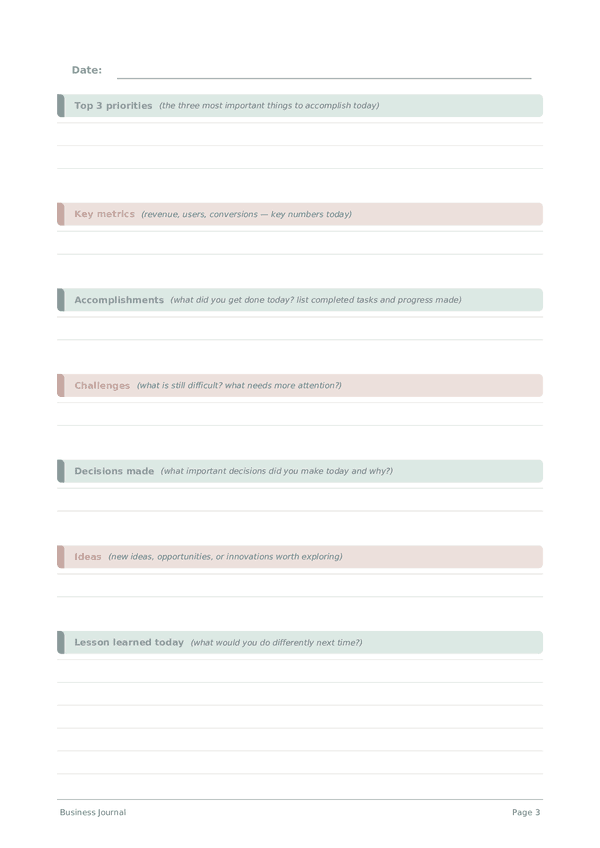
A Business Journal is a daily reflection framework for business owners and managers who want to run their operations with intention rather than reaction. Each entry captures your top priorities, key metrics, accomplishments, challenges, decisions made, new ideas, and lessons learned. It transforms scattered thoughts into a structured record that drives better decision-making day after day.
In the chaos of running a business, it is easy to lose sight of what actually moves the needle. A daily business journal forces you to pause, assess, and plan deliberately. Over time, the accumulated entries reveal patterns — which strategies consistently produce results, which challenges recur, and which decisions paid off or backfired.
Fill in your priorities and metrics each morning before diving into work. At the end of the day, spend ten minutes recording what you accomplished, the decisions you made, and the most important lesson you are taking forward. This evening review is where the real value lives: it turns experience into insight.
Filled example
Here's what a typical entry looks like when filled in:
How to fill in each field
Each day you'll find several labeled sections with lines for writing. Here's what each section is for:
Top 3 priorities
The three most important things to accomplish today
Key metrics
Revenue, users, conversions — key numbers today
Accomplishments
What did you get done today? List completed tasks and progress made
Challenges
What is still difficult? What needs more attention?
Decisions made
What important decisions did you make today and why?
Ideas
Capture your ideas before they disappear. No idea is too small or silly. Some of the best breakthroughs start as rough, half-formed thoughts.
Lesson learned today
Capture one insight from today's experience. Over time, these lessons become a personal wisdom library.
Tips for success
When and how often to write
Write every business day for 15 minutes, ideally at the end of the day when you can reflect on what actually happened. Cover your key metric, decisions made, customer insights, and one priority for tomorrow. Skip weekends unless a significant event occurs. Weekly, dedicate 30 minutes to reviewing the week: what moved the needle, what was wasted effort, and what patterns are emerging. Monthly, reread the full month and extract the three biggest lessons to carry forward.
Frequently Asked Questions
How should I choose what to write in the top 3 priorities section?
Three lines force ruthless selection — only items that move revenue, risk, or strategy. Stephen Covey, 'The 7 Habits of Highly Effective People' (Free Press, 1989) distinguishes important from merely urgent; top 3 priorities is for important. Harvard Business Review (Di Stefano et al., 2014, 'Learning by Thinking', HBR Working Paper 14-093) shows daily explicit priority-setting improves performance versus reactive task work.
What numbers belong in the key metrics section?
The two or three numbers that actually predict your business health — revenue, cash position, key conversion rate, or pipeline. The U.S. Small Business Administration (sba.gov, 'Manage Your Finances') recommends owners track a small set of leading indicators daily rather than chasing dashboards. Two lines forces selection; the same metrics repeated daily reveal trends invisible in monthly reports.
Why journal decisions made separately from accomplishments?
Decisions and outputs are different units of work. Daniel Kahneman, 'Thinking, Fast and Slow' (Farrar, Straus & Giroux, 2011) shows decision quality is best judged against the information available at the time, not the eventual outcome. Recording decisions made in writing the day they happen creates the only honest dataset for later judging whether your decision process — not just luck — is improving.
How is this different from a CEO or productivity app?
Software optimizes capture; paper optimizes reflection. Thaler & Sunstein, 'Nudge' (Yale University Press, 2008) describe written friction as a behavioral feature. The seven sections — priorities, metrics, accomplishments, challenges, decisions, ideas, lesson learned today — force the same review questions daily, while apps tempt you to scroll instead of think. Many founders use both.
What should I capture in the lesson learned today section?
One sentence that names a specific cause-and-effect insight from today, not a platitude. Harvard Business Review (Di Stefano et al., 2014, 'Learning by Thinking', HBR Working Paper 14-093) demonstrates that articulating learning, not just experiencing it, drives performance gains. Two lines is enough; if you cannot name a lesson, write 'none today' rather than fabricating — honest blanks reveal review-worthy patterns.
How do I use the ideas section without it becoming a dumping ground?
Capture, then triage weekly. The U.S. Small Business Administration (sba.gov, 'Plan Your Business') recommends idea capture paired with regular review against current strategy. Two lines per day yields about 10 ideas weekly; on Friday, mark each as Pursue, Park, or Drop. Without weekly triage the section degrades into noise — the journal works as a funnel, not a vault.
Does daily business journaling actually correlate with better performance?
Structured reflection is empirically tied to performance gains. Harvard Business Review (Di Stefano et al., 2014, 'Learning by Thinking', HBR Working Paper 14-093) found 15 minutes of end-of-day reflection improved performance by over 20% versus continuing to work. The seven sections turn that reflection into a habit so it happens reliably rather than depending on mood or memory.
What is the right time of day to fill in the business journal?
End of workday for review sections, morning for top 3 priorities if you prefer. Harvard Business Review (Di Stefano et al., 2014, 'Learning by Thinking', HBR Working Paper 14-093) supports end-of-day reflection specifically. Closing the day with accomplishments, challenges, decisions made, ideas, and lesson learned today consolidates learning while detail is fresh; setting top 3 priorities can wait for that evening or first thing the next morning.
You Might Also Like
Scroll to zoom, drag to move