Printable Investment Journal
Track trades, analyze decisions, and grow your portfolio
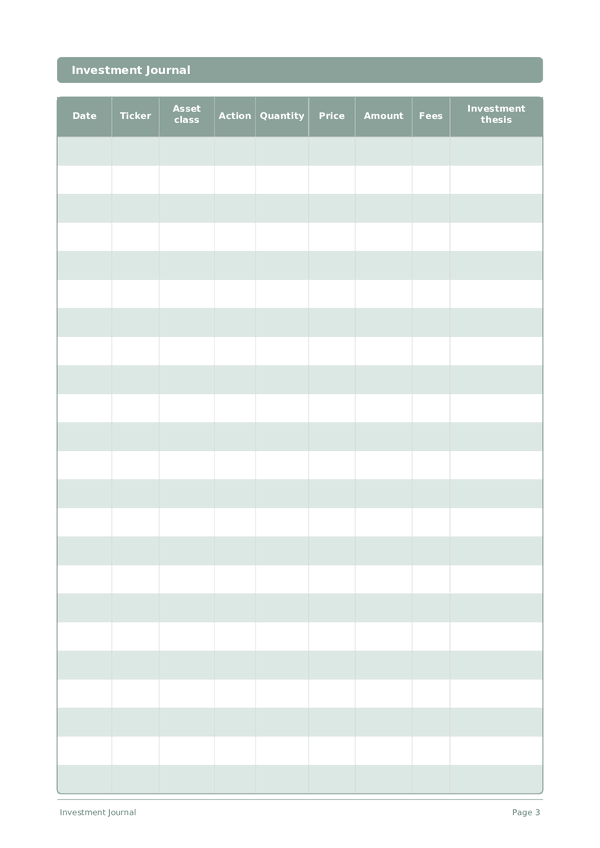
A structured investment journal for recording every trade — ticker, asset class, price, quantity, and your reasoning behind each decision. Reviewing past entries reveals patterns in your strategy, helps you avoid repeating mistakes, and builds the discipline that separates consistent investors from impulsive ones.
Customize fields
Toggle fields on or off. Click the pencil to rename, or add your own fields.
Benefits
How to Use
What is this journal?
An investment journal is a disciplined record-keeping tool for anyone who actively manages their investment portfolio. By logging every transaction — the ticker, asset class, action taken, quantity, price, total amount, fees, and your investment thesis — you create an invaluable archive of your decision-making process. This journal serves both as a practical ledger and as a learning tool that helps you become a better investor over time.
The most common mistake investors make is acting on emotion rather than analysis. A journal combats this by requiring you to articulate your investment thesis before or immediately after each trade. When you must write down why you are buying or selling, you naturally become more thoughtful and deliberate. Reviewing past entries reveals whether your reasoning was sound, which strategies generated returns, and where emotional decisions led to losses.
Whether you invest in individual stocks, ETFs, bonds, cryptocurrency, or real estate, this journal adapts to any asset class. It is especially valuable during volatile markets, where the temptation to panic-sell or chase gains is strongest. Having a written record of your original thesis provides the anchor of rationality that keeps you on your long-term plan.
Filled example
Here's what a typical entry looks like when filled in:
| Date | Ticker | Asset class | Action | Quantity | Price | Amount | Fees | Investment thesis |
|---|---|---|---|---|---|---|---|---|
| 2026-03-01 | VTI | ETF (US Total Market) | Buy | 15 | 268.5 | 4027.5 | 0 | Monthly DCA into broad market index. Long-term core holding. |
| 2026-03-01 | AAPL | Stock (Tech) | Buy | 10 | 192.3 | 1923 | 0 | Strong Services revenue growth, AI integration, attractive P/E after pullback. |
| 2026-03-02 | BND | ETF (Bonds) | Buy | 20 | 72.8 | 1456 | 0 | Rebalancing to 20% bonds allocation. Rate cuts expected in H2 2026. |
| 2026-03-03 | TSLA | Stock (Tech) | Sell | 5 | 245 | 1225 | 0 | Taking partial profits after 35% run-up. Valuation looks stretched. |
| 2026-03-03 | BTC | Crypto | Buy | 0.05 | 82000 | 4100 | 12.3 | Small allocation (2% of portfolio). Halving cycle thesis, long-term hold. |
How to fill in each field
Each page is a table with columns. Fill in one row per entry. Here's what each column is for:
Date
Write today's date. This anchors your entry in time and helps when reviewing entries later.
Ticker
Asset class
Action
Quantity
Price
How much did you pay? Bottle price in your local currency
Amount
Record the amount for this entry. Be precise — rounding creates inaccuracies that add up over time.
Fees
Investment thesis
Tips for success
When and how often to write
Make an entry every time you execute a trade — capture the reasoning, position size, and conviction level in the moment, not after the outcome. For open positions, do a weekly check-in: has the thesis changed? Are you still within your risk parameters? Monthly, review all closed positions and calculate your win rate, average gain vs. average loss, and return by asset class. Quarterly, read back through your thesis entries and grade yourself on discipline.
Frequently Asked Questions
Why should I record an investment thesis with every trade?
Writing your reasoning at purchase reduces hindsight bias and supports later review. The SEC (2023, investor.gov, 'Investing Quick Tips') urges investors to document decisions and avoid emotional trading. Kahneman, 'Thinking, Fast and Slow' (Farrar, Straus & Giroux, 2011) shows decisions captured in writing resist later self-justification. This template's investment thesis column makes that habit operational on every row.
How do I use the asset class column to monitor diversification?
Tag each trade by class — stocks, ETFs, bonds, crypto — then sum amount by class monthly to see allocation drift. The SEC (2023, investor.gov, 'Beginners' Guide to Asset Allocation') frames diversification as the central risk-management discipline. Combining the asset class and amount columns turns a transaction log into an allocation report without external software.
How is this paper journal different from a broker statement?
Broker statements show what you did; this journal records why. The nine columns — including investment thesis, fees, and asset class — preserve intent alongside execution. The SEC (2023, investor.gov, 'Investor Bulletin: Keep Records') recommends maintaining personal records independent of broker reports for tax substantiation and decision review, especially across multiple accounts or platforms.
Why do I need to log fees on every entry?
Fees compound and erode returns more than most investors estimate. The SEC (2014, 'Investor Bulletin: How Fees and Expenses Affect Your Investment Portfolio') shows a 1% annual fee can reduce a portfolio's value by tens of thousands over decades. The fees column on this template forces awareness on every trade rather than once a year on a statement.
Does keeping an investment journal actually improve outcomes?
Documentation supports the deliberate practice loop — record, review, refine. The CFPB (2022, 'Tools for Tracking Your Money') endorses written records for any household financial activity. While no journal guarantees returns, writing the investment thesis and reviewing entries monthly counters the documented overconfidence and loss-aversion biases described in Kahneman, 'Thinking, Fast and Slow' (Farrar, Straus & Giroux, 2011).
Is this journal suitable for ETF and index-fund investors?
Yes. The asset class column accommodates ETFs, index funds, bonds, or individual stocks identically. Even buy-and-hold investors benefit from logging contributions and rationale — the SEC (2023, investor.gov, 'Mutual Funds and ETFs') recommends periodic review of allocation. For low-frequency investors, the 12-row page covers roughly a year of monthly contributions, making review straightforward at tax time.
What common mistakes does this journal help me avoid?
Two big ones — chasing performance and forgetting why you bought. The SEC (2023, investor.gov, 'Investor Alerts') warns that switching strategies based on recent returns destroys long-term performance. Filling the investment thesis field forces a sentence of justification; reviewing it monthly exposes pattern errors like overconcentration, panic selling, or repeatedly buying narratives instead of fundamentals.
How often should I review my journal entries?
Monthly review is the right cadence for most investors — frequent enough to spot drift, infrequent enough to avoid overtrading. The SEC (2023, investor.gov, 'Rebalancing Your Portfolio') suggests checking allocation at set intervals rather than reacting to market moves. With 12 rows per page, one page roughly equals one review cycle; scan investment thesis entries and asset class totals together.
You Might Also Like
Scroll to zoom, drag to move