Printable Career Journal
Track achievements and accelerate professional growth every day
A structured daily journal for professionals who want to grow intentionally. Capture each day's wins, lessons, feedback, and challenges — then set a clear goal for tomorrow. Over time, your entries become a powerful record of growth that fuels performance reviews, career conversations, and personal motivation.
Customize fields
Toggle fields on or off. Click the pencil to rename, or add your own fields.
Benefits
How to Use
What is this journal?
A Career Journal is a daily reflection tool that helps you take ownership of your professional growth. Each entry prompts you to record your accomplishments, skills you developed, what you learned, feedback you received, challenges you faced, and your goals for tomorrow. Over time, it becomes a personal record of progress that is invaluable during performance reviews, job interviews, or moments of self-doubt.
Most professionals underestimate how much they achieve in a given week simply because they never write it down. A career journal solves this by creating a running log of wins, lessons, and growth areas. It also helps you identify recurring patterns — perhaps you thrive in collaborative projects, or you consistently struggle with a particular type of task.
Spend five to ten minutes at the end of each workday filling in your entry. Be specific: instead of writing "did well today," note exactly what you accomplished and why it mattered. The more concrete your entries, the more useful they become when you need to advocate for yourself or chart your next career move.
Filled example
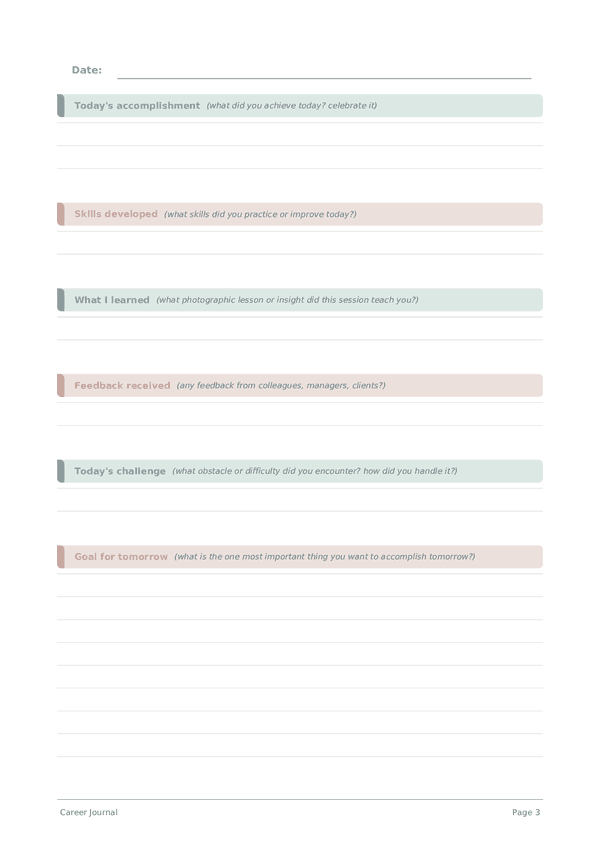
Here's what a typical entry looks like when filled in:
How to fill in each field
Each day you'll find several labeled sections with lines for writing. Here's what each section is for:
Today's accomplishment
Write something you achieved today, no matter how small. Acknowledging daily wins builds confidence and momentum.
Skills developed
What skills did you practice or improve today?
What I learned
Write one new thing you learned today. It can be a fact, a skill, an insight about yourself, or a life lesson. Daily learning compounds into wisdom.
Feedback received
Any feedback from colleagues, managers, clients?
Today's challenge
Describe a difficulty you faced today. Writing about challenges helps you process them and find solutions you might not see otherwise.
Goal for tomorrow
Set one intention for tomorrow. Writing it down tonight primes your brain to act on it. Keep it specific and achievable.
Tips for success
When and how often to write
Write for 10 minutes at the end of each workday, while events are fresh. Cover wins, feedback, challenges, and one goal for tomorrow. Skipping weekends is fine, but aim for every working day. Friday entries should include a brief week-in-review. Monthly, read back through the month and highlight patterns: recurring challenges, growing skills, and themes to discuss with your manager. Quarterly, summarize your progress for your own records — this saves hours when review season arrives.
Frequently Asked Questions
How does the accomplishment section help with performance reviews?
Daily wins captured in writing become concrete examples managers respect. Cal Newport, 'So Good They Can't Ignore You' (Business Plus, 2012) frames career capital as accumulated, demonstrable achievements. Writing three lines of accomplishment per day produces roughly 90 specific examples a quarter — more than any reviewer can recall from memory. Bring the journal or its summary to your review conversation.
Why does the journal include both feedback received and what I learned?
External and internal learning serve different functions. The U.S. Bureau of Labor Statistics (2023, Occupational Outlook Handbook) emphasizes both technical learning and interpersonal feedback for career mobility. Capturing feedback received preserves manager and peer signals you would otherwise forget; what I learned captures self-generated insight. Reviewed together, they show whether your perception aligns with how others see your work.
What should I write in the skills developed section daily?
One concrete skill you actively practiced, not a list of things you used. Cal Newport, 'So Good They Can't Ignore You' (Business Plus, 2012) describes deliberate practice as the engine of expertise — write the specific edge you pushed today. Two lines forces brevity. Over a month, the pattern of skills developed entries shows where you are actually growing versus marking time.
How is this different from an annual self-review or LinkedIn updates?
Annual reviews compress a year into one biased reconstruction. Daniel Kahneman, 'Thinking, Fast and Slow' (Farrar, Straus & Giroux, 2011) documents how memory of work emphasizes peaks and recent events. Daily entries in accomplishment, challenge, and feedback received preserve granular truth. The journal becomes the source from which any retrospective — LinkedIn, resume, review — can be built honestly.
Does daily journaling really accelerate professional growth?
Structured reflection is a documented learning mechanism. The Harvard Business Review (Di Stefano et al., 2014, 'Learning by Thinking: How Reflection Aids Performance', HBR Working Paper 14-093) demonstrates measurable performance gains from end-of-day reflection. Cal Newport, 'So Good They Can't Ignore You' (Business Plus, 2012) makes the same case. The six sections turn reflection into a daily habit.
What should the goal for tomorrow section contain?
One specific, achievable priority — not a to-do list. Stephen Covey, 'The 7 Habits of Highly Effective People' (Free Press, 1989) distinguishes important from merely urgent work; goal for tomorrow should name the single most important thing. Writing it the night before primes intentional action and reduces morning ambiguity. Two lines is enough for the action and its purpose.
How do I use the challenge section without it becoming complaint?
Frame each entry as situation plus response, not problem alone. Stephen Covey, 'The 7 Habits of Highly Effective People' (Free Press, 1989) calls this proactive language. The HBR (Di Stefano et al., 2014, 'Learning by Thinking', HBR Working Paper 14-093) shows reflection on difficulty drives skill development when paired with response analysis. Two lines: what happened, what you did or will try.
When during the day should I fill in the journal?
End of the workday is the documented sweet spot for reflection. The HBR (Di Stefano et al., 2014, 'Learning by Thinking', HBR Working Paper 14-093) showed end-of-day reflective practice improved performance versus continued task work. Filling in accomplishment, challenge, and goal for tomorrow before leaving the desk also closes the day mentally and reduces work spillover into personal time.
You Might Also Like
Scroll to zoom, drag to move