Printable Calorie Journal
Track calories and macros every meal
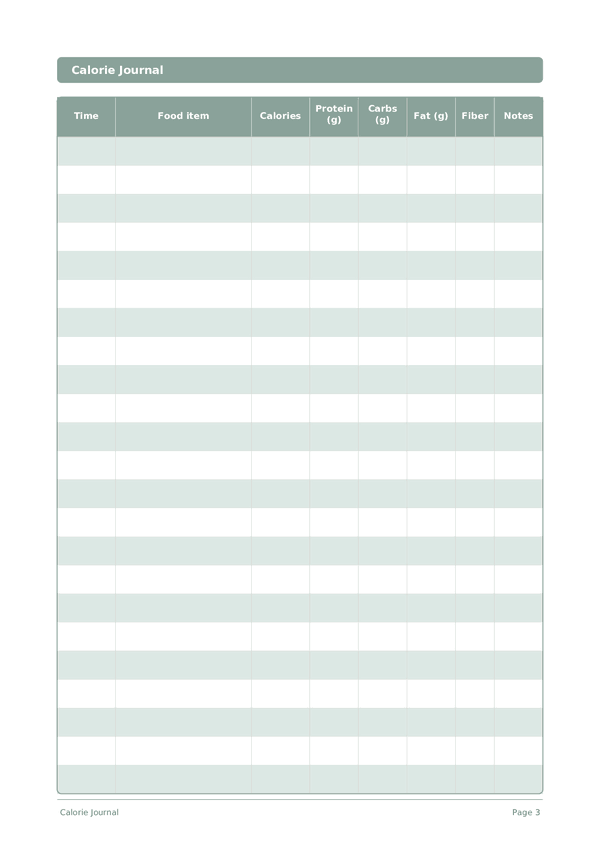
A structured table log for recording every meal with full macro breakdown — calories, protein, carbs, fat, and fiber. Build awareness of your eating patterns and reach your nutrition goals with data-driven consistency.
Customize fields
Toggle fields on or off. Click the pencil to rename, or add your own fields.
Benefits
How to Use
What is this journal?
A calorie journal is a detailed nutritional log where you track not just the calories in every food item you consume, but also the macronutrient breakdown — protein, carbohydrates, fat, and fiber. This level of detail transforms vague dietary intentions into precise, actionable data that supports specific fitness, health, or body composition goals.
This journal is ideal for people who are serious about understanding their nutrition on a granular level: athletes optimizing performance, individuals following structured meal plans, anyone tracking macros for weight loss or muscle gain, or people managing conditions like diabetes where carbohydrate awareness is essential. It is also an excellent learning tool for anyone who wants to develop an intuitive sense of what is in the food they eat.
By logging each food item with its full nutritional profile, you gain clarity about where your calories actually come from. Many people are surprised to discover how quickly fats add up or how little protein they consume relative to their goals. Over time, this journal helps you make informed adjustments — not through restriction, but through awareness — so that your diet genuinely supports the way you want to feel and perform.
Filled example
Here's what a typical entry looks like when filled in:
| Time | Food item | Calories | Protein (g) | Carbs (g) | Fat (g) | Fiber | Notes |
|---|---|---|---|---|---|---|---|
| 7:00 | Scrambled eggs (3 large) | 210 | 18 | 2 | 15 | 0 | Cooked in olive oil spray |
| 7:00 | Whole wheat toast (2 slices) | 180 | 8 | 30 | 3 | 4 | |
| 7:00 | Avocado (half) | 120 | 1 | 6 | 11 | 5 | On toast |
| 10:30 | Protein shake (whey, banana, milk) | 320 | 30 | 35 | 6 | 2 | Post-workout |
| 13:00 | Brown rice (1 cup cooked) | 215 | 5 | 45 | 2 | 3 | |
| 13:00 | Grilled chicken breast (150g) | 230 | 35 | 0 | 9 | 0 | Seasoned with herbs |
| 13:00 | Mixed vegetables, steamed | 85 | 4 | 15 | 1 | 5 | Broccoli, carrots, green beans |
| 16:00 | Almonds (30g) | 175 | 6 | 6 | 15 | 3 | Afternoon snack |
| 19:00 | Pasta with turkey bolognese | 520 | 32 | 60 | 14 | 4 | Whole wheat pasta |
| 19:00 | Side salad with olive oil | 110 | 2 | 5 | 10 | 2 | |
| 21:00 | Greek yogurt with berries | 150 | 12 | 18 | 3 | 2 | Low-fat yogurt |
How to fill in each field
Each page is a table with columns. Fill in one row per entry. Here's what each column is for:
Time
Record what time you ate. Meal timing affects energy, sleep, and digestion. Patterns become visible after a couple of weeks.
Food item
Write what you ate. Be specific enough to be useful (e.g., 'grilled chicken salad' not just 'lunch'). This helps identify food sensitivities and patterns.
Calories
Log your approximate calorie intake. You don't need perfect numbers — estimates help you stay mindful about eating patterns.
Protein (g)
Log protein intake in grams. Adequate protein is crucial for recovery and muscle building, typically 1.6–2.2g per kg of body weight.
Carbs (g)
Fat (g)
Fiber
Notes
Add any additional context or thoughts. This catch-all column is for anything that doesn't fit elsewhere but might be useful later.
Tips for success
When and how often to write
Log each meal and snack immediately in the table format: food item, portion size, calories, and macros if tracking them. Total your calories at the end of each day. Weekly, calculate your daily average and compare it to your target — this weekly view is more meaningful than any single day. Monthly, assess whether your target needs adjustment based on how your body is responding. If counting starts feeling obsessive, take a 3-day break and rely on your built-up food awareness instead.
Frequently Asked Questions
Does counting calories actually help with weight management?
Yes — a Cochrane review and the USDA Dietary Guidelines for Americans (2020–2025) confirm that energy-intake awareness improves weight outcomes when paired with macro balance. American Journal of Clinical Nutrition studies show self-monitoring users lose roughly twice as much weight over six months. This template's five-macro layout (calories, protein, carbs, fat, fiber) supports the broader dietary quality emphasis recommended by ADA, not just calorie restriction.
How accurate do my calorie and macro estimates need to be?
Within ±10–15% is enough for trend tracking, per Academy of Nutrition and Dietetics guidance. American Journal of Clinical Nutrition (2017) studies show even imperfect logging produces meaningful behavior change. Use food labels, USDA FoodData Central, or a barcode app for lookup. Consistency across weeks matters more than per-meal precision — focus on weekly totals rather than chasing single-meal accuracy.
Why does the template separate fiber from carbohydrates?
USDA Dietary Guidelines (2020–2025) recommend 25–34 g daily fiber, yet most US adults consume ~16 g. ADA Standards of Care (2024, Diabetes Care, 47 Suppl 1) emphasize fiber's role in glycemic control and cardiovascular health. Tracking fiber apart from total carbs reveals diet-quality patterns that net-carb counting hides. Aim for fiber as a percentage of total carbs — higher is generally better for metabolic health.
How much protein should I aim for per meal?
USDA recommends 0.8 g/kg body weight daily for sedentary adults; British Journal of Sports Medicine (2018, 52(6)) and ISSN consensus suggest 1.4–2.0 g/kg for active individuals. Dividing across 3–4 meals at 20–40 g per meal optimizes muscle protein synthesis. Use the protein column to check distribution — clustering all protein at dinner is common but less effective than even spacing.
Is this template suitable for someone with disordered eating history?
Use with caution. APA and the Academy for Eating Disorders warn that detailed calorie tracking can worsen restrictive eating or orthorexia. If you have a history of anorexia, bulimia, or binge eating disorder, consult a registered dietitian or therapist before logging. The food-without-calorie variant (food-journal slug) is generally safer. Tracking is a tool, not a moral measure.
How is this different from MyFitnessPal or Cronometer?
Apps automate lookup but encourage continuous on-phone behavior; this printable table prompts brief, intentional logging at meals. NIH NCCIH (2022) notes that behavior-change tools work best when friction is just enough to prompt reflection. Paper logs also avoid the social and ad layers of nutrition apps. Use the app for lookup, then transfer key numbers to the journal for the actual record.
How do I use weekly totals from the journal?
Sum each column across all 7 days. Compare totals against USDA Dietary Guidelines (2020–2025) targets: calories matching estimated needs from CDC's adult BMR tables, protein at 0.8–2.0 g/kg, fiber 25–34 g/day, saturated fat under 10% of calories. Look for weekday vs. weekend patterns — these often reveal the highest-leverage adjustment for both weight and metabolic markers.
What's the most common logging mistake?
Under-recording snacks and beverages. CDC NHANES data and American Journal of Clinical Nutrition (2019) studies show people underestimate intake by 20–40%, mostly from forgotten snacks and liquid calories (soda, juice, alcohol, lattes). Use the time column for every eating occasion — including a single cookie or coffee with cream. Logging zero entries is worse than logging an estimate.
You Might Also Like
Scroll to zoom, drag to move