Printable Health Journal
Track your body, mind, and wellness every day
A comprehensive daily health check-in that combines quick metrics with space for detailed notes. Track your mood, energy, sleep, pain, stress, hydration, exercise, and medication at a glance, then use the writing sections to describe how you feel, log symptoms, and jot down questions for your doctor. Designed to help you spot patterns, build healthy habits, and have more productive medical appointments.
Customize fields
Toggle fields on or off. Click the pencil to rename, or add your own fields.
Benefits
How to Use
What is this journal?
A health journal is a comprehensive daily log where you record key indicators of your physical and mental well-being — from energy levels and sleep quality to symptoms, medications, and exercise. Rather than focusing on a single condition, it gives you a holistic snapshot of how your body and mind are doing each day.
This journal is ideal for anyone who wants to be more intentional about their health, whether you are managing a chronic condition, recovering from illness, preparing for medical appointments, or simply want to understand the connections between your daily habits and how you feel. It is particularly helpful for people who see multiple specialists and need a unified record.
By tracking these metrics consistently, you begin to see patterns that are otherwise invisible. You might discover that your energy dips on days when you drink less water, or that your mood improves during weeks when you exercise regularly. Over time, your health journal becomes a personal health database — empowering you to have more productive conversations with your doctor and to make lifestyle changes grounded in real data rather than guesswork.
Filled example
Here's what a typical entry looks like when filled in:
How to fill in each field
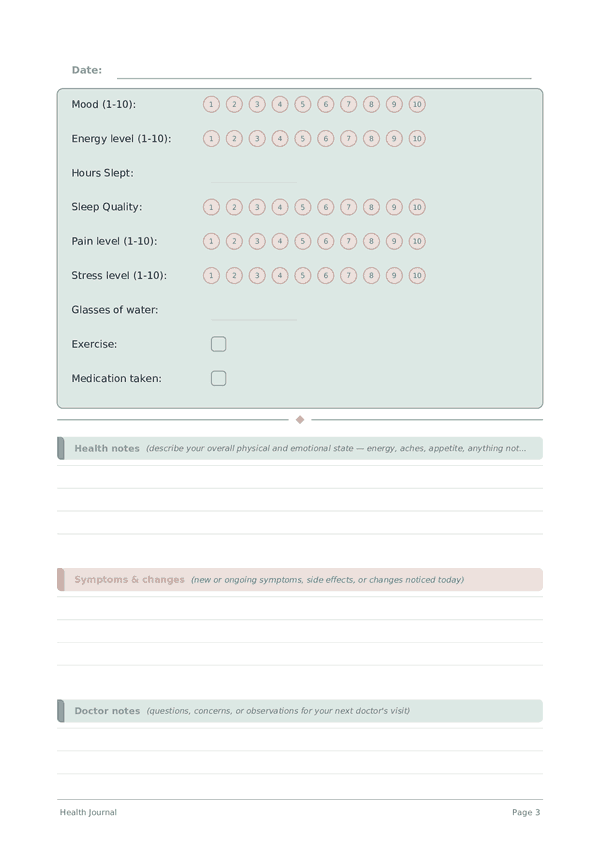
The top of each page has quick-fill fields (ratings, checkboxes, numbers). Below that is a lined section for writing. Here's what each field means:
Mood (1-10)
Rate your overall emotional state for the day. 1 means very low or depressed, 10 means exceptionally happy and positive. Don't overthink — go with your gut feeling.
Energy level (1-10)
Rate your physical and mental energy level. 1 means exhausted and drained, 10 means fully energized and alert. This helps you identify what activities boost or drain your energy.
Hours Slept
Write how many hours you actually slept (not just time in bed). Tracking this alongside mood and energy often reveals powerful connections.
Sleep Quality
Rate how restful your sleep was. 1 means terrible and restless, 5 means deep and refreshing. Quality matters as much as quantity.
Pain level (1-10)
Rate your pain intensity on a scale. Tracking pain levels helps identify triggers, evaluate treatments, and communicate with healthcare providers.
Stress level (1-10)
Rate your stress on a scale of 1–10. Over time, you'll identify your stress patterns and which coping strategies work best.
Glasses of water
Track your daily water intake. Most people need 6–8 glasses. Ticking off glasses throughout the day helps you stay hydrated.
Exercise
Check off whether you exercised today. Even a 10-minute walk counts. The goal is building awareness of your activity patterns.
Medication taken
Did you take your medication today? Note what, when, and any doses missed
Health notes
Describe your overall physical and emotional state — energy, aches, appetite, anything notable
Symptoms & changes
New or ongoing symptoms, side effects, or changes noticed today
Doctor notes
Questions, concerns, or observations for your next doctor's visit
Tips for success
When and how often to write
Fill in the health tracker every evening as part of your bedtime routine — it takes 2-3 minutes. The writing section is for days when something notable happens: a new symptom, a doctor visit, a change in how you feel. Weekly, scan your tracker for patterns — do certain days consistently score lower? Monthly, write a health summary paragraph capturing your overall trajectory. This journal is most powerful when shared with healthcare providers; bring your monthly summaries to checkups.
Frequently Asked Questions
What can a daily health journal reveal that occasional check-ins cannot?
According to NIH (2020, Self-Management of Chronic Diseases) and Mayo Clinic guidance, consistent daily logging surfaces patterns invisible in single snapshots — for example, sleep-pain correlations or stress-driven symptom flares. This template captures nine metrics (mood, energy, sleep, pain, stress, hydration, exercise, medication) plus free-text observations, giving clinicians a 4-week timeline far richer than memory-based history. Consult your physician before making treatment changes.
How should I use the 1–10 ratings for mood, pain, and stress?
The American Pain Society and IASP recommend 0–10 numeric rating scales because they detect clinically meaningful changes of ≥2 points. Rate each evening at the same time, anchor 0 as 'absent' and 10 as 'worst imaginable.' Avoid recalibrating mid-week — consistency matters more than precision. Patterns across 14–21 days carry more weight than any single score and help your clinician evaluate treatment response.
How is this different from a phone app like Apple Health?
Apps automate metrics but rarely capture narrative context. This printable hybrid combines quick tracker fields with a free-text 'How I feel today' section plus symptom and doctor-notes prompts. CDC (2023, Patient-Generated Health Data) notes that handwritten reflection improves recall and reduces app fatigue. Paper journals also avoid data-privacy concerns under HIPAA and are accepted by clinicians who cannot view third-party app exports.
Is daily symptom tracking suitable for someone without a diagnosed condition?
Yes. USPSTF (2022) encourages preventive self-monitoring of weight, sleep, and activity in healthy adults. The template's nine metrics cover modifiable lifestyle factors flagged by AHA's Life's Essential 8 (2022, Circulation, 146(5), e18-e43). Tracking before symptoms appear establishes a personal baseline, making future changes easier to detect. Share patterns with your primary care provider at annual visits.
How do I fill in the 'Notes for my doctor' section effectively?
AAFP (2021, Effective Patient-Clinician Communication) recommends writing three to five specific items: new or worsening symptoms with onset dates, medication side effects, and prioritized questions. Avoid vague entries like 'feeling off.' Use the symptoms-and-changes lines first, then distill into discrete questions. Bring the journal — or photographed pages — to your appointment so the clinician can review trends rather than rely on verbal recall.
How many weeks of data do clinicians actually find useful?
Per NICE clinical guidelines and AHA monitoring protocols, 2–4 weeks of daily entries is the typical minimum for trend analysis. Mayo Clinic recommends 6–8 weeks for chronic conditions like hypertension or chronic pain to detect medication response. Sleep- and mood-related patterns usually emerge within 14 days. Bring all completed pages — incomplete weeks are still informative.
Can tracking symptoms increase health anxiety instead of reducing it?
APA (2021, Clinical Practice Guideline for Anxiety Disorders) notes that structured monitoring generally reduces anxiety by externalizing worries, but rumination is a risk for individuals with health anxiety or OCD. Limit entries to one fixed time per day, use the doctor-notes section to contain concerns, and avoid online symptom searches. If checking becomes compulsive, consult a clinician about cognitive-behavioral approaches.
What's the most common mistake when starting a health journal?
Over-documenting then quitting within two weeks. NIH NCCIH (2022, Behavior Change Research) shows adherence drops sharply when entries take over five minutes. This template is designed for under three minutes: rate the nine tracker items, then write two or three sentences. Skip the lined section entirely on busy days — ratings alone still produce usable trend data for your doctor.
You Might Also Like
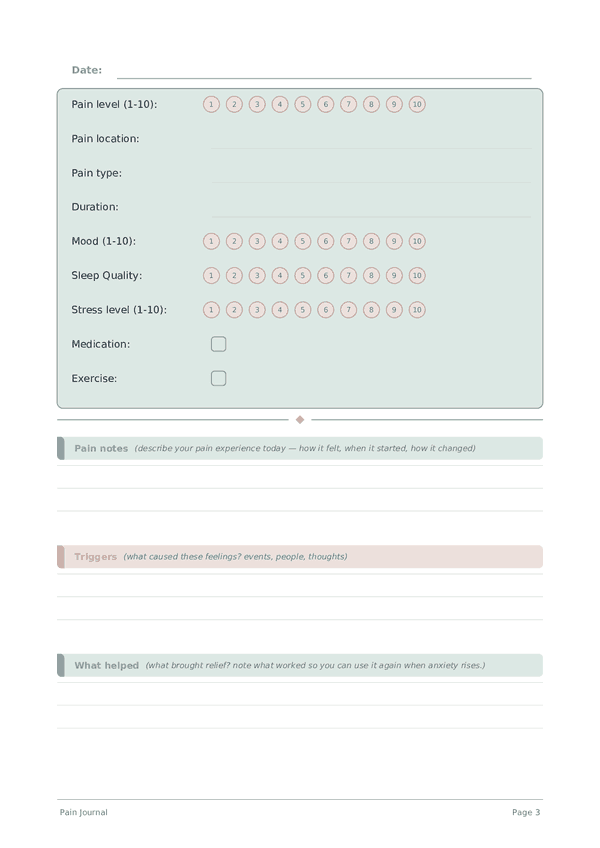
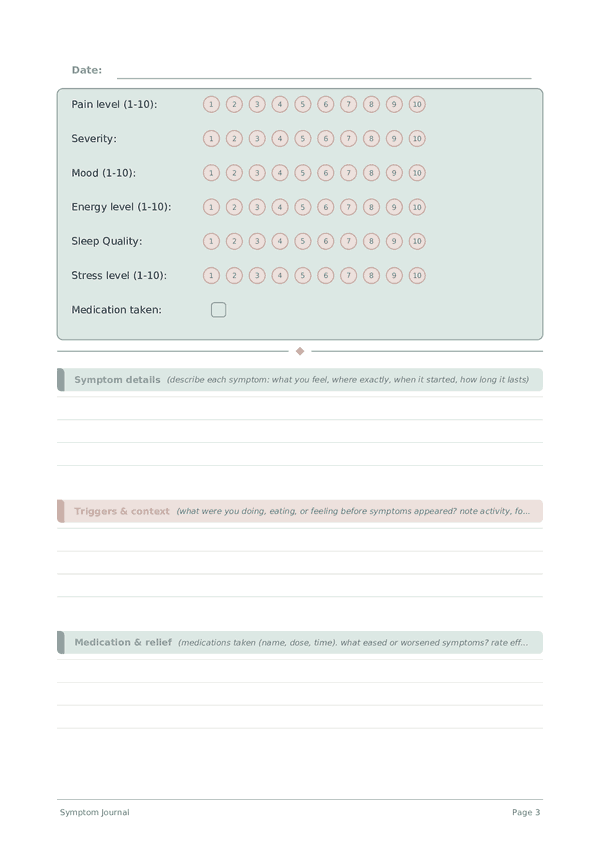
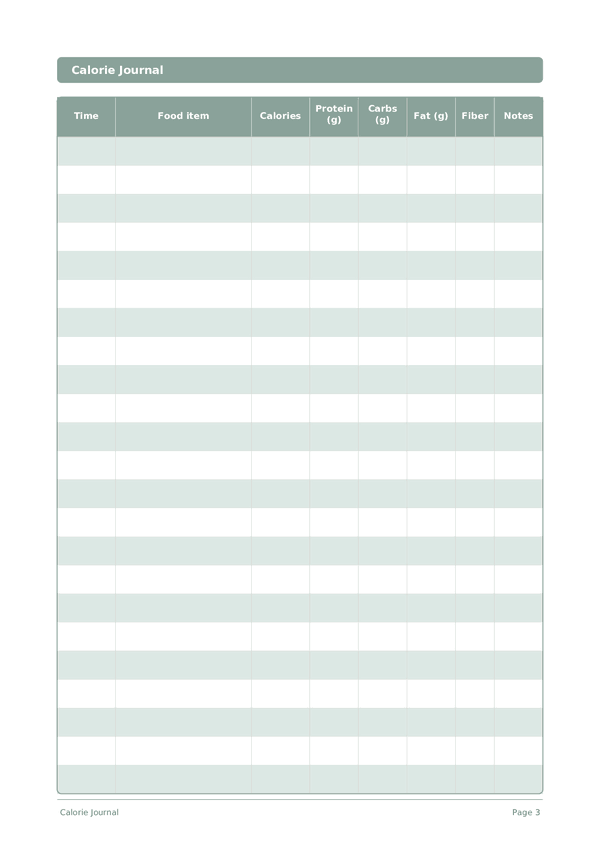
Scroll to zoom, drag to move