Printable Pain Journal
Track pain patterns, triggers, and relief strategies
A comprehensive daily pain tracker that combines structured metrics with reflective writing. Rate pain intensity, log location and type, track sleep, mood, and stress levels, and write about what triggers your pain and what brings relief. Build a detailed record to share with your healthcare provider for more effective treatment.
Customize fields
Toggle fields on or off. Click the pencil to rename, or add your own fields.
Benefits
How to Use
What is this journal?
A pain journal is a structured daily record where you track the details of your physical pain — its location, intensity, duration, and the factors that influence it. By writing down this information consistently, you create a detailed picture of your pain patterns that can be difficult to recall from memory alone, especially during medical appointments.
This journal is designed for anyone living with chronic pain, recovering from injury, or managing conditions like migraines, arthritis, fibromyalgia, or back pain. It is equally useful if you are experiencing new or unexplained pain and want to identify triggers or patterns before consulting a doctor.
Keeping a pain journal helps you take an active role in your own care. Over time, you will be able to see which activities, foods, sleep habits, or stress levels correlate with flare-ups, and which treatments or strategies provide genuine relief. This data becomes an invaluable tool for conversations with healthcare providers and for making informed decisions about your treatment plan.
Filled example
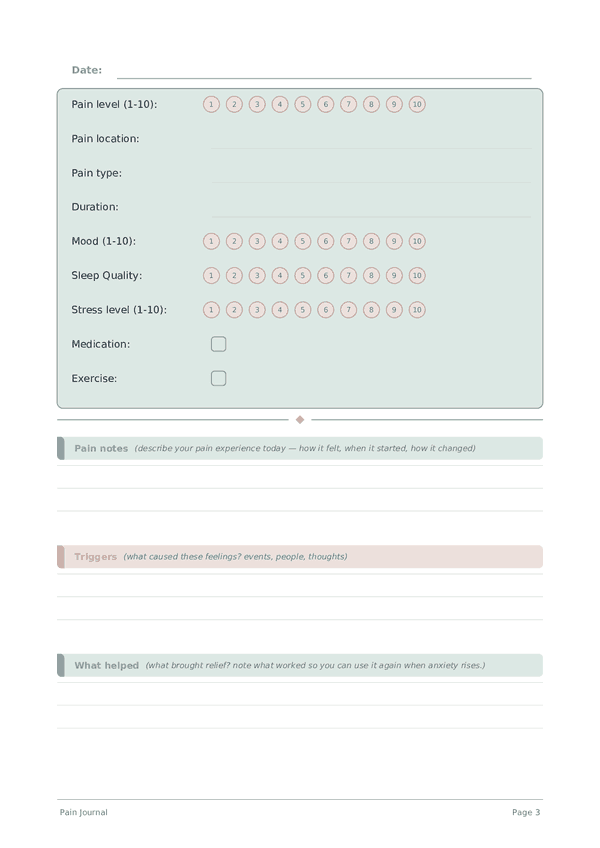
Here's what a typical entry looks like when filled in:
How to fill in each field
The top of each page has quick-fill fields (ratings, checkboxes, numbers). Below that is a lined section for writing. Here's what each field means:
Pain level (1-10)
Rate your pain intensity on a scale. Tracking pain levels helps identify triggers, evaluate treatments, and communicate with healthcare providers.
Pain location
Where does it hurt? Be specific — lower back, left knee, behind the eyes, etc.
Pain type
Describe the sensation — sharp, dull, throbbing, burning, aching, or something else
Duration
Record how long the episode or event lasted. Duration data helps identify patterns and evaluate treatment effectiveness.
Mood (1-10)
Rate your overall emotional state for the day. 1 means very low or depressed, 10 means exceptionally happy and positive. Don't overthink — go with your gut feeling.
Sleep Quality
Rate how restful your sleep was. 1 means terrible and restless, 5 means deep and refreshing. Quality matters as much as quantity.
Stress level (1-10)
Rate your stress on a scale of 1–10. Over time, you'll identify your stress patterns and which coping strategies work best.
Medication
Record medications taken, including name and dosage. Consistent tracking helps you and your doctor evaluate treatment effectiveness.
Exercise
Check off whether you exercised today. Even a 10-minute walk counts. The goal is building awareness of your activity patterns.
Pain notes
Describe your pain experience today — how it felt, when it started, how it changed
Triggers
Identify what caused your emotional reactions — events, people, thoughts, environments. Recognizing triggers gives you the power to prepare for or avoid them.
What helped
What brought relief? Note what worked so you can use it again when anxiety rises.
Daily impact
How did pain affect your activity, sleep, mood, or social life today?
Tips for success
When and how often to write
Fill in the tracker three times daily: morning (how did you wake up?), midday (how is activity affecting pain?), and evening (how did the day go overall?). Keep the tracker entries brief — just numbers and a few words. Use the writing section when pain is significant or when you notice a new pattern. Bring your weekly summary to medical appointments — doctors consistently report that patients with pain journals receive more targeted treatment. Review monthly to spot seasonal or cyclical patterns.
Frequently Asked Questions
What should a pain journal include for a doctor's appointment?
Per the CDC Clinical Practice Guideline for Prescribing Opioids for Pain (2022, MMWR Recommendations and Reports, 71(3)) and American Chronic Pain Association recommendations: 0-10 intensity rating, location, character (burning/stabbing/aching), episode duration, triggers, and medication effectiveness, plus sleep, mood, and activity. This template covers all 9 core fields. Bring 2-4 weeks of entries, enough to identify clinically meaningful patterns.
How do I correctly describe pain character — burning, aching, throbbing?
The standard classification is the McGill Pain Questionnaire (Melzack, 1975, Pain, 1(3), 277-299), still in clinical use. Sensory descriptors: throbbing, shooting, stabbing, sharp, burning, pulling, pressing. Burning often signals neuropathic pain; throbbing suggests vascular (migraine); aching points to musculoskeletal; stabbing to inflammatory. These descriptors help your clinician differentiate pain types and select appropriate therapy.
Is this journal suitable for migraine, fibromyalgia, and arthritis?
Yes. The American Migraine Foundation, American College of Rheumatology, and Arthritis Foundation officially recommend pain journaling. For migraine, capture aura and triggers (food, hormones, weather). For fibromyalgia, track the sleep-stress-pain triad (per ACR 2016 fibromyalgia diagnostic criteria). For arthritis, log morning stiffness and activity correlations. The template is flexible; adapt fields to your specific condition.
What is the 0-10 pain scale and how do I use it?
The Numeric Rating Scale (NRS-11) is the standard tool of the International Association for the Study of Pain (IASP). 0 = no pain, 10 = worst pain imaginable. Hjermstad et al. (2011, Journal of Pain and Symptom Management, 41(6), 1073-1093) validated it in a systematic review of 19 studies. Rate 'right now,' not a daily average; point-in-time ratings yield more reliable clinical data.
How often should I fill in a pain journal — once a day or more?
Three times daily: morning, midday, evening. Stone and Broderick (2007, Pain Medicine, 8(suppl 3), S85-S93) demonstrated that retrospective pain ratings diverge from real-time ratings by 20-30%. The shorter the gap between event and entry, the more reliable the data. During acute episodes or flares, record immediately; capture onset time, duration, and any interventions used.
What pain triggers are worth tracking?
Per the NIH National Institute of Neurological Disorders and Stroke and the American Migraine Foundation: weather (barometric pressure, humidity), food (tyramine-containing items for migraine), sleep quantity and quality, stress, physical activity, hormonal cycle, posture, screen time, caffeine, and alcohol. Log everything in the 24 hours preceding a pain episode. Patterns become visible after 2-4 weeks of systematic tracking.
Why is a paper pain journal better than an app?
Three reasons. Medical-data privacy: after the Flo Health FTC settlement (January 2021), it's documented that health apps can share data with third parties. Clinicians scan handwritten records easily during appointments, with no export needed. Paper works during migraine-related photophobia and requires no battery or connectivity. Apps and paper aren't mutually exclusive; many patients keep both.
Can a pain journal help identify the cause of unexplained pain?
The journal doesn't diagnose, but it reveals patterns clinicians use for diagnosis. The International Association for the Study of Pain (IASP) and the American Academy of Pain Medicine include pain journaling in clinical assessment protocols for chronic pain. Bring at least 2-4 weeks of entries; they provide daily, weekly, and trigger-based pattern data that cannot be reconstructed from memory.
You Might Also Like
Scroll to zoom, drag to move