Printable Camping Journal
Your outdoor adventure log — campsites, nature, and memories
Capture every camping trip in detail: where you stayed, who came with you, what the weather was like, and what made each day unforgettable. Build a personal archive of outdoor experiences that helps you plan better trips and relive your best moments in nature.
Customize fields
Toggle fields on or off. Click the pencil to rename, or add your own fields.
Benefits
How to Use
What is this journal?
A camping journal is a trip log for documenting each campsite, the conditions, and the experiences that make outdoor overnights memorable. By recording location details, weather, and your honest assessments, you build a personal camping guide that helps you remember the magic and avoid repeating mistakes.
This journal is for campers of all types — from car camping families to backcountry minimalists. It captures the practical details future-you will appreciate (campsite quality, weather impact, what to bring next time) alongside the stories and highlights that make camping trips worth remembering and retelling.
Outdoor recreation research confirms that documenting experiences in nature deepens the psychological benefits of being outdoors. Campers who journal report feeling more connected to nature, more restored after trips, and more motivated to get outside regularly. Your camping journal becomes both a practical reference and a collection of your best outdoor stories.
Filled example
Here's what a typical entry looks like when filled in:
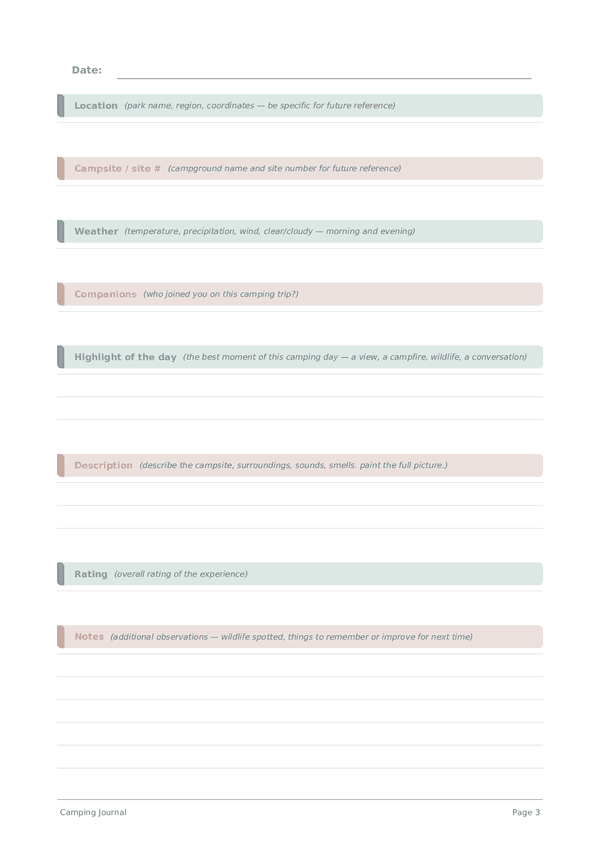
How to fill in each field
Each day you'll find several labeled sections with lines for writing. Here's what each section is for:
Location
Where was the photo taken?
Campsite / site #
Campground name and site number for future reference
Weather
Sunny, cloudy, rain, wind — current conditions
Companions
Who joined you on this camping trip?
Highlight of the day
What was the best part of your day? Capture the moment that made today worth living. These highlights become a collection of your happiest memories.
Description
Write a brief description of what this entry is about. Future-you will thank present-you for the context.
Rating
Overall rating of the experience
Notes
Add any additional context or thoughts. This catch-all column is for anything that doesn't fit elsewhere but might be useful later.
Tips for success
When and how often to write
Write at the end of each camping day, ideally by headlamp or firelight while the day is vivid. Capture the practical details (weather, gear, food) first, then add personal highlights and reflections. After each trip, write a post-trip summary within two days covering what you would do differently. Before planning your next trip, re-read entries from similar destinations and seasons to avoid past mistakes and recreate past successes.
Frequently Asked Questions
What should I record first when I arrive at a campsite?
Location and campsite / site #, immediately. The journal's how to use guidance is correct: details slip away fast once you're setting up. The Leave No Trace Center for Outdoor Ethics also recommends noting site features for future low-impact planning — fire ring presence, water proximity, established tent pads. Lock in the practical facts before the experience becomes a blur.
Why a dedicated highlight section instead of a single trip summary?
A defined highlight forces you to choose the one moment that defined the day, which strengthens memory consolidation. Florence Williams' 'The Nature Fix' (W. W. Norton, 2017) discusses how nature memories gain emotional weight when you actively select them. Three lines under highlight is enough — too much space dilutes focus; too little erases nuance. The format favors recall over completeness.
What kind of description belongs in the three-line description section?
Sensory scene-setting: sounds (river, wind, owls), smells (woodsmoke, pine), light quality (golden hour, moonless dark), and texture (granite, moss, dust). Roger Ulrich's recovery research (Ulrich et al., 1991, Journal of Environmental Psychology, 11(3), 201–230) underlines how natural sensory variety drives well-being. Recording specifics now lets you re-enter the scene later when you reread.
How does this compare to writing in a generic travel journal?
A generic notebook leaves you blank-page paralyzed after a long trail day. This template's eight specific sections — location, site, weather, companions, highlight, description, rating, notes — let you complete a meaningful entry in ten minutes, even tired. Structure isn't constraint; it's the scaffolding that lets a fatigued mind produce a record worth rereading next winter.
Why log companions on every trip?
Camping memories are often relational. The companions field anchors who you shared the experience with, which makes later rereading vivid years on. American Hiking Society community guides note that shared outdoor experiences score higher in long-term memory recall than solo trips. The single line keeps the record practical — just names, occasionally a phrase about their role or mood.
What goes in the two-line notes section?
Practical takeaways for next time: gear that failed, gear you wished you'd packed, water access details, neighbor noise, route-finding tips, permit hassles, recommended return season. Backpacker magazine trip-planning advice consistently urges anglers and campers to keep a lessons-learned habit — most repeat mistakes trace to forgotten previous lessons. The notes section exists for exactly that loop.
Should I journal during the trip or after returning home?
Same evening, on site, while details are fresh. Memory research consistently shows recall fidelity drops sharply after sleep cycles intervene. The lined sections are short enough to complete by headlamp in 10–15 minutes. If conditions truly prevent it (rain, exhaustion), fill the practical fields first — location, site, weather, companions — and expand highlight and description on the drive home.
Is the rating useful or just decoration?
Useful. A simple 1–10 trip rating, reviewed across 20 entries, surfaces patterns most journalers miss — which campgrounds, group sizes, weather windows, and season weeks consistently produce your best trips. American Hiking Society planning resources recommend post-trip ratings precisely for this iterative trip-design loop. Without the number, the journal becomes nostalgia; with it, a planning tool.
You Might Also Like
Scroll to zoom, drag to move