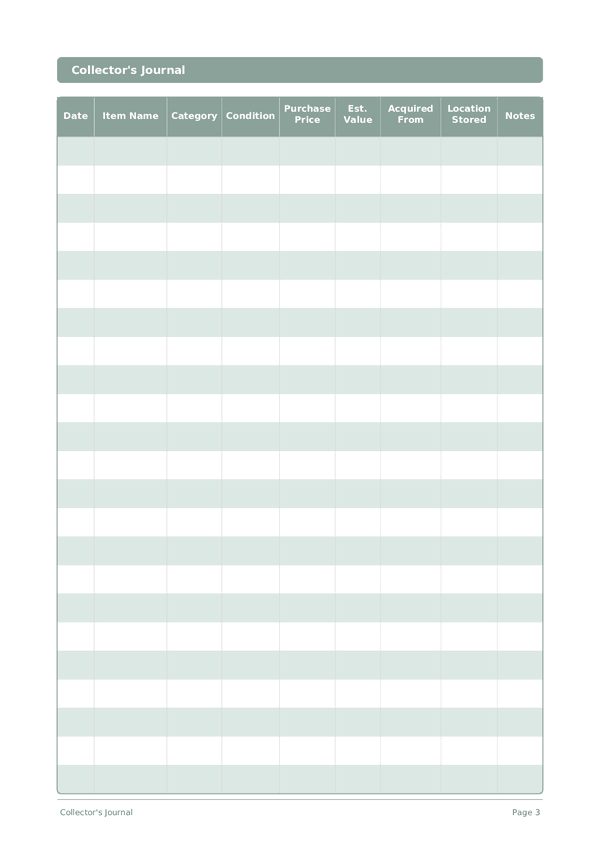
Printable Collector's Journal
Personal collection inventory and valuation tracker
Catalog and manage your entire collection in one organized log. Track acquisition details, current values, conditions, and storage locations for any type of collection.
Customize fields
Toggle fields on or off. Click the pencil to rename, or add your own fields.
What is this journal?
A collector journal is a structured log for documenting every item in your collection. By recording acquisition details, condition, pricing, and storage location alongside your notes, you build a comprehensive inventory that serves as both an insurance record and a love letter to your passion.
This journal is for collectors of anything — vinyl records, vintage watches, stamps, coins, art, sneakers, books, antiques, or any treasured collection. It brings order to the delightful chaos of collecting while preserving the stories behind each acquisition that make a collection more than a list of objects.
Experienced collectors universally recommend maintaining detailed records. Beyond the practical benefits for insurance and estate planning, a well-kept collection journal deepens your expertise by forcing you to examine and describe each item carefully. It also creates a narrative record that captures the hunt, the discovery, and the joy — the human stories that give a collection its soul.
Filled example
Here's what a typical entry looks like when filled in:
| Date | Item Name | Category | Condition | Purchase Price | Est. Value | Acquired From | Location Stored | Notes |
|---|---|---|---|---|---|---|---|---|
| 2025-03-01 | Miles Davis - Kind of Blue (1959 Columbia 6-eye mono) | Vinyl Records | VG+ sleeve, VG++ vinyl | 180 | 350 | Estate sale, Portland | Record shelf A3, sleeved in MoFi inner | Deep groove pressing, Columbia 6-eye label. Surface is remarkably clean for age. One small mark on Side 1 that does not affect play. The estate belonged to a jazz radio DJ — incredible finds that day. |
| 2025-03-04 | Omega Seamaster 300, ref. 165.024 (1967) | Vintage Watches | Good — original dial patina, service needed | 2800 | 4500 | Online dealer, verified via forums | Watch box, position 3, humidity controlled | Original tritium dial with beautiful aged patina. Crown is original. Crystal has light scratches — keeping as-is for authenticity. Movement runs +12s/day — needs service but not urgent. The 165.024 is becoming harder to find in honest, unpolished condition. |
| 2025-03-04 | First edition, The Great Gatsby, Scribner 1925 | Rare Books | Fair — foxing, binding intact, dust jacket absent | 4200 | 6000 | Antiquarian bookshop, New York | Climate-controlled book cabinet, shelf 1 | No dust jacket unfortunately, which affects value significantly. But the text block is clean and binding is tight. Ownership inscription from 1926 on the flyleaf adds provenance. A reading copy of a holy grail — which is exactly how I intend to treat it. |
How to fill in each field
Each page is a table with columns. Fill in one row per entry. Here's what each column is for:
Date
Write today's date. This anchors your entry in time and helps when reviewing entries later.
Item Name
Category
Assign a category to this entry (e.g., food, transport, entertainment). Consistent categories make your data easy to analyze.
Condition
Purchase Price
Est. Value
Acquired From
Location Stored
Notes
Add any additional context or thoughts. This catch-all column is for anything that doesn't fit elsewhere but might be useful later.
Tips for success
When and how often to write
Log every new acquisition immediately, while details about source, price, and condition are fresh. For existing collections, add 2-3 older items per week until the full inventory is documented. Update market values quarterly for investment-grade items. Before attending shows, auctions, or browsing dealers, review your wish list and recent acquisitions to avoid duplicates. This journal functions as both a collector\u2019s diary and a professional-grade inventory system.