Printable Collector's Journal
Personal collection inventory and valuation tracker
Catalog and manage your entire collection in one organized log. Track acquisition details, current values, conditions, and storage locations for any type of collection.
Customize fields
Toggle fields on or off. Click the pencil to rename, or add your own fields.
What is this journal?
A collector journal is a structured log for documenting every item in your collection. By recording acquisition details, condition, pricing, and storage location alongside your notes, you build a comprehensive inventory that serves as both an insurance record and a love letter to your passion.
This journal is for collectors of anything — vinyl records, vintage watches, stamps, coins, art, sneakers, books, antiques, or any treasured collection. It brings order to the delightful chaos of collecting while preserving the stories behind each acquisition that make a collection more than a list of objects.
Experienced collectors universally recommend maintaining detailed records. Beyond the practical benefits for insurance and estate planning, a well-kept collection journal deepens your expertise by forcing you to examine and describe each item carefully. It also creates a narrative record that captures the hunt, the discovery, and the joy — the human stories that give a collection its soul.
Filled example
Here's what a typical entry looks like when filled in:
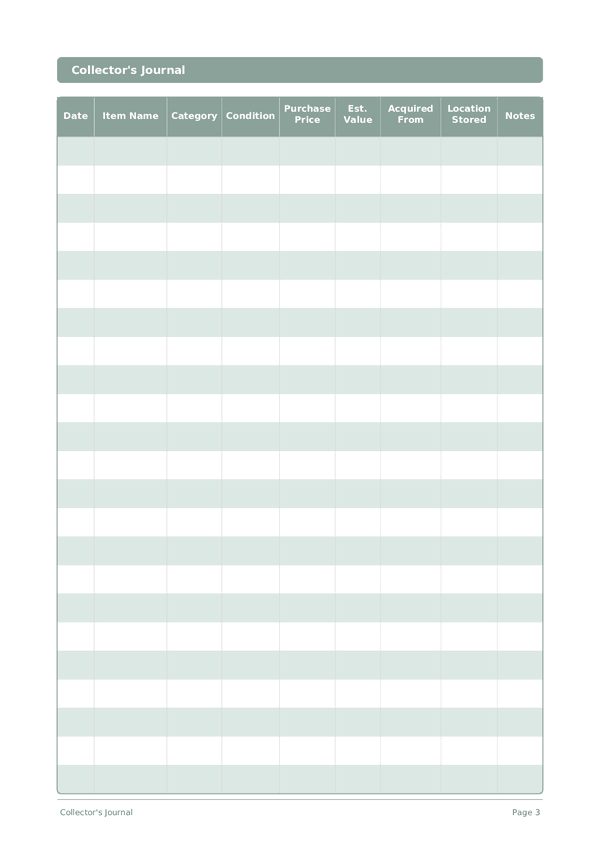
| Date | Item Name | Category | Condition | Purchase Price | Est. Value | Acquired From | Location Stored | Notes |
|---|---|---|---|---|---|---|---|---|
| 2025-03-01 | Miles Davis - Kind of Blue (1959 Columbia 6-eye mono) | Vinyl Records | VG+ sleeve, VG++ vinyl | 180 | 350 | Estate sale, Portland | Record shelf A3, sleeved in MoFi inner | Deep groove pressing, Columbia 6-eye label. Surface is remarkably clean for age. One small mark on Side 1 that does not affect play. The estate belonged to a jazz radio DJ — incredible finds that day. |
| 2025-03-04 | Omega Seamaster 300, ref. 165.024 (1967) | Vintage Watches | Good — original dial patina, service needed | 2800 | 4500 | Online dealer, verified via forums | Watch box, position 3, humidity controlled | Original tritium dial with beautiful aged patina. Crown is original. Crystal has light scratches — keeping as-is for authenticity. Movement runs +12s/day — needs service but not urgent. The 165.024 is becoming harder to find in honest, unpolished condition. |
| 2025-03-04 | First edition, The Great Gatsby, Scribner 1925 | Rare Books | Fair — foxing, binding intact, dust jacket absent | 4200 | 6000 | Antiquarian bookshop, New York | Climate-controlled book cabinet, shelf 1 | No dust jacket unfortunately, which affects value significantly. But the text block is clean and binding is tight. Ownership inscription from 1926 on the flyleaf adds provenance. A reading copy of a holy grail — which is exactly how I intend to treat it. |
How to fill in each field
Each page is a table with columns. Fill in one row per entry. Here's what each column is for:
Date
Write today's date. This anchors your entry in time and helps when reviewing entries later.
Item Name
Category
Assign a category to this entry (e.g., food, transport, entertainment). Consistent categories make your data easy to analyze.
Condition
Purchase Price
Est. Value
Acquired From
Location Stored
Notes
Add any additional context or thoughts. This catch-all column is for anything that doesn't fit elsewhere but might be useful later.
Tips for success
When and how often to write
Log every new acquisition immediately, while details about source, price, and condition are fresh. For existing collections, add 2-3 older items per week until the full inventory is documented. Update market values quarterly for investment-grade items. Before attending shows, auctions, or browsing dealers, review your wish list and recent acquisitions to avoid duplicates. This journal functions as both a collector\u2019s diary and a professional-grade inventory system.
Frequently Asked Questions
What should I record in condition — and does grading vocabulary depend on what I collect?
Yes, condition grading is specific to each collectible. PCGS (Professional Coin Grading Service) uses the Sheldon Scale 1-70 for coins; PSA grades trading cards 1-10; PMG grades currency 1-70. For comic books, CGC and CBCS use 0.5-10. Record both your own assessment and any third-party grade with the grading house and certification number. Mixing vocabulary across entries makes valuation comparison impossible — pick the standard for your category and apply it the same way every time.
How do I track estimated value accurately without overstating my collection?
Cite the source and date. For coins, the PCGS Price Guide and Greysheet (CDN Publishing) are industry references; for cards, the PSA Price Guide and recent sold-comps from major auction houses (Heritage, Goldin); for stamps, the Scott Catalog. Record the source in the notes column next to the figure. Research in the Journal of Consumer Research on collecting (including Belk's foundational work on collecting and possession) warns against valuation inflation — overestimating clouds objective decisions about sales and trades.
Why log acquired from — beyond memory?
Provenance is value. For coins, cards, art, and historical artifacts, a documented chain of ownership materially affects authenticity confidence and resale value. PCGS and PSA both flag provenance gaps as authenticity risks. For insurance, recording the dealer, auction lot number, or private seller establishes legal ownership history. Russell Belk's research published in the Journal of Consumer Research on collecting also points to the narrative side — provenance becomes part of the object's meaning over time.
How is a paper collector's journal different from collection apps like Collectorz or Colnect?
Apps offer database structure and image storage; a paper journal makes you document each item deliberately, which surfaces gaps in your knowledge. Research on collecting psychology in the Journal of Consumer Research, including Belk's work on possessions and self, finds that engaged documentation strengthens the bond between collector and object. Use both: the app for searchable inventory, the journal for the analytical layer — provenance research, condition assessments, valuation history with sources.
How does the location stored field protect my collection?
It serves three practical purposes: insurance documentation, theft recovery, and inheritance clarity. Industry bodies including PCGS and PSA recommend tracking secure storage for high-value items. Note climate conditions where they matter (e.g., humidity for paper, temperature for vinyl). For insurance, photographic provenance plus location records support claims. For descendants, location notes keep items from being misidentified or discarded — a frequent loss documented in collector estate liquidation literature.
Is this journal suitable for any collection — coins, cards, vinyl, books, watches, art?
Yes. The columns — item name, category, condition, purchase price, estimated value, acquired from, location, notes — work across collectibles. For watches, condition might reference original box and papers; for vinyl, jacket and sleeve grade per the Goldmine Standard; for books, the AB Bookman scale. Use the notes column to specify which grading standard applies. Research in the Journal of Consumer Research on collecting suggests structured documentation deepens engagement regardless of category.
How often should I update est. value, and which sources should I trust?
Annually for stable categories (coins, stamps), quarterly for volatile ones (modern sports cards, sneakers, watches). Cite established price guides: the PCGS Price Guide for coins, the PSA Price Guide and sold-listing data for cards. Auction house results (Heritage, Christie's, Sotheby's) reflect actual market clearance. Russell Belk's collecting research in the Journal of Consumer Research notes that grounding valuation in data prevents the emotional inflation common in long-held collections.
Common mistakes that undermine a collector's journal?
First, missing condition grades — this guts a collection's resale documentation. Second, copying retail asking prices as 'estimated value' instead of realized sale prices; PCGS and PSA distinguish guide value from market clearance. Third, vague provenance ('online') instead of a specific seller and date. Fourth, neglecting location updates after storage moves. Fifth, treating the journal as inventory only — Journal of Consumer Research collecting research finds that documented context, not just a listing, builds long-term value.
You Might Also Like
Scroll to zoom, drag to move