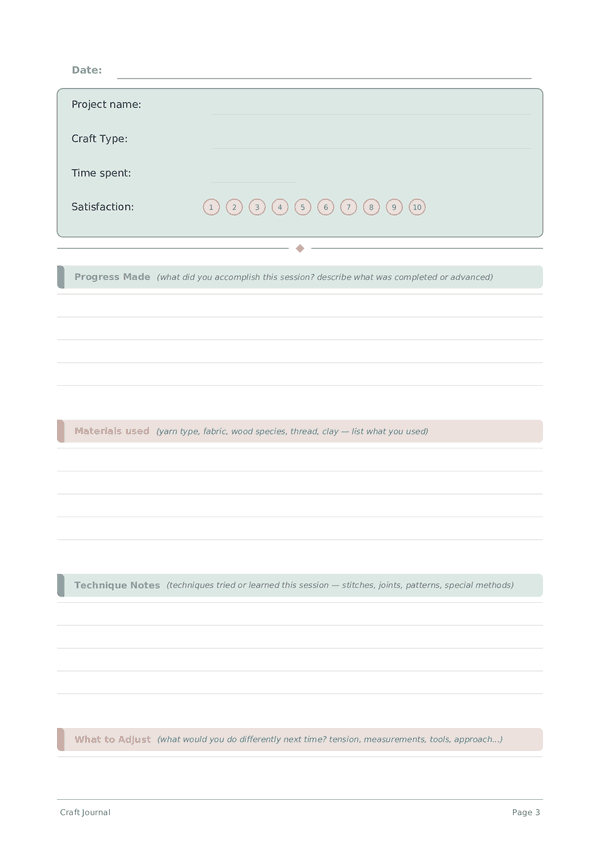
Printable Craft Journal
Craft project tracker and creative hobby journal
Document your craft projects with session logs, material notes, and technique observations. Track progress, capture what works, and build a creative reference library for all your handmade projects.
Customize fields
Toggle fields on or off. Click the pencil to rename, or add your own fields.
What is this journal?
A craft journal documents every making session — the materials you chose, the techniques you tried, and the discoveries that only come from working with your hands. Whether you knit, carve, sew, or build, the gap between what you planned and what actually happened is where learning lives. This journal captures that gap before it fades from memory.
The tracker section logs the project name, craft type, time spent, and a satisfaction rating so you can spot trends in productivity and enjoyment at a glance. The writing section records your progress, materials used, technique notes, and ideas for what to adjust next time. Together these create a maker's logbook that grows more valuable with every entry.
Fill in the tracker during or right after your session and take a few minutes to write about what you noticed. These notes compound: months from now, when you start a similar project, you will have a detailed record of what worked, what to avoid, and exactly which materials and settings produced the results you loved.
Filled example
Here's what a typical entry looks like when filled in:
How to fill in each field
The top of each page has quick-fill fields (ratings, checkboxes, numbers). Below that is a lined section for writing. Here's what each field means:
Project name
What project are you working on today?
Craft Type
e.g. Knitting, Sewing, Woodworking, Embroidery, Crochet, Pottery...
Time spent
How long did you study?
Satisfaction
How satisfied are you with today's session? (1=frustrated, 5=very satisfied)
Progress Made
What did you accomplish this session? Describe what was completed or advanced
Materials used
Yarn type, fabric, wood species, thread, clay — list what you used
Technique Notes
Techniques tried or learned this session — stitches, joints, patterns, special methods
What to Adjust
What would you do differently next time? Tension, measurements, tools, approach...
Tips for success
When and how often to write
Make entries during and after each crafting session while details are fresh. For multi-session projects, write brief notes at the end of each session and a fuller reflection when the project is complete. Aim for at least two entries per week to maintain skill momentum — crafts are motor skills that degrade without regular practice. Monthly, review your completed projects and identify one technique to deepen next month. Seasonal reviews are especially valuable for crafters: they help you plan around seasonal materials, holidays, and gift-giving occasions.
Frequently Asked Questions
What does the Craft Journal track per session?
A 4-field tracker — project name, craft type, time spent, satisfaction (0-10) — plus 5 lined rows for progress made with prompts for materials used, technique notes, and what to adjust. The structure supports knitting, sewing, embroidery, pottery, woodworking, jewelry, paper craft, and any handmade practice. It turns scattered sessions into a coherent project record.
Why is the craft type field useful when I'm just one kind of maker?
It keeps the journal usable as your interests expand. Many makers branch out over time — a knitter picks up embroidery, a woodworker tries leather. The craft type field lets one journal support multiple crafts without losing analytical value. Filtering by craft type later shows time distribution, satisfaction patterns, and which crafts hold your attention versus those that fade after a try or two.
How do I make materials used useful months later?
Note specific yarn weight and dye lot, fabric width and fiber, wood species, glaze codes, thread types. Generic entries ('blue yarn') fail at the exact moment you need them most — when you run out and need a match. Specific entries ('DK weight, Cascade 220, color 9477, dye lot 1224') let you reorder or substitute knowingly. This is professional shop practice scaled down to home crafting.
What goes in technique notes versus what to adjust?
Technique notes records what you did — 'kitchener stitch on the toe,' 'miter cut at 22.5°.' What to adjust records what to change next time — 'start gusset 2 rows earlier,' 'sand grain before staining, not after.' The split separates documentation from learning. Without what to adjust, repeat projects repeat the same small mistakes; with it, each piece improves on the last.
Does journaling really help with craft skill?
Yes — through the same deliberate practice loop Ericsson (2016, Peak, Houghton Mifflin Harcourt) describes for any skilled domain: focused attention on specific techniques with feedback. The technique notes and what to adjust fields are the feedback loop; the satisfaction rating provides the signal. Crafters who journal finish more ambitious projects faster because they don't re-solve the same problems each time.
How is this different from Ravelry or a project tracker app?
Ravelry is craft-specific (knitting and crochet) and built for pattern sharing. App trackers focus on completion status. This journal captures the process knowledge — the materials you actually used, the technique adaptations, the small adjustments. Use Ravelry for patterns and community; use this journal for your private record of how you actually made each piece. Both have a role for serious makers.
Should I journal every session or only when finishing a project?
Every session for projects longer than a few hours. Multi-session crafts (sweaters, quilts, furniture) accumulate small decisions that shape the final result. End-only logging loses 80% of the useful data. For short projects (a card, a small repair), a single entry on completion is enough. The time spent field adds up either way, making total project effort visible across sessions.
How do I review past entries usefully?
Project-by-project review at completion shows technique gains. Cross-project review every 3-6 months reveals patterns — which crafts you return to, what hours support best satisfaction, which materials keep appearing in high-rated projects. Cepeda et al. (2006, Psychological Bulletin, 132(3), 354-380) document how distributed review consolidates learning, which here means turning scattered sessions into maker knowledge you can carry forward.
You Might Also Like
Scroll to zoom, drag to move