Printable Entrepreneur Journal
Daily entrepreneurship tracker and founder journal
Build your business with daily accountability, metric tracking, and strategic reflection. Document wins, decisions, and lessons as you navigate the entrepreneurial journey.
Customize fields
Toggle fields on or off. Click the pencil to rename, or add your own fields.
What is this journal?
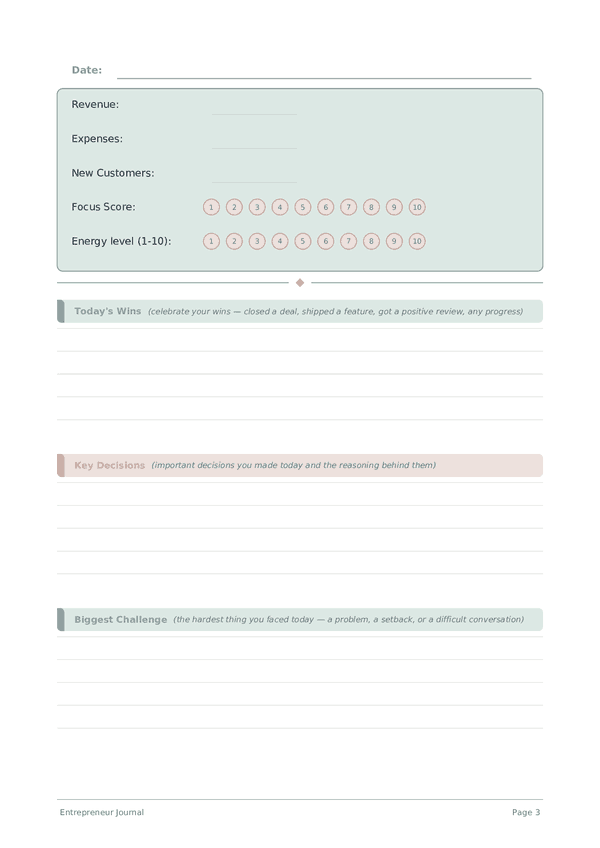
An Entrepreneur Journal combines daily metrics tracking with reflective writing to give you a complete picture of your entrepreneurial journey. The top section lets you quickly log revenue, expenses, new customers acquired, focus score, and energy level. The bottom section provides space for recording your wins, key decisions, biggest challenge, and tomorrow's focus. Together, they capture both the numbers and the narrative behind them.
Entrepreneurship is a marathon of daily decisions, and the best founders are the ones who learn fastest from their own experience. This journal creates a feedback loop: the numbers show you what happened, and the writing forces you to understand why. When you review entries from three months ago, you will see not just the metrics but the thinking that produced them.
Start each entry by filling in the tracker section — it takes under a minute. At the end of the day, write about your wins, the key decisions you made, and the single biggest challenge you faced. Close with a clear focus for tomorrow. Keep entries honest and concise; this journal is for your eyes only, and raw honesty is what makes it useful.
Filled example
Here's what a typical entry looks like when filled in:
How to fill in each field
The top of each page has quick-fill fields (ratings, checkboxes, numbers). Below that is a lined section for writing. Here's what each field means:
Revenue
Total revenue earned today — sales, invoices paid, new contracts signed
Expenses
Total money spent today — costs, bills, subscriptions, purchases
New Customers
Number of new customers or clients acquired today
Focus Score
How focused were you today? 1=scattered, 10=laser-focused
Energy level (1-10)
Rate your physical and mental energy level. 1 means exhausted and drained, 10 means fully energized and alert. This helps you identify what activities boost or drain your energy.
Today's Wins
Celebrate your wins — closed a deal, shipped a feature, got a positive review, any progress
Key Decisions
Important decisions you made today and the reasoning behind them
Biggest Challenge
The hardest thing you faced today — a problem, a setback, or a difficult conversation
Tomorrow's Focus
One clear priority or intention that will guide your focus tomorrow
Tips for success
When and how often to write
Daily entries are non-negotiable for early-stage founders — the pace of change is too fast for weekly reviews to catch. Write for 10-15 minutes each evening covering metrics, decisions, validated learnings, and tomorrow’s single priority. Weekly, review all seven entries and identify the one insight that matters most. Monthly, update your key metrics dashboard and compare to projections. Quarterly, step back and ask: is the current direction still the right one? Your journal will have the evidence to answer honestly.
Frequently Asked Questions
Why does the tracker include energy and focus score alongside financial metrics?
Founder capacity drives business output. Cal Newport, 'So Good They Can't Ignore You' (Business Plus, 2012) treats sustained focus as the rare resource that compounds into career capital. Daniel Kahneman, 'Thinking, Fast and Slow' (Farrar, Straus & Giroux, 2011) shows depleted attention degrades decisions. Tracking focus score and energy beside revenue and expenses links your personal state to business output, showing why some weeks compound and others stall.
How should I record revenue and expenses in the tracker?
Daily totals, not estimates. The U.S. Small Business Administration (sba.gov, 'Manage Your Finances') stresses contemporaneous recording for accurate trend analysis. The IRS (Publication 583, 'Starting a Business and Keeping Records') requires daily summary records sufficient to determine income and expenses. Two numbers per day, recorded that evening, beat reconstructed monthly totals for both tax substantiation and weekly cash-flow awareness.
What counts as a customer acquired entry?
A clear, definable event — a first paid transaction, a signed contract, a paid subscription start. The U.S. Small Business Administration (sba.gov, 'Manage Your Finances') describes customer acquisition as a leading business indicator. Define your rule once and keep it consistent; the daily number only yields a trend if 'acquired' means the same thing every page. Trial signups are usually a separate metric.
How do I use the today's wins prompt without trivializing it?
Capture one substantive win — a closed deal, a fixed bug that unblocked customers, a hire — not a busywork checkmark. Harvard Business Review (Di Stefano et al., 2014, 'Learning by Thinking', HBR Working Paper 14-093) shows that naming wins explicitly drives motivation and learning. Six lines gives you room for a genuine narrative; if no real win exists, write the closest honest progress.
How is this different from a CRM or financial dashboard?
CRMs and dashboards present data; this journal pushes the founder to reflect on what the data means. The U.S. Small Business Administration (sba.gov, 'Plan Your Business') notes the gap between data availability and decision quality. Pairing the daily tracker numbers with handwritten responses on key decisions, biggest challenge, and tomorrow's focus adds an interpretive layer that pure software dashboards cannot replicate.
What should I write under key decisions?
Decisions you actually made today, not items you discussed. Daniel Kahneman, 'Thinking, Fast and Slow' (Farrar, Straus & Giroux, 2011) emphasizes evaluating decisions against the information available, which requires a record of what you decided and why. Examples: pivoted pricing, hired a contractor, paused a feature. Six lines is enough for two or three substantive decisions per day.
Does daily founder journaling correlate with business outcomes?
Structured reflection improves measurable performance. Harvard Business Review (Di Stefano et al., 2014, 'Learning by Thinking', HBR Working Paper 14-093) found end-of-day reflection improved performance by over 20%. Cal Newport, 'So Good They Can't Ignore You' (Business Plus, 2012) makes the case for deliberate practice in any craft. The tracker plus six-line reflection puts both to work daily.
What is the most common mistake in tracking founder metrics?
Adding too many metrics. The U.S. Small Business Administration (sba.gov, 'Manage Your Finances') recommends a small set of leading indicators owners actually act on. The five tracker items — revenue, expenses, new customers, focus score, energy — are deliberately limited. More metrics dilute attention; if one is not driving a weekly decision, it does not earn space on the daily page.
You Might Also Like
Scroll to zoom, drag to move