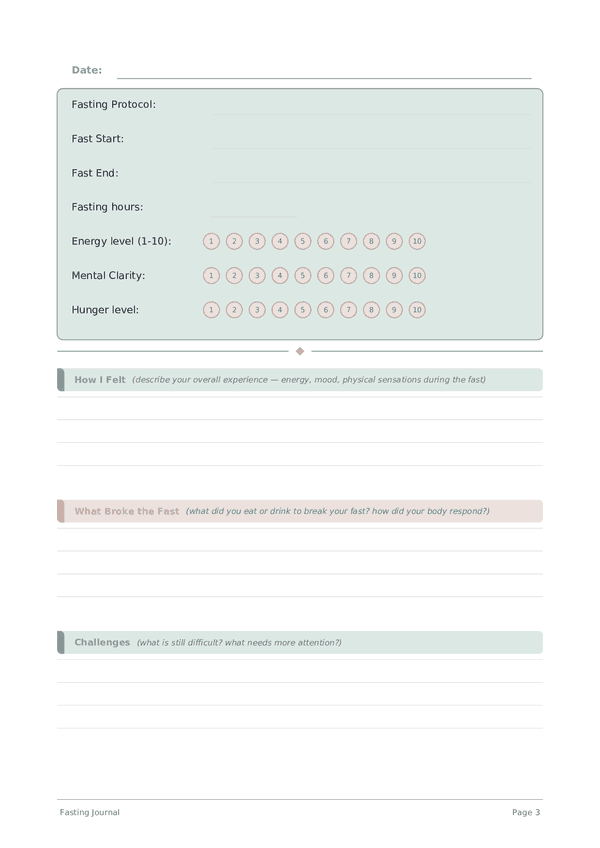
Printable Fasting Journal
Intermittent fasting tracker and energy log
Track your fasting practice with detailed logs of fasting windows, energy levels, mental clarity, and hunger patterns. Build an evidence base for what protocols work best for your body and goals.
Customize fields
Toggle fields on or off. Click the pencil to rename, or add your own fields.
What is this journal?
A fasting journal is a daily companion for anyone practicing intermittent fasting, extended fasts, or any time-restricted eating protocol. The tracker section captures the essential metrics — your fasting protocol, start and end times, total hours fasted, energy, mental clarity, and hunger levels — while the writing section provides space to reflect on how you felt, what you ate to break your fast, and what insights emerged.
Fasting affects every person differently, and what works as a sustainable protocol for one individual may be unsustainable for another. By tracking your experience consistently, you discover your optimal fasting window, learn which factors make fasting easier or harder, and build the self-awareness needed to adjust your approach. Many people find that journaling during their fast helps manage hunger by redirecting attention from food cravings to personal reflection.
Whether you are fasting for weight management, metabolic health, mental clarity, or longevity, this journal helps you go beyond simply watching the clock. It transforms fasting from a willpower exercise into a mindful practice grounded in data and self-knowledge, making it easier to sustain long-term and adapt as your body and goals evolve.
Filled example
Here's what a typical entry looks like when filled in:
How to fill in each field
The top of each page has quick-fill fields (ratings, checkboxes, numbers). Below that is a lined section for writing. Here's what each field means:
Fasting Protocol
e.g. 16:8, 18:6, 20:4, 24hr, OMAD, 5:2 — which fasting method did you follow today?
Fast Start
What time did your fast begin? (e.g. 8:00 PM)
Fast End
What time did you break your fast? (e.g. 12:00 PM)
Fasting hours
Record the number of hours you fasted. Tracking alongside energy and mood helps you find your optimal fasting window.
Energy level (1-10)
Rate your physical and mental energy level. 1 means exhausted and drained, 10 means fully energized and alert. This helps you identify what activities boost or drain your energy.
Mental Clarity
How sharp and focused did your mind feel? 1=foggy and unfocused, 5=crystal clear
Hunger level
How hungry were you overall today? 1 = not hungry at all, 10 = ravenous
How I Felt
Describe your overall experience — energy, mood, physical sensations during the fast
What Broke the Fast
What did you eat or drink to break your fast? How did your body respond?
Challenges
What is still difficult? What needs more attention?
Insights
Any realizations, clarity, or moments of stillness worth remembering?
Tips for success
When and how often to write
Log every fasting day in real time — mark the start when you begin and the end when you break the fast, not from memory later. On rest or non-fasting days, still make a short entry noting how you feel; this creates contrast data that proves whether fasting is actually helping. Review your entries weekly to adjust your protocol. Monthly, compare average energy, hunger curves, and weight trends across different fasting windows to find your optimal schedule.