Printable Fertility Journal
Daily fertility tracking and cycle awareness journal
Support your fertility journey with comprehensive daily tracking of BBT, cervical fluid, ovulation signs, and cycle patterns. Build an accurate picture to optimize timing and understand your body.
Customize fields
Toggle fields on or off. Click the pencil to rename, or add your own fields.
What is this journal?
A fertility journal is a detailed daily record designed to help you track the key biomarkers of your reproductive cycle — basal body temperature, cervical fluid changes, ovulation test results, and other signs that together paint a picture of your fertility window. By recording these observations each day, you develop a nuanced understanding of your unique cycle that supports both conception efforts and reproductive health awareness.
This journal is primarily for individuals and couples who are trying to conceive and want to identify their most fertile days with greater precision. It is also valuable for anyone practicing fertility awareness methods, those undergoing fertility treatments who need detailed cycle records for their clinic, or anyone who simply wants to understand their reproductive health more deeply.
Fertility can feel like a mystery, but tracking transforms it into something you can observe and understand. When you log your BBT every morning, you can confirm ovulation by the temperature shift. When you note cervical fluid changes, you learn to recognize the pattern that signals approaching fertility. Over several cycles, your journal reveals your personal patterns — cycle length variations, typical ovulation day, and how lifestyle factors like stress, sleep, and travel affect your cycle. This knowledge reduces guesswork, supports more effective timing, and gives you meaningful data to share with your healthcare provider.
Filled example
Here's what a typical entry looks like when filled in:
How to fill in each field
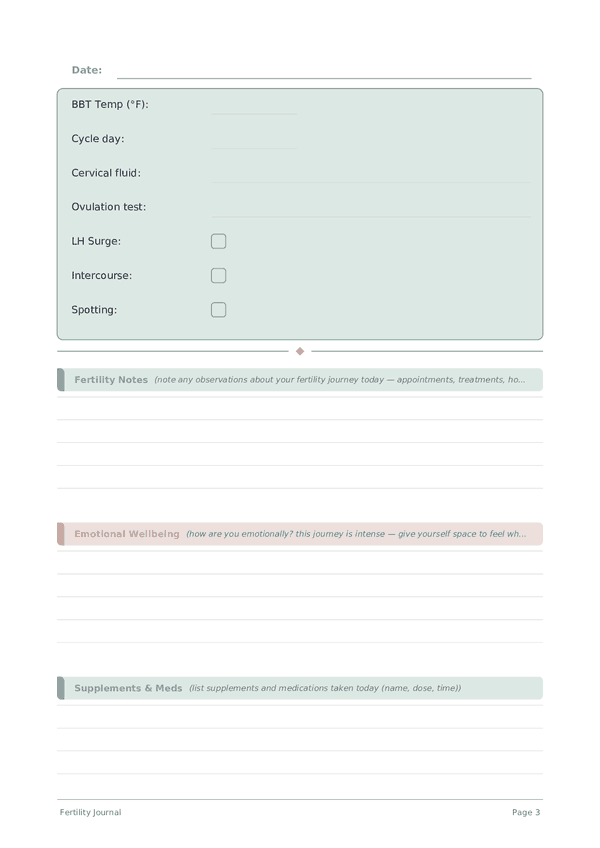
The top of each page has quick-fill fields (ratings, checkboxes, numbers). Below that is a lined section for writing. Here's what each field means:
BBT Temp (°F)
Your basal body temperature taken immediately after waking, before getting up
Cycle day
Record which day of your cycle this is. Consistent tracking helps predict future cycles and identify irregularities.
Cervical fluid
Describe today's cervical fluid — dry, sticky, creamy, watery, or egg-white
Ovulation test
Did you take an ovulation test today? Enter positive, negative, or leave blank
LH Surge
Did you detect an LH surge today? Note the test line intensity if helpful
Intercourse
Did you have intercourse today? A simple yes or no is enough
Spotting
Any light bleeding or spotting today? Note color and amount if present
Fertility Notes
Note any observations about your fertility journey today — appointments, treatments, how your body feels
Emotional Wellbeing
How are you emotionally? This journey is intense — give yourself space to feel whatever arises
Supplements & Meds
List supplements and medications taken today (name, dose, time)
Tips for success
When and how often to write
Take your BBT every single morning at the same time (before moving, talking, or drinking) and log it immediately. Record cervical mucus observations at least once daily, ideally twice (morning and evening). Log OPK results as you take them. After each cycle, review the full chart to identify your ovulation day and fertile window. Over 3–6 months, your personal pattern will become clear, making timing more precise. If trying to conceive, bring your tracked cycles to your fertility specialist.
Frequently Asked Questions
How does BBT (basal body temperature) help identify ovulation?
ACOG and NIH NICHD describe a classic biphasic pattern: BBT rises 0.3–0.6°F (0.2–0.4°C) after ovulation due to progesterone, sustained ~10–14 days through the luteal phase. Measure with a digital BBT thermometer (0.1° precision) immediately on waking, before any activity. The bBT temp (°F) column captures this. Note that BBT confirms ovulation retrospectively — it does not predict the fertile window in advance.
What does cervical fluid tell me about fertility?
Per ACOG and Fertility Awareness-Based Methods literature, cervical mucus changes through the cycle: dry/sticky early, creamy mid-cycle, then 'egg white' (clear, stretchy) at peak fertility 1–3 days before ovulation. This is the most reliable real-time fertile sign — more predictive than BBT. The cervical fluid text field captures a qualitative description (dry/creamy/egg-white) consistent with Billings or symptothermal methods.
How do I use ovulation tests with this journal?
Ovulation predictor kits detect the LH surge 12–36 hours before ovulation, per ACOG. Test daily mid-cycle (around days 10–20 for a 28-day cycle) until positive. Record the result in ovulation test (positive/negative) and check lH surge when positive. Combined with BBT confirmation 1–2 days later, this brackets your ovulation window accurately. Most cycles have one detectable surge.
When is the fertile window for timing intercourse?
NIH NICHD and NEJM (1995, 333(23)) research identifies the fertile window as the 6 days ending on ovulation day — sperm survive 3–5 days in fertile cervical fluid, and the egg is viable ~24 hours. Highest conception probability is 1–2 days before ovulation. The intercourse checkbox combined with cervical fluid and ovulation test data lets you verify timing afterward, useful when discussing with a fertility specialist.
What if my cycles are irregular?
Cycles 21–35 days are normal; consistently outside this range may suggest PCOS, thyroid dysfunction, or perimenopause, per ACOG. With irregular cycles, BBT and cervical fluid tracking still works — they identify ovulation as it happens, regardless of cycle length. Track 3–6 cycles and bring them to a reproductive endocrinologist if you've been trying 6+ months (age 35+) or 12+ months (under 35) without conception, per ACOG.
How long should I track before seeing a fertility specialist?
ACOG and ASRM (American Society for Reproductive Medicine) recommend evaluation after 12 months of unprotected intercourse for women under 35, or 6 months for women 35+. Bring 3+ cycles of journal data — BBT charts, cervical fluid patterns, LH surge timing, and intercourse timing. This evidence shortens the diagnostic work-up by ruling out timing issues and demonstrating ovulation.
Are fertility awareness methods reliable for contraception?
Used perfectly, symptothermal methods (BBT + cervical fluid) achieve ~99% effectiveness per WHO data, but typical-use effectiveness drops to ~76–88%. CDC and ACOG note that fertility awareness is less reliable than hormonal or barrier methods. This journal is designed for conception support, not contraception — combine with other methods if you're avoiding pregnancy, and consult your gynecologist.
What emotional support does the journal provide during trying-to-conceive?
The emotional well-being prompt acknowledges that TTC stress is clinically significant. APA (2021) and ASRM data show that 25–60% of fertility patients experience clinical anxiety or depression. Logging your emotional state alongside physical data normalizes the experience and helps you spot when to seek therapy or join a support group. RESOLVE and APA recommend mental health support after 12+ months of TTC.
You Might Also Like
Scroll to zoom, drag to move