Printable Fishing Journal
Log catches, locations, and fishing conditions
Track every fishing trip in detail — species caught, weight, length, bait used, and water conditions. Over time your log reveals the patterns behind your best catches and helps you replicate success on future trips.
Customize fields
Toggle fields on or off. Click the pencil to rename, or add your own fields.
Benefits
How to Use
What is this journal?
A fishing journal is a detailed log for recording every fishing trip — the catches, the conditions, and the techniques that worked. By tracking species, weight, bait, and water conditions alongside your own notes, you build a personal reference that makes you a more effective angler over time.
This journal is for anglers of all levels — from weekend hobbyists to dedicated sportfishers. It is especially valuable because fish behavior follows predictable patterns based on weather, water temperature, season, and time of day. By recording these variables, you build a database that tells you exactly when and how to fish each of your favorite spots.
Experienced anglers universally recommend keeping a log. The patterns that emerge over months and years — which baits produce in which conditions, which spots are productive at which water levels, which moon phases correlate with activity — give you an edge that cannot be gained from any guide book. Your fishing journal becomes your most reliable fishing partner.
Filled example
Here's what a typical entry looks like when filled in:
| Date | Time | Location | Species | Weight (kg) | Length (cm) | Bait | Water conditions | Notes |
|---|---|---|---|---|---|---|---|---|
| 2025-03-04 | 6:30 | Mirror Lake, east bank | Rainbow Trout | 1.8 | 38 | Olive woolly bugger, size 10 | Clear, 8C, slight current | Hit on the third cast near submerged log. Strong fight for its size. Released. |
| 2025-03-04 | 7:15 | Mirror Lake, east bank | Rainbow Trout | 0.9 | 28 | Olive woolly bugger, size 10 | Clear, 8C, slight current | Smaller fish, same area. Feeding actively near the log structure. |
| 2025-03-04 | 8:40 | Mirror Lake, inlet stream | Brown Trout | 2.4 | 44 | Gold Rapala, 5cm | Slightly murky at inlet, 7C | Best fish of the day. Took the lure on a slow retrieve. Beautiful coloring. Photo taken, released. |
| 2025-03-04 | 10:00 | Mirror Lake, west cove | 0 | 0 | Various flies and spinners | Clear, warming to 10C, wind picking up | No bites after 9:30. Sun got high and wind pushed bait fish away from cove. Packed up. |
How to fill in each field
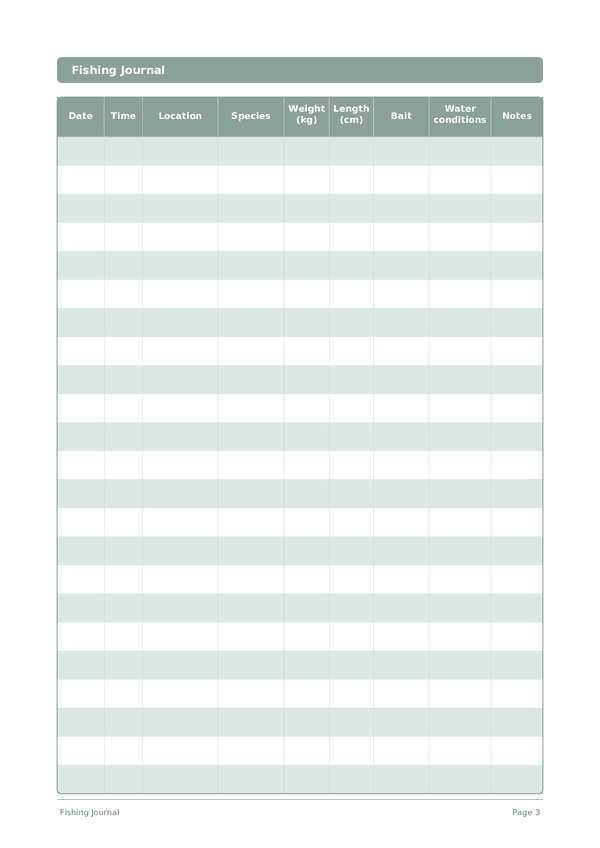
Each page is a table with columns. Fill in one row per entry. Here's what each column is for:
Date
Write today's date. This anchors your entry in time and helps when reviewing entries later.
Time
Record the time of the measurement or event. Consistent timing makes data comparable and reveals time-of-day patterns.
Location
Where was the photo taken?
Species
Name of the fish species caught
Weight (kg)
Record your weight if you're tracking it. Weigh yourself at the same time each day for consistent data. Focus on weekly trends, not daily fluctuations.
Length (cm)
Fish length in centimeters
Bait
Live bait, spinner, fly, jig, plastic worm, topwater lure...
Water conditions
Clear, murky, choppy, calm, current speed, tide...
Notes
Add any additional context or thoughts. This catch-all column is for anything that doesn't fit elsewhere but might be useful later.
Tips for success
When and how often to write
Fill in one row per catch (or attempted catch) during every fishing trip. Enter data on the water if possible, or immediately after returning. Before each new trip, review your log entries for the same location, season, and conditions to choose bait and timing based on your own proven data. Monthly, scan for patterns across all trips. Serious anglers who log consistently for a full year report significantly higher catch rates in the second year.