Printable Fishing Journal
Log catches, locations, and fishing conditions
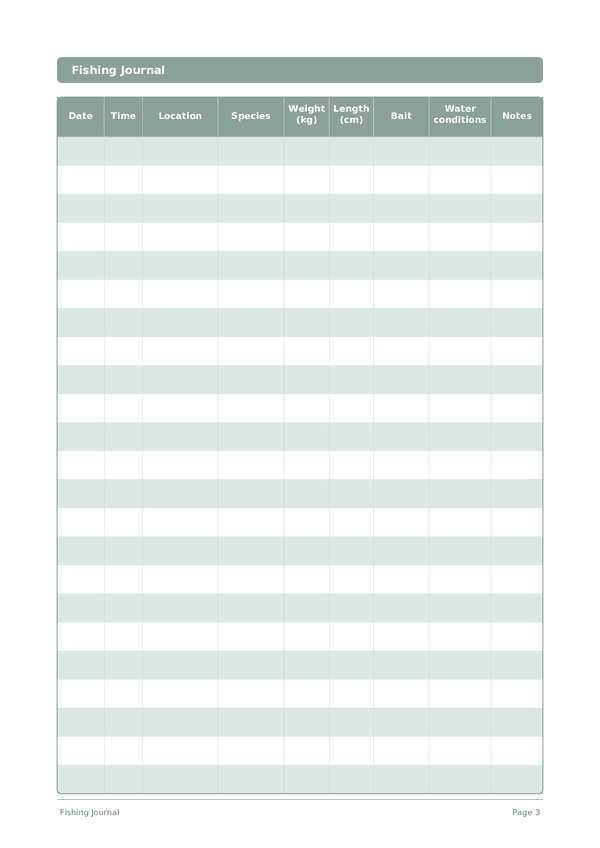
Track every fishing trip in detail — species caught, weight, length, bait used, and water conditions. Over time your log reveals the patterns behind your best catches and helps you replicate success on future trips.
Customize fields
Toggle fields on or off. Click the pencil to rename, or add your own fields.
Benefits
How to Use
What is this journal?
A fishing journal is a detailed log for recording every fishing trip — the catches, the conditions, and the techniques that worked. By tracking species, weight, bait, and water conditions alongside your own notes, you build a personal reference that makes you a more effective angler over time.
This journal is for anglers of all levels — from weekend hobbyists to dedicated sportfishers. It is especially valuable because fish behavior follows predictable patterns based on weather, water temperature, season, and time of day. By recording these variables, you build a database that tells you exactly when and how to fish each of your favorite spots.
Experienced anglers universally recommend keeping a log. The patterns that emerge over months and years — which baits produce in which conditions, which spots are productive at which water levels, which moon phases correlate with activity — give you an edge that cannot be gained from any guide book. Your fishing journal becomes your most reliable fishing partner.
Filled example
Here's what a typical entry looks like when filled in:
| Date | Time | Location | Species | Weight (kg) | Length (cm) | Bait | Water conditions | Notes |
|---|---|---|---|---|---|---|---|---|
| 2025-03-04 | 6:30 | Mirror Lake, east bank | Rainbow Trout | 1.8 | 38 | Olive woolly bugger, size 10 | Clear, 8C, slight current | Hit on the third cast near submerged log. Strong fight for its size. Released. |
| 2025-03-04 | 7:15 | Mirror Lake, east bank | Rainbow Trout | 0.9 | 28 | Olive woolly bugger, size 10 | Clear, 8C, slight current | Smaller fish, same area. Feeding actively near the log structure. |
| 2025-03-04 | 8:40 | Mirror Lake, inlet stream | Brown Trout | 2.4 | 44 | Gold Rapala, 5cm | Slightly murky at inlet, 7C | Best fish of the day. Took the lure on a slow retrieve. Beautiful coloring. Photo taken, released. |
| 2025-03-04 | 10:00 | Mirror Lake, west cove | 0 | 0 | Various flies and spinners | Clear, warming to 10C, wind picking up | No bites after 9:30. Sun got high and wind pushed bait fish away from cove. Packed up. |
How to fill in each field
Each page is a table with columns. Fill in one row per entry. Here's what each column is for:
Date
Write today's date. This anchors your entry in time and helps when reviewing entries later.
Time
Record the time of the measurement or event. Consistent timing makes data comparable and reveals time-of-day patterns.
Location
Where was the photo taken?
Species
Name of the fish species caught
Weight (kg)
Record your weight if you're tracking it. Weigh yourself at the same time each day for consistent data. Focus on weekly trends, not daily fluctuations.
Length (cm)
Fish length in centimeters
Bait
Live bait, spinner, fly, jig, plastic worm, topwater lure...
Water conditions
Clear, murky, choppy, calm, current speed, tide...
Notes
Add any additional context or thoughts. This catch-all column is for anything that doesn't fit elsewhere but might be useful later.
Tips for success
When and how often to write
Fill in one row per catch (or attempted catch) during every fishing trip. Enter data on the water if possible, or immediately after returning. Before each new trip, review your log entries for the same location, season, and conditions to choose bait and timing based on your own proven data. Monthly, scan for patterns across all trips. Serious anglers who log consistently for a full year report significantly higher catch rates in the second year.
Frequently Asked Questions
Which fields drive the best catch insights over time?
All nine columns matter, but bait, water conditions, weather, and time are the strongest predictors of repeatable success. Recording species, weight, and length builds your personal-best records. Cross-referencing bait against water clarity and time of day reveals patterns memory alone can't hold. The notes column captures moon phase, barometric trends, and structure — variables long-form anglers consistently track.
How should I describe water conditions?
Use repeatable terms: clarity (clear / stained / muddy), level (low / normal / high / rising / falling), temperature if known, and surface (calm / rippled / choppy). Consistency across entries matters more than vocabulary. Once you've logged 20–30 trips, you can sort entries by water condition and quickly see which bait choices produced fish under each scenario — that's the journal's real return.
Why log unsuccessful trips, not just catches?
Negative data has equal value. A blank day under specific water and weather conditions teaches you what doesn't work there, which is half of pattern recognition. Leave the species column empty but fill in location, weather, water, and bait. Over a season, blank entries cluster around predictable bad-condition windows — knowledge that improves future trip-planning more than catch counts alone.
Should I record exact GPS or general location?
Specific enough that you can return. Many anglers code spots with personal labels ('NW bend below the willow') rather than coordinates, to keep prized locations private if the journal is ever lost. The 16-unit-wide location column accommodates either approach. For very large waters, pair a code name with a general lake or river section so context survives years later.
How does this compare to fishing apps like Fishbrain?
Fishing apps log catches socially and crowdsource hotspots; this paper journal keeps your data private and forces deliberate recording at the dock or shore. Apps depend on battery and signal — neither reliable on remote water. Many anglers run both: an app for community and species ID, the journal for confidential personal records and the focused review sessions paper invites.
What goes in the notes column?
Variables not covered elsewhere: barometric pressure trend, moon phase, structure fished (drop-off, weed edge, log), other anglers' activity, your gear setup, and post-trip lessons. Many veteran anglers say notes is where the real value lives — patterns emerge from these qualitative observations more reliably than from raw catch counts alone. Be specific; vague notes age poorly.
How long until patterns become useful?
One full season (roughly 12–20 trips) starts revealing bait and water-condition pairings. Three seasons make the journal predictively valuable — you'll glance at conditions, recall similar past entries, and choose tackle accordingly. With 12 rows per page, a page covers a typical regional season. Review the prior season's pages before opening day each year.
Is this journal useful for catch-and-release anglers?
Yes — especially so. Recording weight and length without harvest builds an honest personal records list and contributes to a data culture. The notes column is ideal for release condition and post-release behavior. Many fly-fishing clubs and trout-stream associations encourage detailed personal logs as part of low-impact angling ethics. Skip the photo, keep the record.
You Might Also Like
Scroll to zoom, drag to move