Printable Food Journal
Track every meal with mindfulness and intention
A structured daily food log to record meals, portions, calories, hunger cues, and mood. Build awareness of your eating patterns, spot nutritional gaps, and make more intentional choices for better health.
Customize fields
Toggle fields on or off. Click the pencil to rename, or add your own fields.
Benefits
How to Use
What is this journal?
A food journal is a daily log where you record everything you eat and drink, along with contextual details like meal timing, portion sizes, hunger levels, and how food makes you feel. It goes beyond simple calorie counting by helping you understand your relationship with food — the emotional, physical, and situational factors that shape your eating habits.
This journal is for anyone who wants to develop healthier eating patterns, manage food sensitivities or allergies, support a weight management goal, or simply become more mindful about what they consume. Nutritionists, dietitians, and doctors often recommend food journaling as one of the most effective tools for understanding and improving dietary habits.
Research consistently shows that people who keep food journals are more successful at reaching their nutrition goals. Writing down what you eat creates a natural pause for reflection — you become more aware of mindless snacking, emotional eating, and portion sizes. Over weeks and months, your journal reveals clear patterns: which foods give you energy, which leave you sluggish, and how your mood and hunger interact with your choices.
Filled example
Here's what a typical entry looks like when filled in:
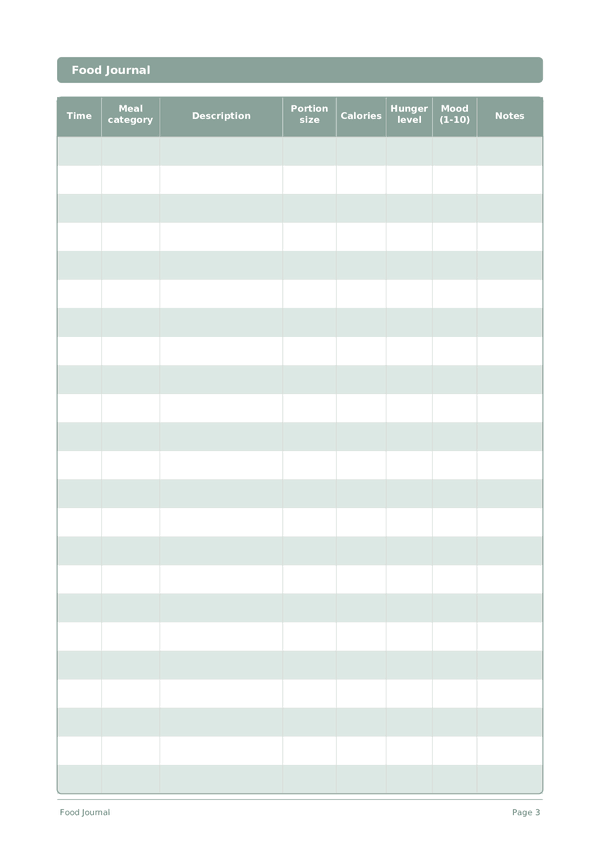
| Time | Meal category | Description | Portion size | Calories | Hunger level | Mood (1-10) | Notes |
|---|---|---|---|---|---|---|---|
| 7:30 | Breakfast | Oatmeal with blueberries, walnuts, and honey. Black coffee. | 1 bowl, 1 cup | 420 | 7 | Rested, calm | Felt satisfied until mid-morning |
| 10:15 | Snack | Greek yogurt with a drizzle of honey | 150g | 130 | 4 | Focused | Light snack before a meeting |
| 13:00 | Lunch | Grilled chicken salad with mixed greens, cherry tomatoes, cucumber, feta, olive oil dressing. Whole wheat roll. | Large bowl, 1 roll | 580 | 8 | Hungry, slightly stressed | Ate at my desk, felt rushed |
| 16:00 | Snack | Apple with almond butter | 1 medium apple, 1 tbsp | 195 | 5 | Afternoon slump | Craving something sweet |
| 19:30 | Dinner | Baked salmon with roasted sweet potatoes and steamed broccoli. Glass of white wine. | 150g salmon, 1 potato, 1 cup broccoli | 720 | 7 | Relaxed | Cooked at home, enjoyed the meal slowly |
| 21:00 | Snack | Chamomile tea and two dark chocolate squares | 1 cup, 20g | 110 | 2 | Content | Not really hungry, just a habit |
How to fill in each field
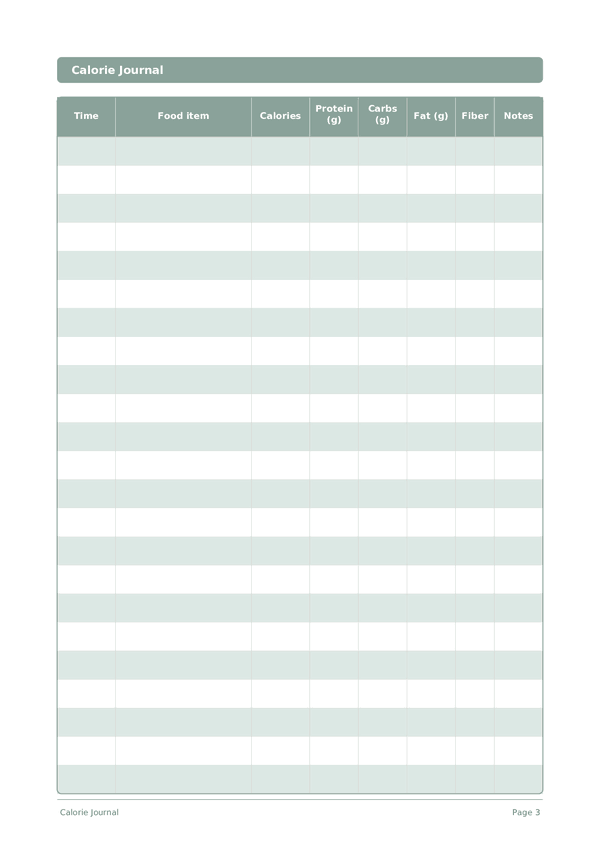
Each page is a table with columns. Fill in one row per entry. Here's what each column is for:
Time
Record what time you ate. Meal timing affects energy, sleep, and digestion. Patterns become visible after a couple of weeks.
Meal category
Description
Write a brief description of what this entry is about. Future-you will thank present-you for the context.
Portion size
Calories
Log your approximate calorie intake. You don't need perfect numbers — estimates help you stay mindful about eating patterns.
Hunger level
How hungry were you overall today? 1 = not hungry at all, 10 = ravenous
Mood (1-10)
Rate your overall emotional state for the day. 1 means very low or depressed, 10 means exceptionally happy and positive. Don't overthink — go with your gut feeling.
Notes
Add any additional context or thoughts. This catch-all column is for anything that doesn't fit elsewhere but might be useful later.
Tips for success
When and how often to write
Log every meal and snack as close to real-time as possible — this is a table-based journal, so each entry is quick: food, portion, time. Aim for completeness over detail; a simple entry is better than a skipped one. Review your food log weekly to spot patterns: late-night eating, skipped meals, emotional triggers. Share your monthly summary with a nutritionist if you are working on dietary goals. Most people see their biggest insights after 2-3 weeks of consistent logging.
Frequently Asked Questions
How does the hunger level 1–10 scale support mindful eating?
The Academy of Nutrition and Dietetics recommends the hunger-fullness scale (1=starving, 5=neutral, 10=stuffed) to distinguish physical hunger from emotional eating. Rating before each meal interrupts automatic eating. American Journal of Clinical Nutrition (2014, 100(2)) shows mindful eaters consume fewer calories with greater satisfaction. The template's pre-meal hunger column turns an internal cue into a recordable habit, supporting weight goals without restriction.
Why log mood alongside meals?
Per APA (2021) and obesity research in JAMA (2018, 319(7)), 30–60% of overeating episodes are emotion-driven (stress, boredom, sadness, celebration). Logging mood next to food reveals patterns calorie counting alone can't see. After 2–3 weeks, most users identify 1–3 emotional triggers — knowledge that enables targeted interventions like the HALT check (Hungry, Angry, Lonely, Tired) before eating.
How is a food journal different from a calorie counter?
A food journal emphasizes context — meal timing, hunger, mood, portion — rather than precise numbers. USDA Dietary Guidelines (2020–2025) and Cochrane reviews support both approaches. The food-journal template includes calorie estimation as a single column among eight, intentionally de-emphasizing numerical precision. This works better for users prone to disordered eating or who find strict calorie counting unsustainable, per APA guidance.
Should I weigh portions or eyeball them?
For accuracy, weighing on a kitchen scale during the first 1–2 weeks calibrates your portion estimates — eyeballed values are typically off by 20–40% per American Journal of Clinical Nutrition (2018, 107(6)). After calibration, hand-based measures (palm=protein, fist=carbs, thumb=fats) work for most meals. The portion size column accepts any consistent unit — grams, cups, handfuls — as long as you stick with it.
Can this journal help identify food sensitivities?
Yes, when used systematically. AAAAI (American Academy of Allergy, Asthma & Immunology) and AAP recommend a 2–4 week elimination diet with detailed food logging to identify sensitivities. Use the notes column to track symptoms (bloating, headache, fatigue, skin reactions) within 24–48 hours of meals. For suspected allergies (anaphylaxis, hives), consult an allergist; this is screening, not diagnosis.
What meal categories should I use?
Standard categories per USDA Dietary Guidelines: Breakfast, Lunch, Dinner, Snack. Some users add 'Drink' for caffeinated or alcoholic beverages. The meal category column accepts free text — consistency matters more than the exact label. Tracking 3 meals + 2 snacks daily reveals eating-frequency patterns; ADA Standards of Care (2024, Diabetes Care, 47 Suppl 1) link irregular meal timing to higher glycemic variability.
How long until I see patterns in my food journal?
Most users identify clear patterns in 2–3 weeks. Behavior research from NIH NCCIH (2022) shows 21 days of consistent logging is the typical threshold for self-insight. Review weekly: cluster meals by category, look for late-night eating, identify high-hunger times, and connect mood with specific foods. Bring 4+ weeks to a registered dietitian for personalized analysis.
Is food journaling safe for someone with disordered eating history?
Use with clinician guidance. APA and the Academy for Eating Disorders note that detailed food tracking can worsen anorexia, bulimia, binge eating disorder, or orthorexia by reinforcing food preoccupation. If you have such a history, consider focusing on hunger and mood ratings without calorie counts, or use only the notes column. A registered dietitian or eating disorder specialist can adapt the journal safely.
You Might Also Like
Scroll to zoom, drag to move