Printable Grief Journal
Navigate loss with compassion and courage
A structured companion for the grief journey. Each day you track the intensity of your grief and sleep, write freely about what you feel, honour memories, and practise small acts of self-care. Research shows that directed expressive writing — combining emotional release with meaning-making — supports long-term healing far better than unguided journaling alone.
Customize fields
Toggle fields on or off. Click the pencil to rename, or add your own fields.
Benefits
How to Use
What is this journal?
A grief journal is a gentle daily companion for navigating the landscape of loss. By tracking grief intensity and sleep alongside writing about feelings, memories, and letters to the person you have lost, you create a sacred space where grief can be witnessed, honored, and gradually integrated into your life.
This journal is for anyone moving through grief — the loss of a loved one, a pet, a relationship, a career, or any significant loss that has reshaped your world. Grief does not follow a timeline, and this journal does not ask it to. It simply creates space for whatever is true today.
Bereavement research has moved beyond the outdated "five stages" model to recognize that grief is not linear but wavelike — coming and going with varying intensity. Writing through grief has been shown to reduce complicated grief symptoms, improve physical health markers, and help mourners find meaning in loss. This journal supports the natural rhythm of your grief while ensuring you do not grieve in isolation.
Filled example
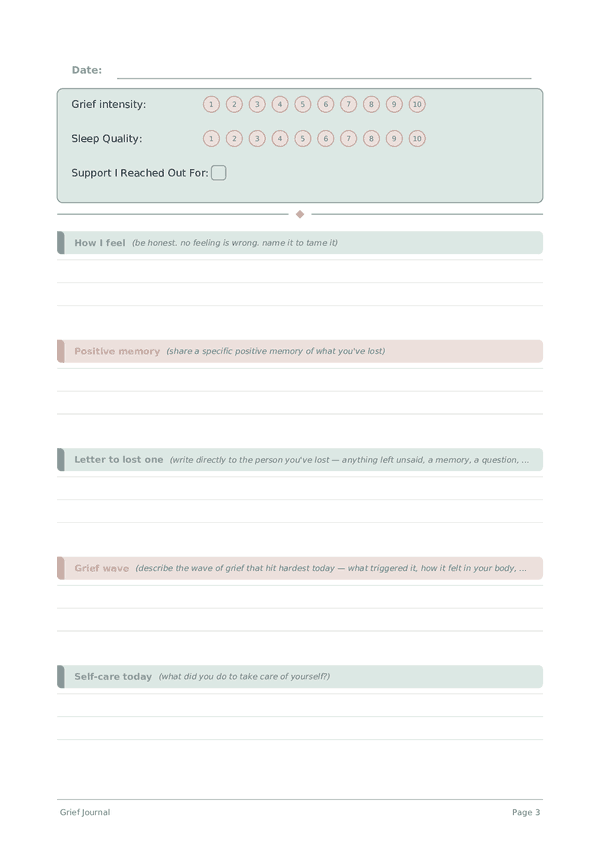
Here's what a typical entry looks like when filled in:
How to fill in each field
The top of each page has quick-fill fields (ratings, checkboxes, numbers). Below that is a lined section for writing. Here's what each field means:
Grief intensity
How intense is your grief right now? Rate from 1 (quiet ache) to 10 (overwhelming wave)
Sleep Quality
Rate how restful your sleep was. 1 means terrible and restless, 5 means deep and refreshing. Quality matters as much as quantity.
Support I Reached Out For
Did you call, text, or talk to someone — a friend, sponsor, family, or counselor?
How I feel
Describe how you feel right now in your own words. There are no wrong answers. Simply putting feelings on paper reduces their emotional charge.
Positive memory
Share a specific positive memory of what you've lost
Letter to lost one
Write directly to the person you've lost — anything left unsaid, a memory, a question, or simply 'I miss you'
Grief wave
Describe the wave of grief that hit hardest today — what triggered it, how it felt in your body, how long it lasted
Self-care today
What did you do to take care of yourself?
What I'm grateful for today
List 1–3 things you're grateful for today. They can be big or tiny — a good meal, a kind word, sunshine. Gratitude journaling is one of the most scientifically supported well-being practices.
Tips for success
When and how often to write
There is no "right" frequency for grief journaling — write when you need to. In acute grief (the first weeks and months), daily writing provides essential release. As grief becomes integrated, write whenever a wave hits or a memory surfaces. Always journal on significant dates: birthdays, anniversaries, holidays. Over time, you may notice the journal shifts from processing pain to preserving connection — both are healthy and valuable.