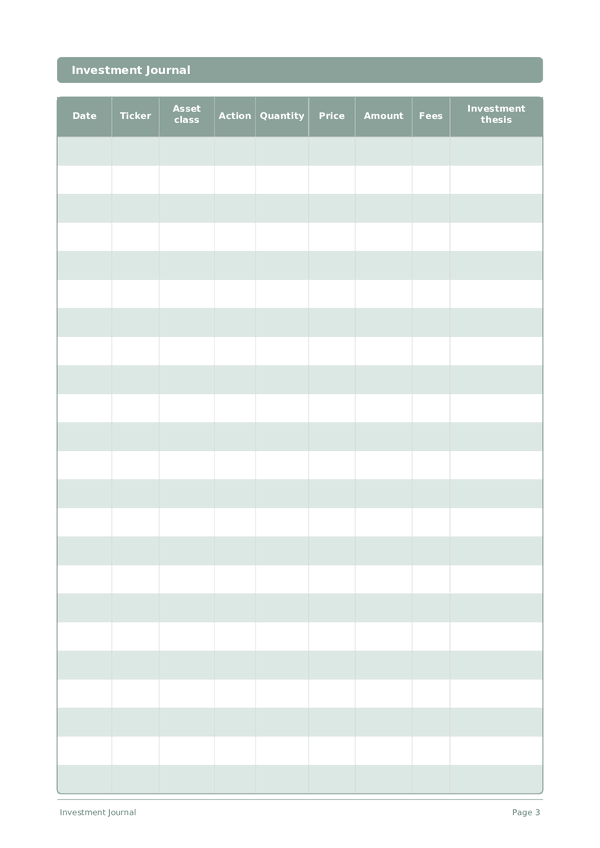
Printable Investment Journal
Track trades, analyze decisions, and grow your portfolio
A structured investment journal for recording every trade — ticker, asset class, price, quantity, and your reasoning behind each decision. Reviewing past entries reveals patterns in your strategy, helps you avoid repeating mistakes, and builds the discipline that separates consistent investors from impulsive ones.
Customize fields
Toggle fields on or off. Click the pencil to rename, or add your own fields.
Benefits
How to Use
What is this journal?
An investment journal is a disciplined record-keeping tool for anyone who actively manages their investment portfolio. By logging every transaction — the ticker, asset class, action taken, quantity, price, total amount, fees, and your investment thesis — you create an invaluable archive of your decision-making process. This journal serves both as a practical ledger and as a learning tool that helps you become a better investor over time.
The most common mistake investors make is acting on emotion rather than analysis. A journal combats this by requiring you to articulate your investment thesis before or immediately after each trade. When you must write down why you are buying or selling, you naturally become more thoughtful and deliberate. Reviewing past entries reveals whether your reasoning was sound, which strategies generated returns, and where emotional decisions led to losses.
Whether you invest in individual stocks, ETFs, bonds, cryptocurrency, or real estate, this journal adapts to any asset class. It is especially valuable during volatile markets, where the temptation to panic-sell or chase gains is strongest. Having a written record of your original thesis provides the anchor of rationality that keeps you on your long-term plan.
Filled example
Here's what a typical entry looks like when filled in:
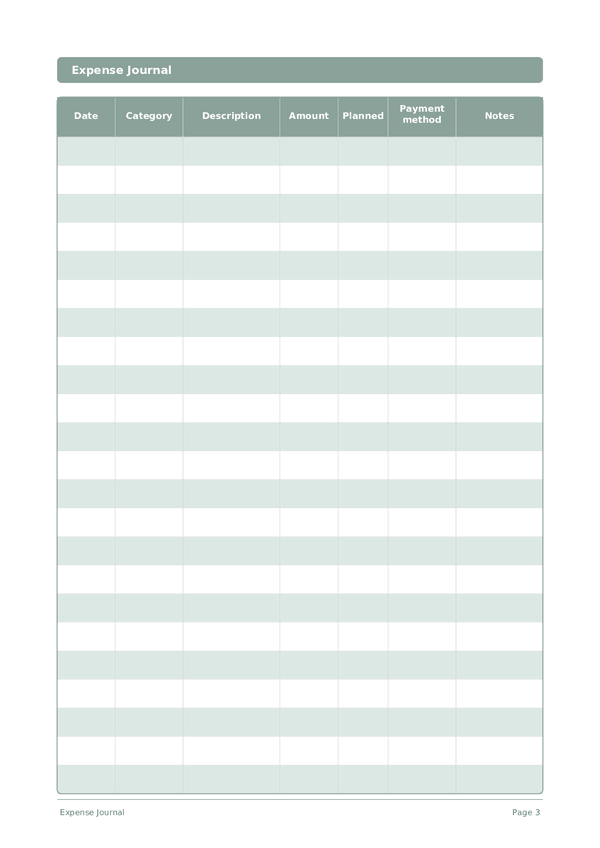
| Date | Ticker | Asset class | Action | Quantity | Price | Amount | Fees | Investment thesis |
|---|---|---|---|---|---|---|---|---|
| 2026-03-01 | VTI | ETF (US Total Market) | Buy | 15 | 268.5 | 4027.5 | 0 | Monthly DCA into broad market index. Long-term core holding. |
| 2026-03-01 | AAPL | Stock (Tech) | Buy | 10 | 192.3 | 1923 | 0 | Strong Services revenue growth, AI integration, attractive P/E after pullback. |
| 2026-03-02 | BND | ETF (Bonds) | Buy | 20 | 72.8 | 1456 | 0 | Rebalancing to 20% bonds allocation. Rate cuts expected in H2 2026. |
| 2026-03-03 | TSLA | Stock (Tech) | Sell | 5 | 245 | 1225 | 0 | Taking partial profits after 35% run-up. Valuation looks stretched. |
| 2026-03-03 | BTC | Crypto | Buy | 0.05 | 82000 | 4100 | 12.3 | Small allocation (2% of portfolio). Halving cycle thesis, long-term hold. |
How to fill in each field
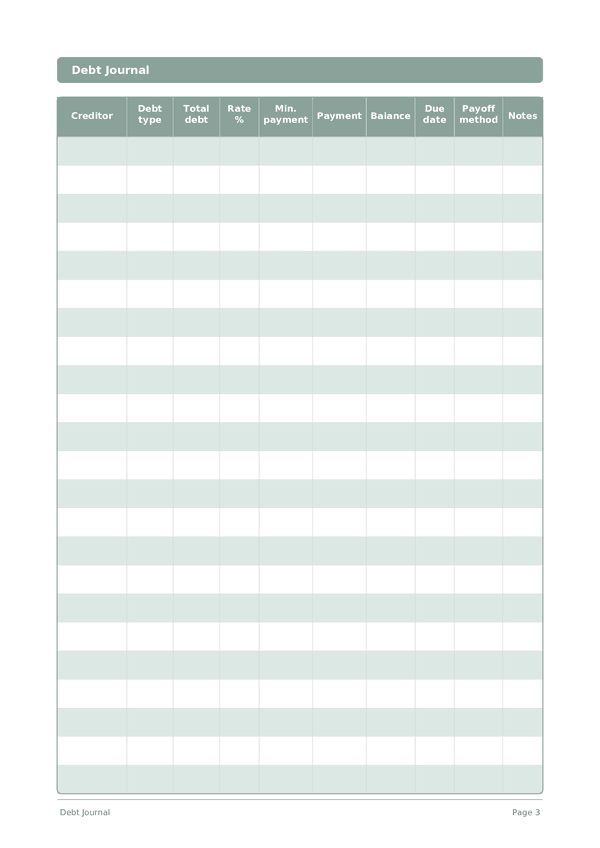
Each page is a table with columns. Fill in one row per entry. Here's what each column is for:
Date
Write today's date. This anchors your entry in time and helps when reviewing entries later.
Ticker
Asset class
Action
Quantity
Price
How much did you pay? Bottle price in your local currency
Amount
Record the amount for this entry. Be precise — rounding creates inaccuracies that add up over time.
Fees
Investment thesis
Tips for success
When and how often to write
Make an entry every time you execute a trade — capture the reasoning, position size, and conviction level in the moment, not after the outcome. For open positions, do a weekly check-in: has the thesis changed? Are you still within your risk parameters? Monthly, review all closed positions and calculate your win rate, average gain vs. average loss, and return by asset class. Quarterly, read back through your thesis entries and grade yourself on discipline.