Printable Language Learning Journal
Daily language learning tracker and study journal
Accelerate your language learning journey with daily practice tracking, vocabulary logging, and progress reflection. Build consistency and fluency one day at a time.
Customize fields
Toggle fields on or off. Click the pencil to rename, or add your own fields.
What is this journal?
A language journal is your personal lab for tracking daily study sessions and measuring real progress over time. Learning a language involves dozens of micro-skills — vocabulary, grammar, listening, speaking, reading — and without a structured log it is easy to mistake busy-ness for progress. This journal fixes that by combining quick metrics with reflective writing after every session.
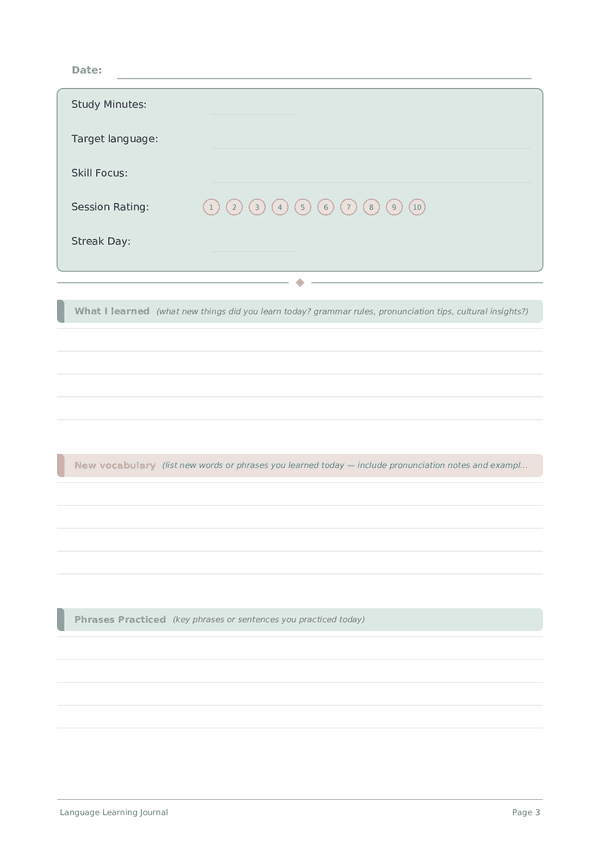
The tracker section captures how long you studied, which language and skill you focused on, your session rating, and your streak day. The writing section is where you consolidate learning: note new vocabulary, record phrases you practised, and jot down grammar rules you encountered. Writing these out by hand strengthens memory and reveals which areas need more attention.
Whether you are working through a textbook, using an app, or practising conversation with a partner, filling in this journal right after your session locks in the gains and gives you a clear roadmap for what to study next.
Filled example
Here's what a typical entry looks like when filled in:
How to fill in each field
The top of each page has quick-fill fields (ratings, checkboxes, numbers). Below that is a lined section for writing. Here's what each field means:
Study Minutes
Total minutes spent studying today
Target language
Which language are you studying? e.g. Spanish, Japanese, French
Skill Focus
Reading, writing, listening, speaking, vocabulary, grammar...
Session Rating
How effective was your session? (1=poor, 5=excellent)
Streak Day
How many consecutive days have you studied?
What I learned
Write one new thing you learned today. It can be a fact, a skill, an insight about yourself, or a life lesson. Daily learning compounds into wisdom.
New vocabulary
List new words or phrases you learned today — include pronunciation notes and example sentences
Phrases Practiced
Key phrases or sentences you practiced today
Grammar Notes
Grammar rules, patterns, or structures you focused on
Tips for success
When and how often to write
Write daily, even if only three sentences in your target language. Polyglot research consistently shows that 10 minutes of daily writing outperforms an hour-long weekly session for language retention. Use your journal as a warm-up before formal study sessions. Weekly, revisit five entries from the past month and correct them with your current knowledge — this spaced review solidifies grammar and vocabulary. Monthly, write one full page entirely in the target language as a benchmark of fluency progress.