Printable Language Learning Journal
Daily language learning tracker and study journal
Accelerate your language learning journey with daily practice tracking, vocabulary logging, and progress reflection. Build consistency and fluency one day at a time.
Customize fields
Toggle fields on or off. Click the pencil to rename, or add your own fields.
What is this journal?
A language journal is your personal lab for tracking daily study sessions and measuring real progress over time. Learning a language involves dozens of micro-skills — vocabulary, grammar, listening, speaking, reading — and without a structured log it is easy to mistake busy-ness for progress. This journal fixes that by combining quick metrics with reflective writing after every session.
The tracker section captures how long you studied, which language and skill you focused on, your session rating, and your streak day. The writing section is where you consolidate learning: note new vocabulary, record phrases you practised, and jot down grammar rules you encountered. Writing these out by hand strengthens memory and reveals which areas need more attention.
Whether you are working through a textbook, using an app, or practising conversation with a partner, filling in this journal right after your session locks in the gains and gives you a clear roadmap for what to study next.
Filled example
Here's what a typical entry looks like when filled in:
How to fill in each field
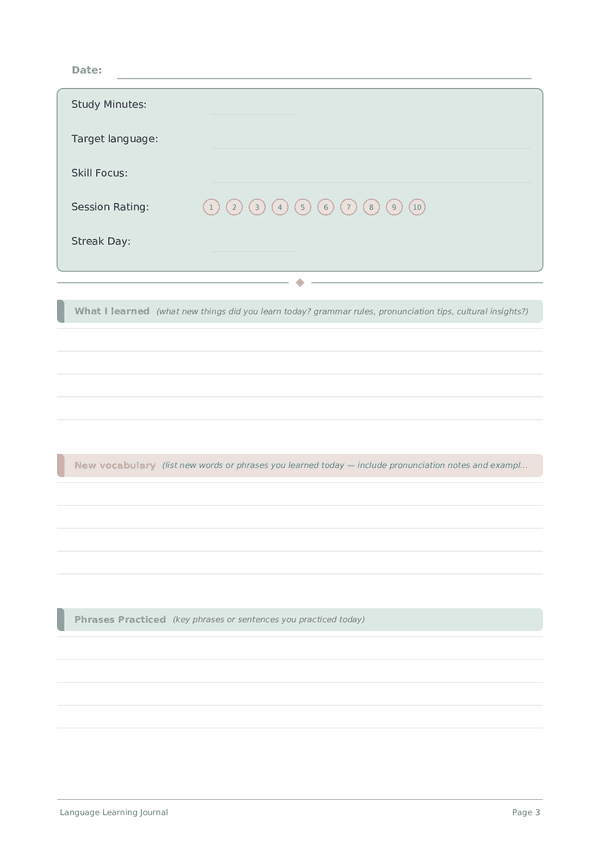
The top of each page has quick-fill fields (ratings, checkboxes, numbers). Below that is a lined section for writing. Here's what each field means:
Study Minutes
Total minutes spent studying today
Target language
Which language are you studying? e.g. Spanish, Japanese, French
Skill Focus
Reading, writing, listening, speaking, vocabulary, grammar...
Session Rating
How effective was your session? (1=poor, 5=excellent)
Streak Day
How many consecutive days have you studied?
What I learned
Write one new thing you learned today. It can be a fact, a skill, an insight about yourself, or a life lesson. Daily learning compounds into wisdom.
New vocabulary
List new words or phrases you learned today — include pronunciation notes and example sentences
Phrases Practiced
Key phrases or sentences you practiced today
Grammar Notes
Grammar rules, patterns, or structures you focused on
Tips for success
When and how often to write
Write daily, even if only three sentences in your target language. Polyglot research consistently shows that 10 minutes of daily writing outperforms an hour-long weekly session for language retention. Use your journal as a warm-up before formal study sessions. Weekly, revisit five entries from the past month and correct them with your current knowledge — this spaced review solidifies grammar and vocabulary. Monthly, write one full page entirely in the target language as a benchmark of fluency progress.
Frequently Asked Questions
What does the Language Learning Journal track per session?
Five tracker items — study minutes, target language, skill focus (listening/speaking/reading/writing/grammar/vocab), session rating (0-10), and streak day — plus four lined rows for what I learned, with prompts for new vocabulary, phrases practiced, and grammar notes. The structure aligns with the four-skills framework used in the CEFR (Common European Framework of Reference for Languages, Council of Europe) and ACTFL guidelines.
Why does the skill focus field matter — can't I just practice the language?
The CEFR and ACTFL proficiency guidelines treat listening, speaking, reading, writing, grammar, and vocabulary as distinct competencies that develop unevenly. Tracking skill focus exposes neglect — most self-learners over-rely on reading and vocabulary apps while avoiding speaking. Rotating focus across sessions builds more balanced proficiency than staying with whatever feels comfortable.
How many minutes a day does it take to make real progress?
20-30 minutes of focused daily practice produces visible CEFR-level progress within 6-12 months for most learners. Krashen's input hypothesis (1985, 'The Input Hypothesis', Longman) argues that comprehensible input is the primary driver of acquisition. The study minutes field tracks volume, but session quality matters more — 20 focused minutes outperform 60 distracted ones.
How much new vocabulary should I log per session?
5-10 high-utility words per session is sustainable; logging more invites forgetting. Paul Nation's vocabulary research consistently shows learners need 6-20 meaningful encounters with a word across different contexts to truly acquire it. Use the new vocabulary field for words encountered in real input, not random lists — context-grounded vocabulary sticks far better than isolated frequency lists.
Why track a streak day count?
Daily consistency drives language acquisition more than session length, especially in early stages. Cepeda et al. (2006, Psychological Bulletin, 132(3), 354-380) demonstrated that distributed practice outperforms massed practice for long-term retention — and language learning is the textbook case. The streak day field makes consistency visible. A 10-minute day still counts; protect the streak before optimizing volume.
How is this different from Duolingo or Anki?
Apps deliver content and drill recall; this journal builds metacognition. The session rating and 'what I learned' fields prompt you to articulate what you actually understood — Roediger and Karpicke (2006, Psychological Science, 17(3), 249-255) show that this kind of retrieval and elaboration strengthens memory. Use both: apps for input and spaced repetition, the journal for reflection and skill rotation. They address different parts of acquisition.
What goes in the grammar notes section?
One rule or pattern that confused or clarified something in today's session — not a textbook summary. Example: 'Spanish ser vs. estar — ser for permanent traits (soy alta), estar for temporary states (estoy cansada).' Brief, personally meaningful entries are easier to recall than reformatted references. Over weeks, these notes become a personal grammar handbook organized by your actual confusions, not a textbook's sequence.
Is this journal useful for both beginners and advanced learners?
Yes, but the focus shifts. Beginners use skill focus to ensure they don't skip speaking; advanced learners use it to push weaker skills, often writing or formal speaking. The CEFR levels A1-C2 (Council of Europe) describe what each level requires across the four skills. Use the session rating to gauge whether your sessions are challenging enough — comfort plateaus stall progress fastest.
You Might Also Like
Scroll to zoom, drag to move