Printable Legacy Journal
Preserve your life stories and wisdom for generations to come
A legacy journal is more than a diary — it is a gift to the future. Write down the memories, turning points, and hard-won lessons that shaped you. Capture the people who mattered, the values you lived by, and the wisdom you wish you had known sooner. Each entry becomes a permanent record your children, grandchildren, and great-grandchildren can return to long after you are gone.
Customize fields
Toggle fields on or off. Click the pencil to rename, or add your own fields.
Benefits
How to Use
What is this journal?
A legacy journal is a life-story writing practice designed to preserve your experiences, wisdom, and values for future generations. Each entry captures a story from a specific period of your life, the people who shaped it, the lessons you learned, and the advice you would pass on — creating a written gift that outlasts you.
This journal is for anyone who wants to leave more than photographs behind. It is for grandparents preserving their stories for grandchildren, for parents documenting the journey of building a family, and for anyone at any age who recognizes that their ordinary life contains extraordinary wisdom worth sharing.
Research on narrative identity shows that the stories we tell about our lives give meaning to our experiences and shape how future generations understand their own identity. Families who pass down stories create stronger bonds across generations. Your legacy journal is not just a record — it is a bridge between your lived experience and the wisdom your descendants will need.
Filled example
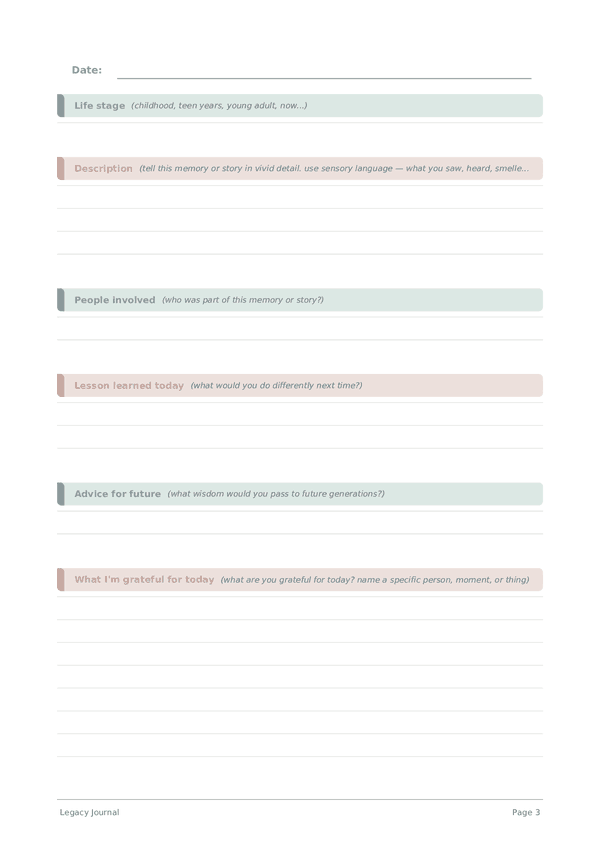
Here's what a typical entry looks like when filled in:
How to fill in each field
Each day you'll find several labeled sections with lines for writing. Here's what each section is for:
Life stage
Childhood, teen years, young adult, now...
Description
Write a brief description of what this entry is about. Future-you will thank present-you for the context.
People involved
Who was part of this memory or story?
Lesson learned today
Capture one insight from today's experience. Over time, these lessons become a personal wisdom library.
Advice for future
What wisdom would you pass to future generations?
What I'm grateful for today
List 1–3 things you're grateful for today. They can be big or tiny — a good meal, a kind word, sunshine. Gratitude journaling is one of the most scientifically supported well-being practices.
Tips for success
When and how often to write
Write one entry per day, focusing on a single story, value, or piece of wisdom. Depth matters more than breadth — a richly told 15-minute story is worth more than a hurried overview of your entire childhood. Weekly, choose a theme: one week for childhood memories, another for career lessons, another for relationship wisdom. There is no deadline for a legacy journal, but there is urgency — the memories you don\u2019t write down are the ones that disappear.
Frequently Asked Questions
How is a legacy journal different from a memoir or autobiography?
A memoir is a published narrative shaped for readers; a legacy journal is an accumulating personal record for descendants, written one entry at a time. Erikson's stages of psychosocial development (Erikson, 1950, Childhood and Society) place the late-life task of integrity-versus-despair at the heart of generativity — passing meaning forward. The journal's six fields (life stage, description, people, lesson, advice, gratitude) scaffold that work without requiring book-length structure or literary craft.
How do I choose what life events deserve a legacy entry?
Erikson (1950, Childhood and Society) and later researchers on the life-review process emphasize turning points: moments that changed your direction, beliefs, or relationships. The Oral History Association methodology suggests focusing on decisions made, lessons learned the hard way, and the people who altered your path. Don't document every birthday — instead, pick the 50-100 events whose absence would leave a fundamentally incomplete picture of who you became.
What should I write in the lesson learned and advice for future sections?
These fields anchor Erikson's generativity stage (Erikson, 1950, Childhood and Society) — wisdom transferred is wisdom preserved. Write the lesson as a specific causal observation: 'I learned that...' rather than abstract maxim. Advice should be concrete and conditional: 'If you face X, consider Y.' Oral History Association practitioners note that descendants find specific, hard-won lessons more valuable than generic encouragement; honesty about mistakes carries more weight than curated wisdom.
Why include people involved and grateful for in every entry?
Erikson (1950, Childhood and Society) frames identity as deeply relational; lives are made by people, not events alone. The what I'm grateful for today field draws on positive psychology research summarized by the American Psychological Association linking gratitude practice to well-being. Naming people preserves family memory — descendants frequently know names but not stories. Together, these fields keep the journal from becoming a list of accomplishments and ground each entry in relationship and meaning.
Is this journal suitable if I'm in my 30s or 40s — or only for older adults?
Suitable at any age. Erikson's (1950, Childhood and Society) generativity stage typically activates in midlife, around the 40s, but the Oral History Association documents value in starting earlier — memories under 20 years old retain reliable detail. Younger writers should focus on formative events: education, early career, becoming a parent. Waiting until 70+ means losing decades of texture; start now and add older memories as they surface.
How do I write about painful or shameful events for future readers?
Erikson's integrity stage (Erikson, 1950, Childhood and Society) explicitly requires honest reckoning, not curated highlights. Pennebaker's expressive writing research (Writing to Heal, 2004, New Harbinger) shows that writing about difficult experiences benefits the writer. For descendants, honest accounts of failure and recovery often prove the most useful inheritance. If a story is too raw to share now, write it anyway and seal it with instructions for later opening — the act of recording matters.
How often should I write, and how long should each entry take?
There is no single research-based cadence, but Pennebaker's expressive writing protocols (Writing to Heal, 2004) suggest 15-20 minute focused sessions. Weekly or biweekly entries sustain practice without burnout. The six-field structure typically takes 30-45 minutes per entry done thoroughly. Over 2-3 years of weekly writing, you accumulate 100-150 entries — a substantial inheritance. Quality and specificity matter far more than volume.
Common mistakes that weaken a legacy journal?
First, sanitizing — only the wins, never the failures, produces an unbelievable record. Second, abstraction — 'family is important' is less useful than the specific Christmas your grandfather drove three hours through snow. Third, skipping the life stage field, leaving descendants unable to place events chronologically. Fourth, writing for a wide audience rather than specific descendants — Oral History Association practitioners note that naming intended readers sharpens voice and honesty.
You Might Also Like
Scroll to zoom, drag to move