Printable Lessons Learned Journal
Extract wisdom from every experience and grow faster
Stop letting valuable lessons slip away. This structured daily journal guides you through the full after-action cycle — from describing what happened and the outcome, to distilling the core lesson, imagining what you would do differently, and committing to concrete next steps. Grounded in after-action review methodology used by top organisations and reflective learning research, it transforms experience into lasting personal growth.
Customize fields
Toggle fields on or off. Click the pencil to rename, or add your own fields.
Benefits
How to Use
What is this journal?
A lessons learned journal is a daily practice for extracting wisdom from experience. Each entry records a situation, its outcome, and — most importantly — the lesson embedded in it. Over time, you build a personal wisdom library that transforms mistakes into assets and experience into genuine expertise.
This journal is for lifelong learners, professionals who want to accelerate their growth, and anyone who believes that experience alone does not teach — reflection on experience teaches. It is particularly valuable for leaders, managers, and entrepreneurs who make decisions in complex, uncertain environments.
Research on experiential learning shows that professionals who regularly reflect on their experiences develop expertise up to 23% faster than those who simply accumulate experience without reflection. The key is structured reflection — not just asking "what happened?" but "what would I do differently?" and "what concrete steps will I take next time?" This journal provides that structure.
Filled example
Here's what a typical entry looks like when filled in:
How to fill in each field
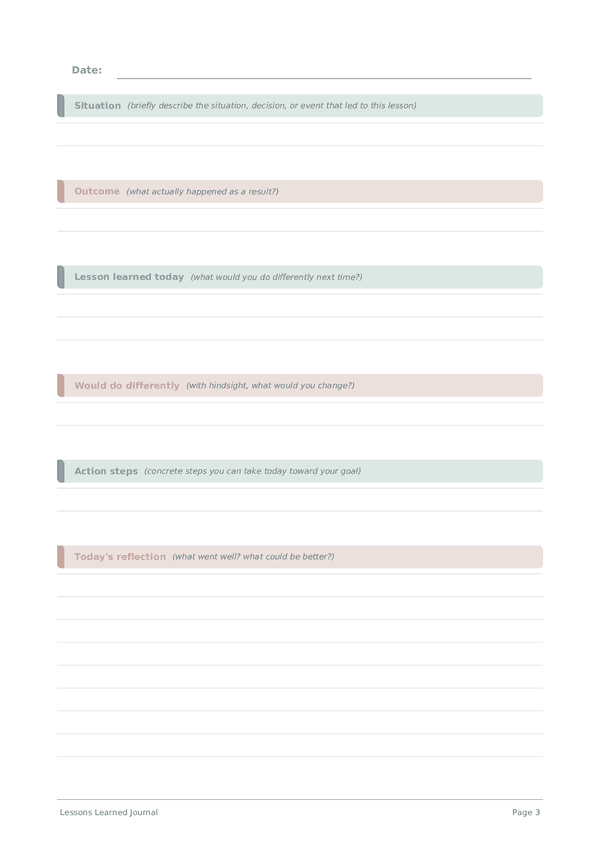
Each day you'll find several labeled sections with lines for writing. Here's what each section is for:
Situation
Describe the situation or event objectively, as if you're a neutral observer. Separating facts from feelings helps you see things more clearly.
Outcome
What actually happened as a result?
Lesson learned today
Capture one insight from today's experience. Over time, these lessons become a personal wisdom library.
Would do differently
With hindsight, what would you change?
Action steps
Break your goal into concrete next actions. What exactly will you do, when, and how? The more specific, the better.
Today's reflection
Look back at your day honestly. What went well? What could be better? This isn't about judgment — it's about learning and growing.
Tips for success
When and how often to write
Write an entry whenever a meaningful experience occurs — aim for at least 3-4 entries per week. The best time is the same evening, while details and emotions are vivid. On Sundays, spend 15 minutes reviewing the week\u2019s lessons and highlight the one that matters most. Monthly, re-read your accumulated lessons and notice which ones you have actually applied versus merely recorded. This review cycle is what transforms isolated observations into lasting personal wisdom.
Frequently Asked Questions
What is the after-action review structure behind this journal?
Each entry has six fields: situation, outcome, lesson learned today, would do differently, action steps, reflection. This mirrors the after-action review methodology originating with the US Army and adopted across organizations — describe what happened, what was supposed to happen, why the gap, and what changes next time. The action steps field is the bridge that converts insight into changed behavior.
Why separate the lesson from the 'would do differently' field?
A lesson is a general insight ('I underestimate prep time'); 'would do differently' is a specific behavioral change ('add 30% buffer to estimates'). Conflating them keeps lessons abstract and unactionable. The split forces both abstraction and concreteness in the same entry. David Allen's Getting Things Done (Penguin, 2001; revised 2015) makes a similar distinction between insight capture and next-action commitment.
How is this different from a regular reflection or diary entry?
Diaries process feelings; this journal extracts transferable knowledge. The structured six-field format prevents drift into rumination — every entry must end in action steps. Reflective learning research consistently shows that structured reflection produces more behavior change than open journaling. The template enforces that structure, making it harder to write entries that feel meaningful but change nothing.
How often should I write entries — daily or after significant events?
Use it after any decision, mistake, or surprising outcome — not on a fixed daily schedule. Most users write three to five entries per week. Forcing daily entries when nothing notable happened produces hollow content. Cal Newport's Deep Work (Grand Central, 2016) emphasizes quality of reflection over quantity. Save the journal for moments that genuinely teach something.
What kind of situations are best worth journaling about?
Three types yield the most insight: outcomes that surprised you (positive or negative), decisions you made under pressure, and repeated mistakes. Sophie Leroy's research on attention residue (2009, Organizational Behavior and Human Decision Processes, 109(2)) suggests that processing context-switching errors specifically reduces their recurrence. The journal's situation and would do differently fields directly target this.
How long until lessons translate into real behavioral change?
Most users see behavioral shifts on specific patterns after four to eight weeks of consistent use. The action steps field is the conversion mechanism — without it, lessons stay theoretical. Lally et al. (2010, European Journal of Social Psychology, 40(6)) found habit formation averaged 66 days, range 18-254. Action steps need to be small enough that you actually do them next time.
What's the most common mistake people make with this journal?
Writing lessons too general to act on. 'Communicate better' is useless; 'send agenda 24 hours before meetings' is actionable. Also: not returning to check if action steps were taken. Edwin Locke and Gary Latham (2002, American Psychologist, 57(9)) showed that specific, feedback-supported goals drive performance — vague resolutions don't. Make every action step concrete enough to be checkable next week.
Can this journal help with team retrospectives or project reviews?
Yes — the structure parallels formal after-action reviews used in project management. For team use, fill in situation and outcome collaboratively, then capture individual lessons before sharing. The action steps field becomes the retro's commitment list. Harvard Business Review and MIT Sloan Management Review both feature this practice as a core organizational learning tool when consistently applied.
You Might Also Like
Scroll to zoom, drag to move