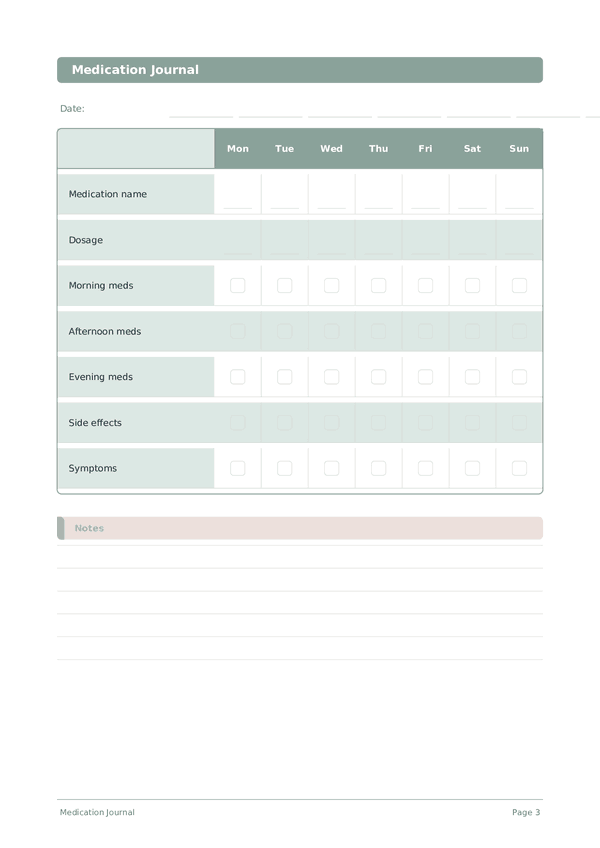
Printable Medication Journal
Never miss a dose with medication tracking
Track morning, afternoon, and evening medication doses alongside symptom presence. Ensure consistent adherence to your treatment plan with clear visual records.
Customize fields
Toggle fields on or off. Click the pencil to rename, or add your own fields.
Benefits
How to Use
What is this journal?
A medication tracker journal is a weekly visual tool designed for anyone taking one or more daily medications. By checking off each dose as you take it — morning, afternoon, and evening — you maintain a clear record of adherence that eliminates the guesswork of "did I take my pill today?" This journal is invaluable for people managing chronic conditions, post-surgical recovery, or complex multi-drug regimens.
Medication adherence is one of the most critical factors in treatment success, yet studies show that up to half of all patients do not take their medications as prescribed. A simple check-mark system makes it easy to build a consistent habit and quickly see any gaps. The journal also tracks side effects and symptoms, helping you and your doctor determine whether a medication is working well or needs adjustment.
Whether you are managing medications for blood pressure, thyroid conditions, mental health, diabetes, or any other condition, this tracker provides accountability and clarity. It is especially helpful when multiple people in a household take medications, or when caring for an elderly family member who needs dosing support.
Filled example
Here's what a typical entry looks like when filled in:
| Mon | Tue | Wed | Thu | Fri | Sat | Sun | |
|---|---|---|---|---|---|---|---|
| Medication name | Lisinopril | Lisinopril | Lisinopril | Lisinopril | Lisinopril | Lisinopril | Lisinopril |
| Dosage | 10mg | 10mg | 10mg | 10mg | 10mg | 10mg | 10mg |
| Morning meds | ✓ | ✓ | ✓ | ✓ | ✓ | ✓ | ✓ |
| Afternoon meds | |||||||
| Evening meds | ✓ | ✓ | ✓ | ✓ | ✓ | ✓ | |
| Side effects | ✓ | ||||||
| Symptoms | ✓ | ✓ |
How to fill in each field
Each page is a weekly grid. Rows are your tracking items, columns are days of the week. Here's what each item means:
Medication name
Dosage
Morning meds
Check off your morning medication. Consistent morning timing is important for many medications to work effectively.
Afternoon meds
Check off your afternoon medication. If you frequently miss this dose, consider setting a phone alarm.
Evening meds
Check off your evening medication. Linking it to a bedtime routine helps build the habit.
Side effects
Symptoms
List symptoms you experienced today. Be specific about type, location, and severity. Patterns in symptoms often point to triggers or treatment needs.
Tips for success
When and how often to write
Mark each dose at the moment you take it — do not rely on end-of-day recall. For medications taken multiple times daily, set phone alarms aligned with your tracking times. At the end of each week, review your adherence rate and note any missed doses with the reason (forgot, side effects, ran out). Before each doctor or pharmacist visit, review your log to report adherence honestly and discuss any side effects. Monthly, verify that your tracked list matches your current prescriptions — medication changes are easily lost without a written record.
Frequently Asked Questions
Why does medication adherence matter so much clinically?
WHO (2003, Adherence to Long-term Therapies) estimates ~50% adherence to chronic disease medications, costing ~125,000 US lives annually per NEJM (2005, 353(5)). AHA and ADA show that missed doses worsen blood pressure, glycemic control, and cardiovascular outcomes. The morning/afternoon/evening checkboxes create a visible adherence record — research shows visible tracking improves adherence by 15-25%.
How should I organize multiple medications on the tracker?
Per AAFP (American Academy of Family Physicians, 2021), list each medication with dose in the dedicated rows. The morning/afternoon/evening columns let you track timing-specific adherence across all medications. Color-code or initial each medication for easy reading. Bring the journal to all medical appointments — polypharmacy management requires accurate adherence data, especially for patients on 5+ medications.
What should I do if I miss a dose?
Per Mayo Clinic and FDA guidance, generally: if it's near the next scheduled dose, skip and continue normally. Do not double-dose unless your physician specifically instructed otherwise. Specific medications (insulin, anticoagulants, immunosuppressants) have unique protocols — check with your pharmacist. Note missed doses in the symptoms column for clinical review. Patterns of missed doses indicate need for reminder systems or schedule changes.
Why log symptoms alongside medication doses?
Per FDA MedWatch and pharmacology guidelines, side effects often emerge within 2-4 weeks of starting a medication. The symptoms checkbox creates a record linking medication timing to new symptoms — essential for distinguishing drug reactions from underlying illness. Document specifics in margins or attached notes. Bring this to medication review appointments; pharmacists and physicians use this data to optimize regimens and identify interactions.
How is this different from pill organizer apps like Medisafe?
Apps send reminders and track adherence digitally, but per NIH NCCIH (2022) and JAMA Internal Medicine (2017, 177(5)), paper tracking shows comparable adherence outcomes with greater privacy. Many medications and adherence patterns are HIPAA-protected health information; sharing with apps creates data-flow concerns. Paper journals are also accepted by clinicians who don't view third-party app data. Combine if useful — app for reminders, journal for medical record.
What's the safest way to track controlled substances?
Per CDC (2022, MMWR Recommendations and Reports, 71(3)) opioid prescribing guidelines and DEA recommendations, log exact times, doses, and remaining quantity to detect early signs of tolerance, dependence, or diversion. The morning/afternoon/evening checkboxes apply, but add quantity tracking in the symptoms column. Bring to every pain management or addiction medicine appointment — accurate records protect patients and clinicians.
How long should I track for medication effectiveness assessment?
Per drug class: antihypertensives reach steady state in 2-4 weeks; SSRIs require 4-8 weeks for therapeutic effect; statins show lipid response in 4-6 weeks; thyroid medications need 6-8 weeks. ADA, AHA, and APA guidelines all reference 4-12 week monitoring windows. Track consistently across this period before assessing efficacy with your physician — too-early evaluation leads to premature changes.
When should medication side effects prompt a doctor call?
FDA MedWatch and Mayo Clinic red flags: rash, swelling (especially face/tongue), severe nausea/vomiting, breathing difficulty, abnormal bleeding, chest pain, severe mood changes, fainting, or signs of allergic reaction warrant immediate physician contact or emergency care. Less severe but persistent side effects (>2 weeks) should be discussed at next appointment. Document onset and severity in the symptoms column — this distinguishes drug effects from illness progression.
You Might Also Like
Scroll to zoom, drag to move