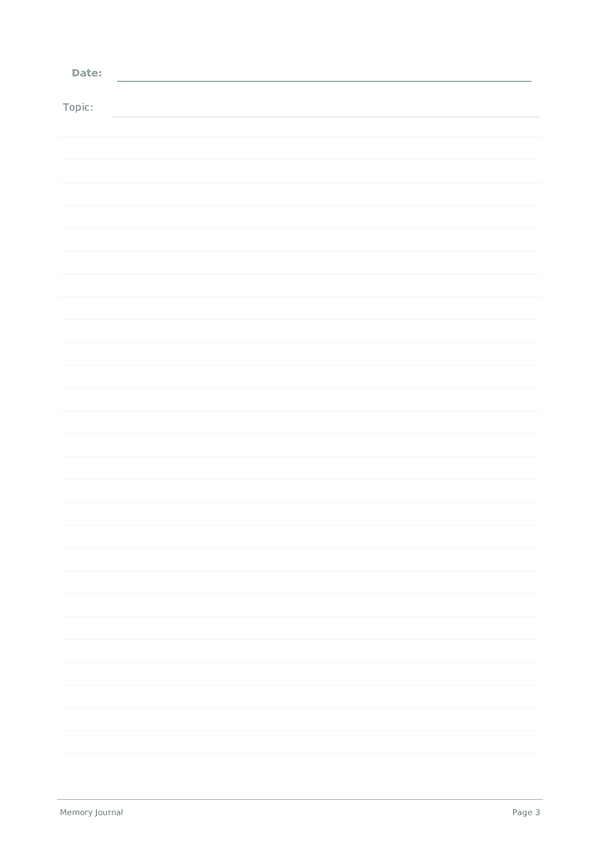
Printable Memory Journal
Preserve your most cherished memories in writing
A freeform lined journal for capturing memories — childhood moments, milestones, everyday scenes, and the people who shaped your life. Write freely, draw, and preserve your personal history before it fades.
Benefits
How to Use
What is this journal?
A memory journal is a freeform writing practice dedicated to preserving your most meaningful memories before they fade. Each entry captures a specific memory in vivid detail — the people present, the emotions felt, and the sensory details that bring the moment back to life on the page.
This journal is for anyone who wants to create a written treasury of their life's most important moments. It is especially valuable for older adults preserving their life story, parents documenting family memories, or anyone who has realized that even our most treasured memories become distorted or lost without deliberate recording.
Memory science reveals a sobering truth: human memory is reconstructive, not reproductive. Each time we recall a memory, we subtly alter it. Written records created close to the event preserve details that would otherwise be lost or changed. Your memory journal becomes the most reliable version of your own story — a gift to your future self and to those who come after you.
Filled example
Here's what a typical entry looks like when filled in:
Tips for success
When and how often to write
Write whenever a memory surfaces clearly — don\u2019t wait for a "journaling session" or the moment will pass. Aim for 2-3 entries per week as a baseline. Morning is often rich for memories, as the brain consolidates during sleep and surfaces them upon waking. When visiting family, old neighborhoods, or looking through photos, bring your journal — these triggers unlock memories that are otherwise dormant. Over years, this journal becomes an irreplaceable personal archive.
Frequently Asked Questions
Why does the journal ask for people present, prompt question, and emotion alongside the memory?
Autobiographical memory research in the journal Memory and the Journal of Experimental Psychology: Learning, Memory, and Cognition consistently shows that contextual cues — who was there, what triggered recall, the emotion attached — strengthen retrieval and consolidation. Pennebaker's expressive writing work (Pennebaker, 2004, Writing to Heal, New Harbinger) similarly emphasizes that naming emotion improves processing outcomes. Without these anchors, written memories often flatten into generic vignettes within months.
Does writing down memories actually help me remember them better long-term?
Yes. Decades of work in the Journal of Experimental Psychology: Learning, Memory, and Cognition document the testing effect and reconsolidation: retrieving and re-encoding a memory strengthens it. Writing forces deliberate retrieval, unlike passive recall. The American Psychological Association notes that elaboration — adding sensory and contextual detail — further consolidates traces. Memories written within days of an event are markedly more accurate than those reconstructed years later from photographs alone.
How is a memory journal different from a regular daily diary?
A daily diary records present events; a memory journal deliberately reaches backward to capture past experiences before they decay. The freeform lined format with date title header lets you write a 1972 wedding entry on Tuesday's page. Pennebaker's expressive writing research (Writing to Heal, 2004) shows that writing about specific past events with emotional content produces measurable benefits, distinct from daily logging. One memory per page keeps each story complete and retrievable.
What sensory details should I include to make a memory vivid?
Research in the journal Memory shows that sensory richness — smell, sound, tactile texture, light quality — is the strongest predictor of vivid recall, more than narrative accuracy. Try to name at least three senses per entry: the smell of your grandmother's kitchen, the texture of a wool coat, the sound of a specific song. The American Psychological Association's autobiographical memory literature confirms these multimodal cues become primary retrieval handles decades later.
Should I write memories chronologically or as they surface?
Write them as they surface. Oral History Association methodology and APA autobiographical memory literature both note that triggered, spontaneous recall is often more accurate and emotionally complete than forced chronological reconstruction. Date each entry with the memory's approximate date in the title field; reorder chronologically only when assembling for family. The prompt question field is specifically designed to capture what triggered today's memory — a song, smell, photograph, or conversation.
Is this journal suitable for processing difficult or painful memories?
It can be, with care. Pennebaker's expressive writing research (Writing to Heal, 2004) documents emotional and even physical health benefits from writing about difficult experiences in 15-20 minute sessions over several days. However, the American Psychological Association distinguishes supportive reflective writing from clinical trauma treatment — for significant trauma, consult a licensed mental health professional. The journal supports memory preservation; it does not replace therapy when distress is severe.
How often should I write, and how many memories per session?
Pennebaker's classic protocol (Writing to Heal, 2004) involved 15-20 minutes of focused writing on consecutive days; for memory preservation, weekly sessions sustain engagement without depleting reserves. Write one memory per page deeply rather than three superficially — APA autobiographical memory research consistently shows depth of elaboration trumps quantity for long-term retention. Aim for 50-100 entries within a year to capture a meaningful slice of life history.
What mistakes blur memories instead of preserving them?
First, generalizing — 'we always went to grandma's' loses the specific Sunday. Memory research in the journal Memory shows specific instances retain detail; aggregates fade. Second, skipping the emotion field; APA research links emotional labeling to retrieval strength. Third, editing for grandchildren's eyes mid-draft, which sanitizes the texture that makes memory authentic. Fourth, waiting decades — start with memories under 20 years old, where detail still survives reliably.
You Might Also Like
Scroll to zoom, drag to move