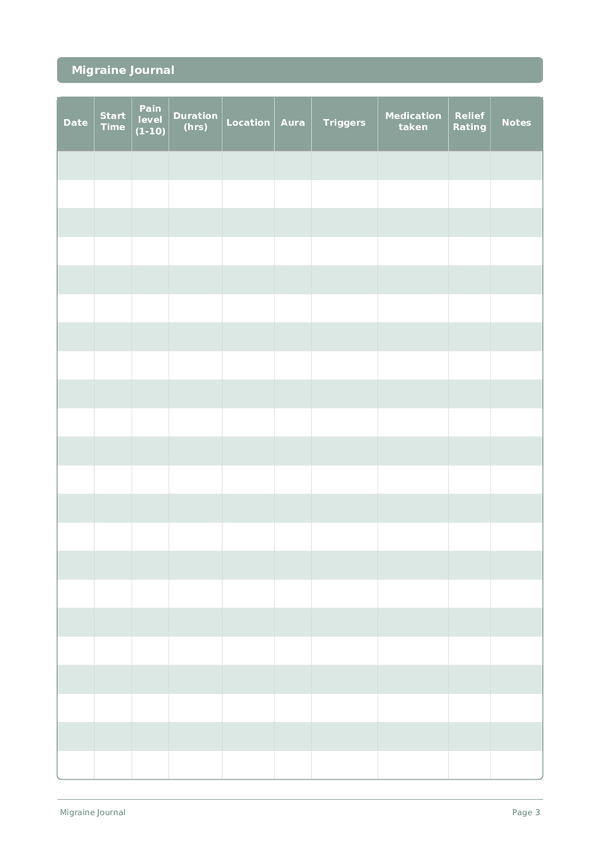
Printable Migraine Journal
Migraine attack tracker and headache diary
Track migraine patterns with detailed attack logging for better diagnosis and treatment. Record triggers, symptoms, medications, and relief outcomes to identify patterns and communicate effectively with your neurologist.
Customize fields
Toggle fields on or off. Click the pencil to rename, or add your own fields.
What is this journal?
A migraine journal is a detailed attack diary designed for anyone who experiences recurrent migraines or severe headaches. By systematically recording each episode — including onset time, pain level, duration, location of pain, aura symptoms, potential triggers, and medications used — you create a medical-grade log that helps both you and your neurologist understand your unique migraine pattern.
Migraines are highly individual, and what triggers one person may have no effect on another. The power of a migraine journal lies in revealing your personal triggers over time. After several weeks of consistent entries, you may discover connections between attacks and factors like sleep changes, certain foods, weather shifts, hormonal cycles, or stress. This insight is invaluable for developing a targeted prevention strategy.
Healthcare providers frequently recommend migraine diaries as part of treatment planning. A well-maintained journal helps your doctor evaluate medication effectiveness, determine whether preventive treatment is needed, and track whether attack frequency is improving. It transforms vague recollections into concrete data that drives better clinical decisions.
Filled example
Here's what a typical entry looks like when filled in:
| Date | Start Time | Pain level (1-10) | Duration (hrs) | Location | Aura | Triggers | Medication taken | Relief Rating | Notes |
|---|---|---|---|---|---|---|---|---|---|
| 2026-02-25 | 14:00 | 7 | 6 | Right temple | Visual spots | Skipped lunch, bright lights | Sumatriptan 50mg | 6 | Had to leave work early |
| 2026-02-27 | 06:30 | 5 | 3 | Both temples | None | Poor sleep (4 hours) | Ibuprofen 400mg | 8 | Woke up with headache, resolved by mid-morning |
| 2026-03-01 | 18:00 | 8 | 10 | Left side | Tingling in hand | Red wine at dinner, stress | Sumatriptan 50mg + Metoclopramide | 5 | Severe nausea, had to lie down in dark room |
| 2026-03-03 | 11:00 | 4 | 2 | Forehead | None | Screen time, dehydration | Paracetamol 500mg | 9 | Mild episode, resolved with medication and water |
How to fill in each field
Each page is a table with columns. Fill in one row per entry. Here's what each column is for:
Date
Write today's date. This anchors your entry in time and helps when reviewing entries later.
Start Time
Pain level (1-10)
Rate your pain intensity on a scale. Tracking pain levels helps identify triggers, evaluate treatments, and communicate with healthcare providers.
Duration (hrs)
Location
Where was the photo taken?
Aura
Triggers
Identify what caused your emotional reactions — events, people, thoughts, environments. Recognizing triggers gives you the power to prepare for or avoid them.
Medication taken
Did you take your medication today? Note what, when, and any doses missed
Relief Rating
Notes
Add any additional context or thoughts. This catch-all column is for anything that doesn't fit elsewhere but might be useful later.
Tips for success
When and how often to write
Log every headache and migraine event as it happens — onset time, symptoms, triggers, and treatment. On headache-free days, still record a brief entry noting sleep quality, stress, and any potential trigger exposures. This baseline data is essential because your doctor needs to see both attack days and non-attack days to identify patterns. Weekly, tally your headache days. Monthly, bring your complete log to your neurologist — studies show patients with migraine diaries receive more accurate diagnoses and better-targeted treatment plans.
Frequently Asked Questions
What information do neurologists need from a migraine diary?
Per American Migraine Foundation and International Headache Society (ICHD-3, 2018) criteria, neurologists need attack frequency, duration, pain intensity (0-10), location, aura presence, triggers, medications, and relief outcomes — all eight columns of this template. Cephalalgia (2019, 39(3)) shows 8-12 weeks of detailed tracking enables differential diagnosis between migraine subtypes, tension headache, and cluster headache.
How does the aura column help with diagnosis?
ICHD-3 (2018) distinguishes migraine with aura (visual, sensory, speech, or motor symptoms preceding pain) from migraine without aura — different management implications. The aura column captures presence and type. Common visual auras: zigzag lines, blind spots, flashing lights. Aura without subsequent headache also occurs. American Migraine Foundation notes ~25-30% of migraine patients experience aura. Document onset timing relative to headache.
Which triggers should I track most carefully?
Per Headache (2019, 59(9)) and American Migraine Foundation: common triggers are stress, sleep changes, menstrual cycle, specific foods (aged cheese, processed meats, alcohol, MSG), weather changes, dehydration, missed meals, and intense sensory stimuli. The triggers column should capture all candidates within 24 hours of attack onset. Patterns require 3-6 months of logging — single attacks rarely identify true triggers.
How do I know if a medication is actually working?
International Headache Society effectiveness criteria: pain reduction from severe (7+) to mild (<=3) within 2 hours, sustained for 24 hours, no recurrence. Log medication name, dose, timing, and relief rating (0-10). Compare across 10+ attacks — single-attack response is unreliable. American Headache Society (2021) recommends preventive medication consideration when attacks exceed 4 days/month or significantly impair function.
What pain levels and durations are clinically meaningful?
ICHD-3 migraine criteria require attacks lasting 4-72 hours (untreated), with moderate-severe pain (5+ on 10-point scale), often unilateral and pulsating. Status migrainosus (continuous attack >72 hours) warrants medical evaluation. The duration (hrs) and pain level (1-10) columns capture this. Headache (2020, 60(3)) data show patients underestimate frequency by 30-50% without daily logging.
How is this journal different from migraine apps like Migraine Buddy?
Apps automate prompts but rely on memory across days for retrospective entry; paper logs encourage immediate post-attack documentation. The structured 10-column format here matches ICHD-3 diagnostic criteria more comprehensively than most apps. Cephalalgia (2020) studies show standardized paper diaries remain the gold standard for clinical trials and neurological consultations. Use both if helpful — app for reminders, journal for the medical record.
When should headaches prompt urgent medical attention?
American Migraine Foundation and Mayo Clinic red flags: 'thunderclap' headache reaching peak intensity in seconds, worst headache of life, headache with fever and stiff neck, neurological symptoms (weakness, vision loss, confusion, slurred speech), headache after head injury, new headache pattern after age 50. These suggest serious conditions (stroke, hemorrhage, meningitis) requiring immediate ER evaluation.
How long until patterns become useful for treatment?
Per American Headache Society, 8-12 weeks of detailed daily logging typically reveals trigger patterns, optimal medication response, and attack frequency baseline. Three months of data is the standard for preventive medication evaluation — assess whether attacks decreased by >=50% in frequency or severity. Bring all pages to your neurologist; trends matter more than single attacks for treatment decisions.
You Might Also Like
Scroll to zoom, drag to move