Printable Minimalism Journal
Daily decluttering and intentional living journal
Guide your minimalism journey with daily decluttering logs, reflections on letting go, and intentions for intentional living. Create space for what truly matters.
Customize fields
Toggle fields on or off. Click the pencil to rename, or add your own fields.
What is this journal?
A minimalism journal is a daily practice for documenting your journey toward a simpler, more intentional life. Each entry records what you decluttered, how it felt to let go, and the space — both physical and mental — that you created. It transforms minimalism from a one-time purge into a sustainable daily practice.
This journal is for anyone drawn to living with less — whether you are in the early stages of decluttering a packed home or already living simply and want to maintain that intentionality. It is equally valuable for digital minimalism, relationship decluttering, and simplifying your schedule.
Research on the psychology of possessions shows that our relationship with objects is deeply emotional. Simply discarding things creates anxiety, but reflective decluttering — where you process the feelings attached to each item — leads to lasting freedom from accumulation. This journal guides that reflective process, making minimalism a practice of self-discovery as much as tidying.
Filled example
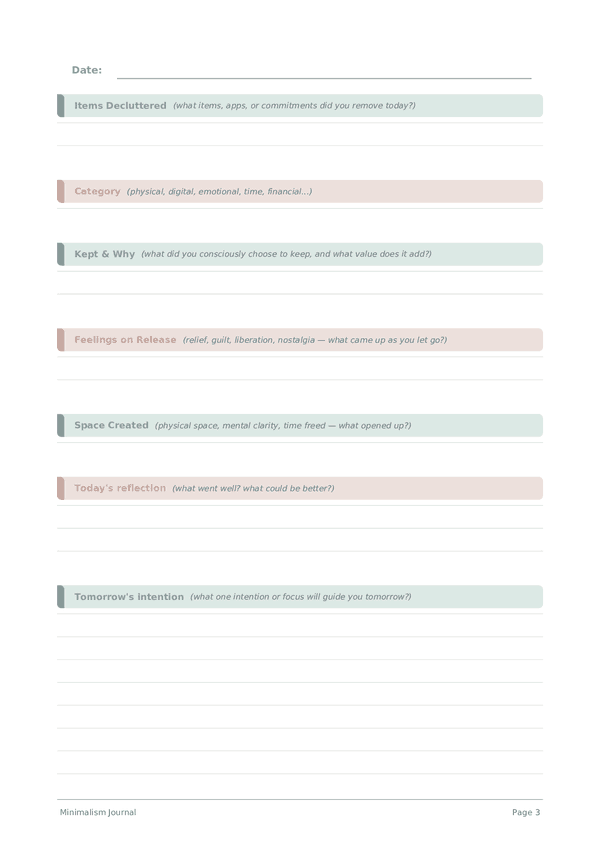
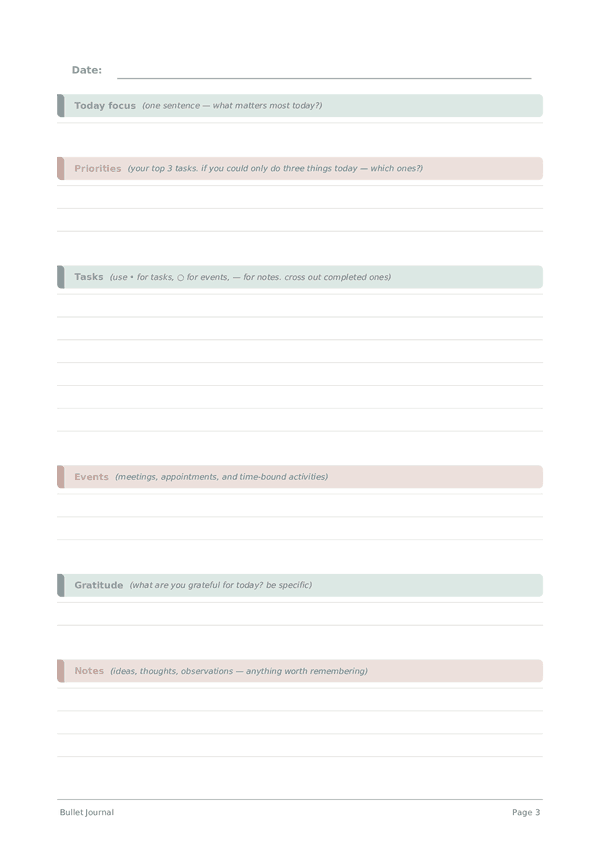
Here's what a typical entry looks like when filled in:
How to fill in each field
Each day you'll find several labeled sections with lines for writing. Here's what each section is for:
Items Decluttered
What items, apps, or commitments did you remove today?
Category
Physical, digital, emotional, time, financial...
Kept & Why
What did you consciously choose to keep, and what value does it add?
Feelings on Release
Relief, guilt, liberation, nostalgia — what came up as you let go?
Space Created
Physical space, mental clarity, time freed — what opened up?
Today's reflection
Look back at your day honestly. What went well? What could be better? This isn't about judgment — it's about learning and growing.
Tomorrow's intention
What one intention or focus will guide you tomorrow?
Tips for success
When and how often to write
Write daily in the evening, reflecting on your relationship with possessions and consumption that day. Each entry takes just 5-10 minutes. Weekly, review your entries to spot consumption triggers and patterns. When you are in an active decluttering phase, write before and after each session to process the emotions that arise. Once your space stabilizes, shift to 3-4 entries per week focused on maintaining intentionality and resisting lifestyle creep.
Frequently Asked Questions
What does each daily entry in the Minimalism Journal capture?
Seven fields per day: items decluttered, category, kept and why, feelings on release, space created, reflection, and tomorrow's intention. The structure tracks both action (what left) and emotion (how letting go felt), recognizing that minimalism is a psychological practice as much as a physical one. Tomorrow's intention turns each entry into a small commitment for the next day.
Why track feelings on release alongside the items decluttered?
Decluttering surfaces strong emotions: guilt over gifts, grief over identity items, relief over hoarded clutter. Logging feelings on release prevents the cycle of declutter-and-replace by exposing emotional triggers. Greg McKeown's Essentialism (Crown Business, 2014) frames this as discerning what truly matters; the feeling field is where you notice when 'I might need it' is actually 'I'm afraid to let go'.
What category system works best for tracking what you let go?
Use broad categories that match your home: clothing, books, paperwork, kitchen, sentimental, digital, duplicates. Cal Newport's Digital Minimalism (Portfolio, 2019) extends the same logic to apps and notifications. After two to four weeks, a weekly review of category totals reveals which life domains hold the most excess, usually a surprise, and where your attention is needed next.
Why is the 'kept items' field as important as what you decluttered?
Listing what you chose to keep forces conscious endorsement. Without this field, decluttering becomes purely subtractive, and you don't develop clarity about what genuinely earned its space. McKeown's Essentialism (Crown Business, 2014) calls this the 'less but better' shift: the goal isn't empty space, it's space filled deliberately. Every kept item should pass an explicit reason check.
How is this different from following Marie Kondo's KonMari method?
KonMari is a one-time category-by-category purge; this journal supports daily incremental practice. Both share core principles, conscious choice and gratitude toward objects, but the journal suits people who can't dedicate weekends to mass decluttering and prefer slow, sustainable change. Daily entries also build the reflection muscle that prevents future accumulation, which one-time purges often don't address.
Will this journal help if I have hoarding tendencies?
It can support gradual change for general clutter habits, but clinical hoarding disorder requires qualified professional treatment, typically cognitive-behavioral therapy with a clinician who specializes in hoarding. The feelings on release field may help you notice patterns, but it is not a clinical instrument. If decluttering causes significant distress or impairs daily life, please consult a mental-health professional rather than relying on a self-help journal.
How long until decluttering becomes a stable practice?
Lally et al. (2010, European Journal of Social Psychology, 40(6)) found habit formation averaged 66 days, range 18-254. For minimalism, expect 8-12 weeks of daily entries before letting go feels routine rather than effortful. The tomorrow's intention field acts as the BJ Fogg-style (Tiny Habits, 2019) tiny next step, making consistency easier than ambitious one-room blitzes.
What's the most common mistake with a minimalism journal?
Treating it as a counting exercise, chasing item totals rather than capturing reflection. Decluttering 30 items mindlessly is less valuable than decluttering three items with honest feelings on release entries. McKeown's Essentialism (Crown Business, 2014) warns against substituting visible activity for genuine clarity. The reflection and tomorrow's intention fields are where the practice deepens beyond a tidy house.
You Might Also Like
Scroll to zoom, drag to move