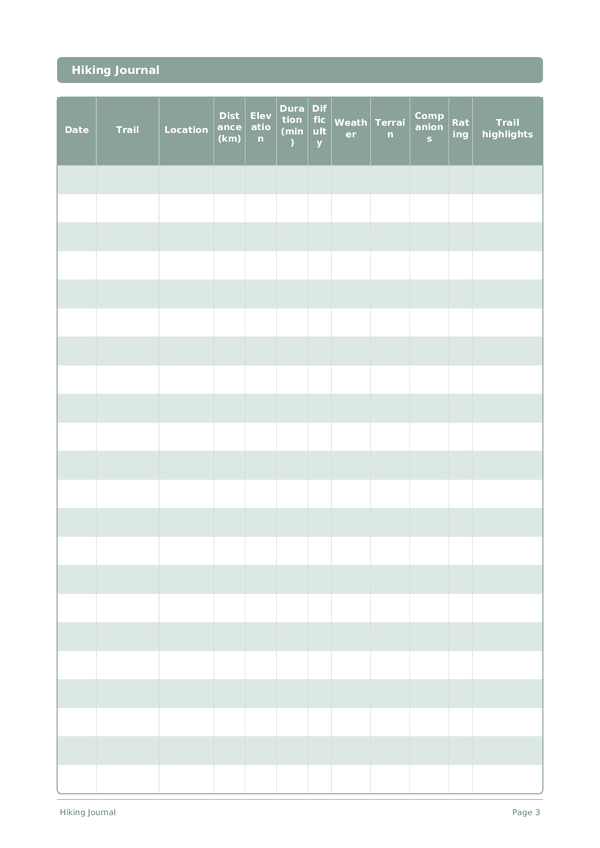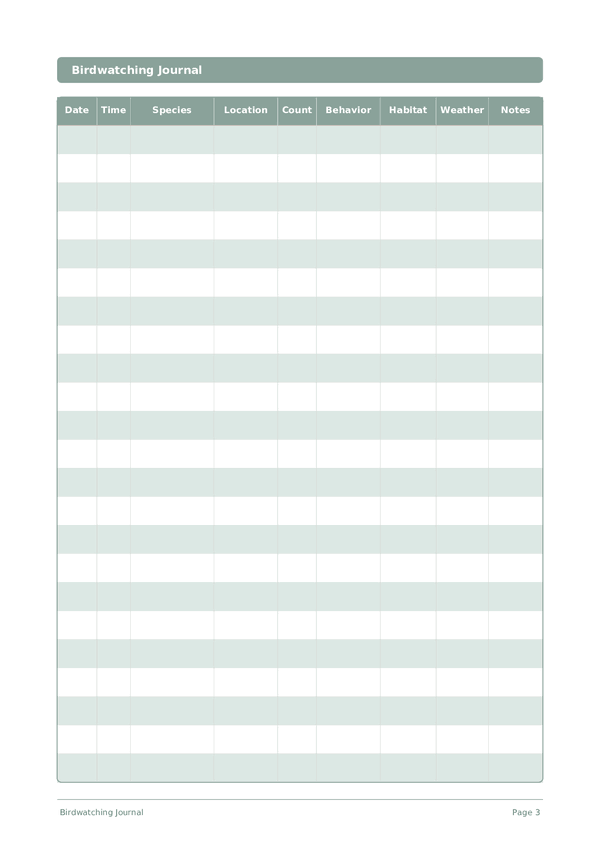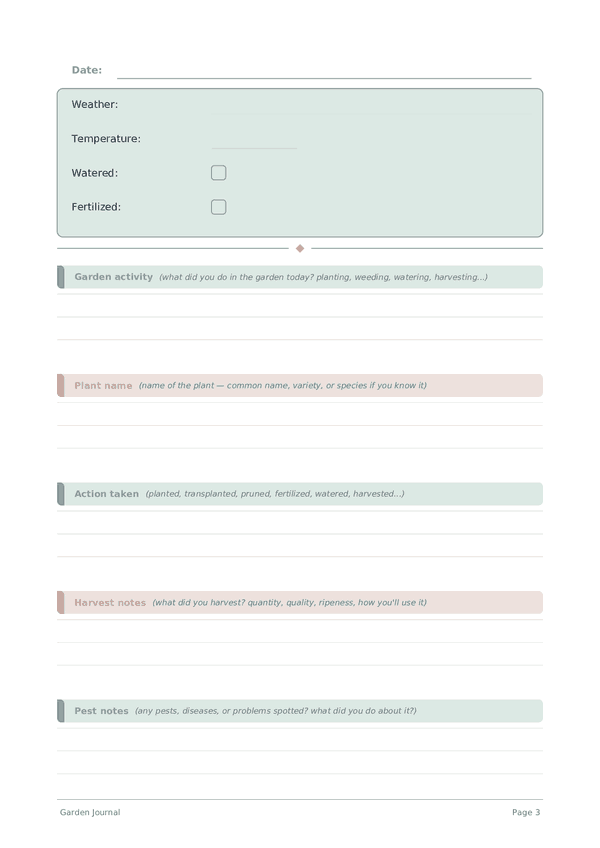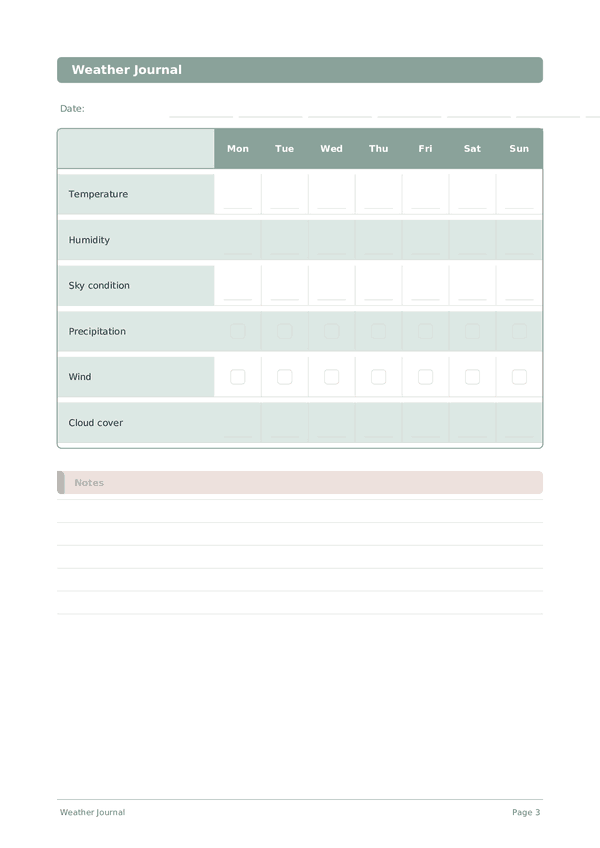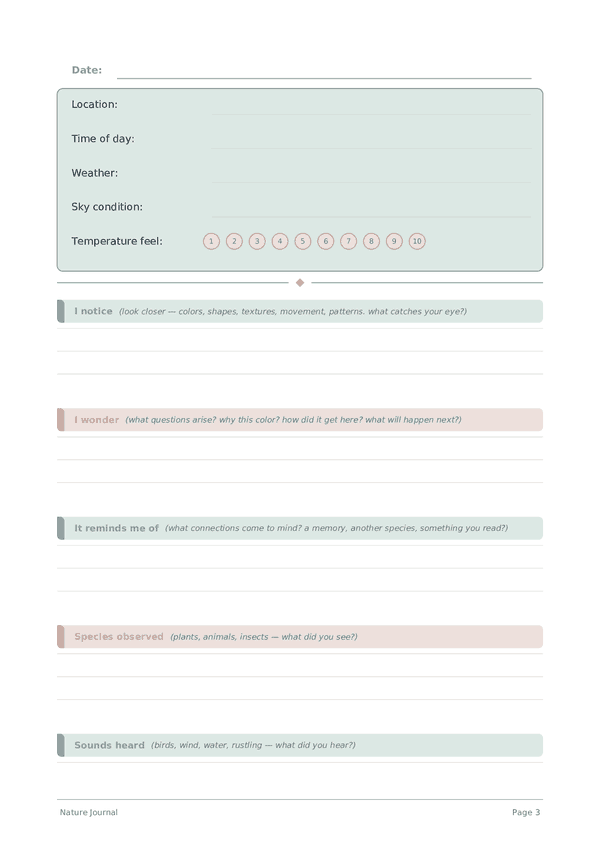
Nature Journal — page preview

Printable Nature Journal

Observe, wonder, and connect with the natural world

Hybrid Travel & Nature

A structured nature journal inspired by the John Muir Laws method of "I Notice, I Wonder, It Reminds Me Of." Each page combines quick environmental data — location, weather, sky conditions, and temperature — with guided observation prompts that train you to see nature more deeply. Record species, sounds, and sketches alongside your reflections to build a personal field record over time.


Print-ready A4 / Letter 100% Free 3 downloads

days
Customize fields

Toggle fields on or off. Click the pencil to rename, or add your own fields.

Download Free PDF

Benefits

Sharpen observational skills through structured prompts
Deepen your connection to local ecosystems and seasonal rhythms
Build a personal biodiversity record of your area
Develop scientific curiosity through the "I Wonder" practice
Reduce stress through mindful outdoor engagement
Track weather patterns and their effect on wildlife activity

How to Use

Fill in the top section with your location, time, weather, sky condition, and temperature feel
In "I Notice" write everything you observe — colors, shapes, textures, movement
In "I Wonder" turn observations into questions — don't worry about answering them
In "It Reminds Me Of" draw connections to memories, other species, or things you've read
List specific species you saw and sounds you heard
Use the sketch section for quick drawings with labels — artistic skill is not required

What is this journal?

A nature journal is a daily observation practice that trains you to see the natural world with fresh, attentive eyes. By recording what you notice, what you wonder about, and what species you observe, you develop the naturalist's art of careful attention that transforms any outdoor moment into a discovery.

This journal is for nature lovers, aspiring naturalists, environmental educators, and anyone who wants to slow down and actually see the world around them. You do not need to be an expert — the practice of noticing and wondering is itself the skill being developed.

Environmental education research shows that regular nature journaling increases ecological awareness, scientific thinking skills, and reported connection to the natural world. The practice of writing "I notice" and "I wonder" — championed by naturalist John Muir Laws — bypasses the need for expert knowledge and activates genuine curiosity, making every outdoor experience richer and more meaningful.

Filled example

Here's what a typical entry looks like when filled in:

Tuesday, March 4
Location Riverside Park, west bank trail
Time of day 7:30 AM
Weather Cool, light mist
Sky condition Overcast, thin cloud layer
Temperature feel 4/10
I notice
The willow trees along the river are the first to show green — tiny lime-colored buds have appeared overnight. The rest of the trees are still bare. Frost on the grass but not on the path. A spider web between two fence posts, heavy with dew drops, catching what little light there is.
I wonder
Why do willows bud before other trees? Is it their proximity to water, their species biology, or both? I wonder if the spider web was built last night or if the spider has been maintaining it for days. Do spiders repair or rebuild?
It reminds me of
The mist on the river reminds me of mornings at my grandparents' lake house — that same quality of silence where sound carries differently. The willow buds remind me that spring does not arrive all at once; it sends scouts ahead.
Species observed
3 mallard ducks on the river (2 males, 1 female). A great blue heron standing motionless in the shallows. At least 4 species of birds singing that I could not identify. One squirrel burying something near the oak tree.
Sounds heard
The river — a constant low rush. A woodpecker drumming somewhere upstream. Morning birdsong — layered, multiple species, surprisingly loud for 7:30am. My own footsteps on the gravel path. Distant traffic, barely audible.
Sketch & notes
Quick sketch of the spider web with dew — tried to capture how the drops lined up along each strand. Also sketched the willow bud close-up: more complex than I expected, with tiny folded leaves visible inside a papery sheath.

How to fill in each field

The top of each page has quick-fill fields (ratings, checkboxes, numbers). Below that is a lined section for writing. Here's what each field means:

Location

Where was the photo taken?

Time of day

Morning, afternoon, evening, night

Weather

Sunny, cloudy, rain, wind — current conditions

Sky condition

What does the sky look like right now? Describe clouds, clarity, or weather

Temperature feel

How does the temperature feel on your skin? Describe it in your own words

I notice

Look closer — colors, shapes, textures, movement, patterns. What catches your eye?

I wonder

What questions arise? Why this color? How did it get here? What will happen next?

It reminds me of

What connections come to mind? A memory, another species, something you read?

Species observed

Plants, animals, insects — what did you see?

Sounds heard

Birds, wind, water, rustling — what did you hear?

Sketch & notes

Quick sketch of your observation — no drawing skills needed, just shapes and labels

Tips for success

Start each entry with the John Muir Laws trifecta: I Notice, I Wonder, It Reminds Me Of. This framework trains you to see beyond the obvious and make deeper connections
Sketch even if you think you cannot draw. Studies show that drawing an organism, however roughly, improves observation and recall far more than photography alone
Record weather, wind direction, and sky conditions first. These set the stage for everything else and explain why certain species are active or hidden
Revisit the same spot across seasons. A single location observed monthly becomes a living document of ecological change that no field guide can replicate
Write down questions you cannot answer on the spot. Unanswered curiosities drive you to research, which deepens future observations exponentially

When and how often to write

Bring your journal every time you step outdoors with intention \u2014 whether it is a park walk, a forest hike, or sitting in your backyard. Write for 15\u201320 minutes while observing. Aim for at least twice a week to build a continuous seasonal record. Review entries monthly to notice phenological patterns like when certain birds appear, when wildflowers bloom, and when insects emerge. Over a year, your journal becomes a personal field guide for your area.