Printable One Line a Day Journal
Capture your life in one sentence — a five-year memory journal
The One Line a Day Journal is a five-year memory book built on a single powerful habit: write just one meaningful sentence each day. Each page covers one calendar date across five consecutive years, so on any given day you can read what you wrote on that same date in previous years. Over time, a single line becomes a remarkable record of how your life, thoughts, and feelings evolve. No pressure, no blank-page anxiety — just one headline for your day.
Customize fields
Toggle fields on or off. Click the pencil to rename, or add your own fields.
Benefits
How to Use
What is this journal?
A one-line journal is the most minimal daily writing practice — just one sentence to capture the essence of your day, plus a quick mood check and gratitude note. Its power lies in its simplicity: when every other journal feels like too much, one line is always possible.
This journal is for busy people, reluctant writers, or anyone who has abandoned more ambitious journals because the blank page felt overwhelming. It is also a beautiful long-term practice — imagine reading back five years of single-line daily summaries and watching your life unfold in miniature.
Micro-journaling research shows that even brief daily writing — as little as one sentence — delivers measurable benefits for self-awareness and emotional processing. The constraint of one line forces you to distill your day to its essence, developing the valuable skill of identifying what actually mattered rather than defaulting to what was merely busy.
Filled example
Here's what a typical entry looks like when filled in:
How to fill in each field
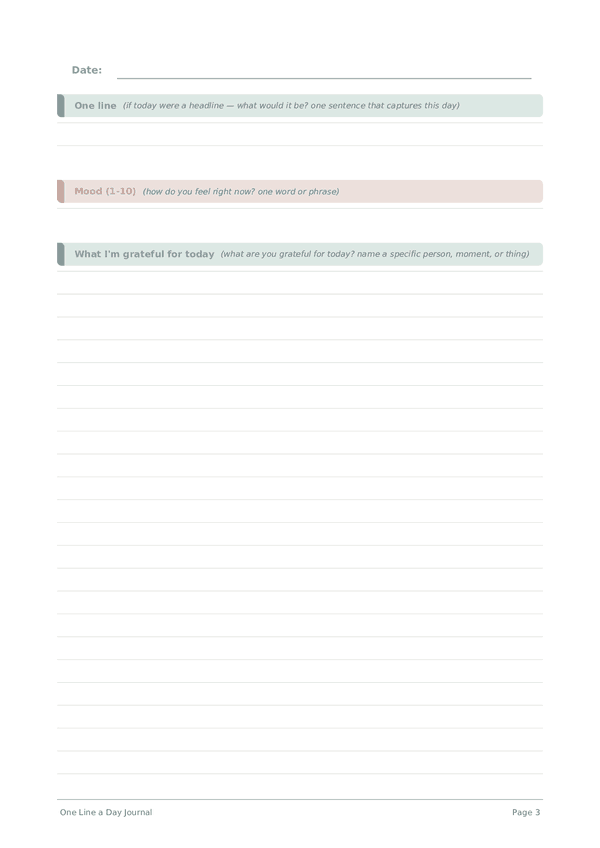
Each day you'll find several labeled sections with lines for writing. Here's what each section is for:
One line
If today were a headline — what would it be? One sentence that captures this day
Mood (1-10)
Rate your overall emotional state for the day. 1 means very low or depressed, 10 means exceptionally happy and positive. Don't overthink — go with your gut feeling.
What I'm grateful for today
List 1–3 things you're grateful for today. They can be big or tiny — a good meal, a kind word, sunshine. Gratitude journaling is one of the most scientifically supported well-being practices.
Tips for success
When and how often to write
Write every single day, no exceptions. The one-line format was designed for daily consistency \u2014 it takes under 60 seconds and the low barrier is the whole point. Write at the same time each day, ideally before bed, when you can scan the full day. Missing a day breaks the chain that makes this journal magical: the ability to compare the same date across years. If you do miss a day, fill it in the next morning from memory rather than leaving a blank.