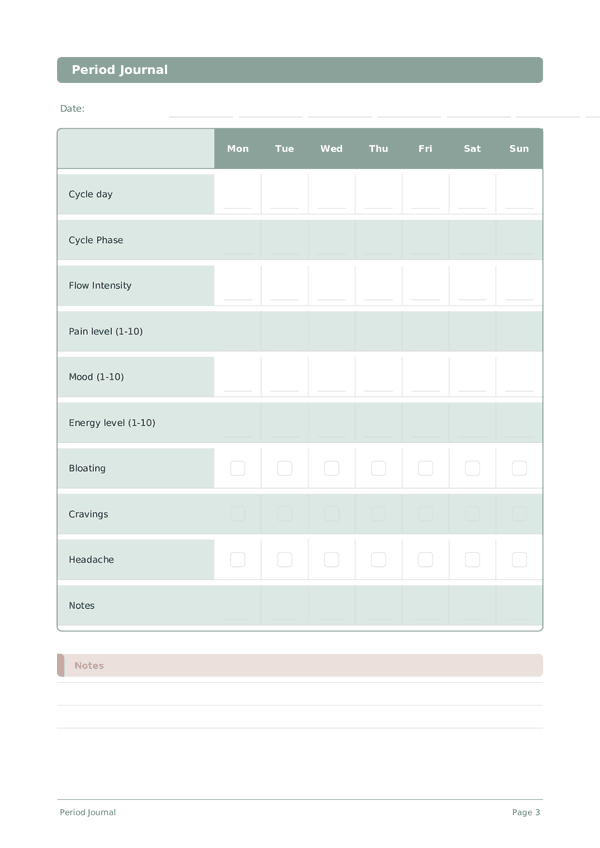
Printable Period Journal
Menstrual cycle tracker and symptom log
Track your menstrual cycle with detailed symptom logging, mood and energy patterns, and phase awareness. Build a comprehensive picture of your cycle for better health and self-understanding.
Customize fields
Toggle fields on or off. Click the pencil to rename, or add your own fields.
What is this journal?
A period journal is a daily tracker where you record the details of your menstrual cycle — cycle day, flow intensity, pain levels, mood, energy, and common symptoms like bloating, cravings, and headaches. By tracking these patterns consistently cycle after cycle, you develop a deep understanding of your body's rhythms that no app algorithm can replicate, because it is grounded in your own lived experience.
This journal is for anyone who menstruates and wants to understand their cycle better. Whether you are trying to predict your period more accurately, manage painful symptoms, prepare for hormonal shifts that affect your mood and energy, or gather data to share with a gynecologist, this tracker gives you a structured and private space to record it all.
Many people are surprised by what their period journal reveals. You might discover that your energy peaks during the follicular phase, that headaches reliably appear two days before your period, or that cravings are strongest on specific cycle days. This knowledge is empowering — it allows you to plan demanding tasks for your high-energy days, prepare for symptom management before symptoms start, and have informed conversations with healthcare providers about your menstrual health.
Filled example
Here's what a typical entry looks like when filled in:
| Mon | Tue | Wed | Thu | Fri | Sat | Sun | |
|---|---|---|---|---|---|---|---|
| Cycle day | 1 | 2 | 3 | 4 | 5 | 6 | 7 |
| Cycle Phase | Menstrual | Menstrual | Menstrual | Menstrual | Menstrual | Follicular | Follicular |
| Flow Intensity | 3 | 8 | 7 | 5 | 3 | 1 | 0 |
| Pain level (1-10) | 7 | 6 | 4 | 3 | 2 | 1 | 0 |
| Mood (1-10) | 4 | 5 | 5 | 6 | 6 | 7 | 8 |
| Energy level (1-10) | 3 | 4 | 4 | 5 | 6 | 7 | 8 |
| Bloating | ✓ | ✓ | ✓ | ✓ | |||
| Cravings | ✓ | ✓ | ✓ | ||||
| Headache | ✓ | ||||||
| Notes | First day, heavy cramps in the morning. Took ibuprofen. | Heaviest day. Stayed home. Hot water bottle helped. | Flow easing. Mild cramps in the evening. | Much lighter. Energy starting to return. | Spotting only. Felt almost normal. | Period basically over. Good energy. | Feeling great. Went for a run. |
How to fill in each field
Each page is a weekly grid. Rows are your tracking items, columns are days of the week. Here's what each item means:
Cycle day
Record which day of your cycle this is. Consistent tracking helps predict future cycles and identify irregularities.
Cycle Phase
Flow Intensity
Pain level (1-10)
Rate your pain intensity on a scale. Tracking pain levels helps identify triggers, evaluate treatments, and communicate with healthcare providers.
Mood (1-10)
Rate your overall emotional state for the day. 1 means very low or depressed, 10 means exceptionally happy and positive. Don't overthink — go with your gut feeling.
Energy level (1-10)
Rate your physical and mental energy level. 1 means exhausted and drained, 10 means fully energized and alert. This helps you identify what activities boost or drain your energy.
Bloating
Cravings
Headache
Notes
Add any additional context or thoughts. This catch-all column is for anything that doesn't fit elsewhere but might be useful later.
Tips for success
When and how often to write
Mark flow and symptoms every day during your period, and note any mid-cycle symptoms (ovulation pain, spotting, discharge changes) as they occur. On non-event days, a quick daily check-in about mood and energy still provides valuable cycle data. At the end of each cycle, review the full pattern. After 3 months, you will be able to predict symptom onset and prepare accordingly. Share tracked data with your gynecologist at annual checkups for more productive appointments.