Printable Period Journal
Menstrual cycle tracker and symptom log
Track your menstrual cycle with detailed symptom logging, mood and energy patterns, and phase awareness. Build a comprehensive picture of your cycle for better health and self-understanding.
Customize fields
Toggle fields on or off. Click the pencil to rename, or add your own fields.
What is this journal?
A period journal is a daily tracker where you record the details of your menstrual cycle — cycle day, flow intensity, pain levels, mood, energy, and common symptoms like bloating, cravings, and headaches. By tracking these patterns consistently cycle after cycle, you develop a deep understanding of your body's rhythms that no app algorithm can replicate, because it is grounded in your own lived experience.
This journal is for anyone who menstruates and wants to understand their cycle better. Whether you are trying to predict your period more accurately, manage painful symptoms, prepare for hormonal shifts that affect your mood and energy, or gather data to share with a gynecologist, this tracker gives you a structured and private space to record it all.
Many people are surprised by what their period journal reveals. You might discover that your energy peaks during the follicular phase, that headaches reliably appear two days before your period, or that cravings are strongest on specific cycle days. This knowledge is empowering — it allows you to plan demanding tasks for your high-energy days, prepare for symptom management before symptoms start, and have informed conversations with healthcare providers about your menstrual health.
Filled example
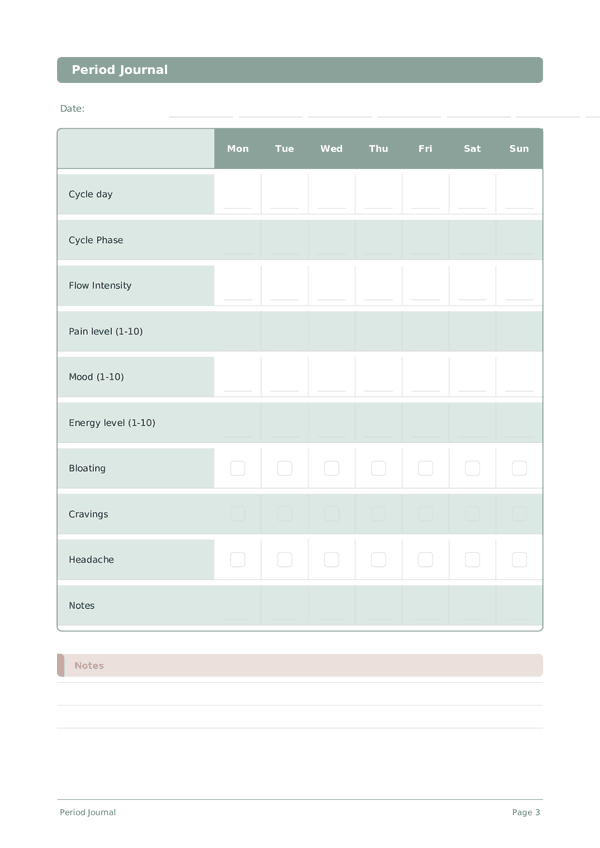
Here's what a typical entry looks like when filled in:
| Mon | Tue | Wed | Thu | Fri | Sat | Sun | |
|---|---|---|---|---|---|---|---|
| Cycle day | 1 | 2 | 3 | 4 | 5 | 6 | 7 |
| Cycle Phase | Menstrual | Menstrual | Menstrual | Menstrual | Menstrual | Follicular | Follicular |
| Flow Intensity | 3 | 8 | 7 | 5 | 3 | 1 | 0 |
| Pain level (1-10) | 7 | 6 | 4 | 3 | 2 | 1 | 0 |
| Mood (1-10) | 4 | 5 | 5 | 6 | 6 | 7 | 8 |
| Energy level (1-10) | 3 | 4 | 4 | 5 | 6 | 7 | 8 |
| Bloating | ✓ | ✓ | ✓ | ✓ | |||
| Cravings | ✓ | ✓ | ✓ | ||||
| Headache | ✓ | ||||||
| Notes | First day, heavy cramps in the morning. Took ibuprofen. | Heaviest day. Stayed home. Hot water bottle helped. | Flow easing. Mild cramps in the evening. | Much lighter. Energy starting to return. | Spotting only. Felt almost normal. | Period basically over. Good energy. | Feeling great. Went for a run. |
How to fill in each field
Each page is a weekly grid. Rows are your tracking items, columns are days of the week. Here's what each item means:
Cycle day
Record which day of your cycle this is. Consistent tracking helps predict future cycles and identify irregularities.
Cycle Phase
Flow Intensity
Pain level (1-10)
Rate your pain intensity on a scale. Tracking pain levels helps identify triggers, evaluate treatments, and communicate with healthcare providers.
Mood (1-10)
Rate your overall emotional state for the day. 1 means very low or depressed, 10 means exceptionally happy and positive. Don't overthink — go with your gut feeling.
Energy level (1-10)
Rate your physical and mental energy level. 1 means exhausted and drained, 10 means fully energized and alert. This helps you identify what activities boost or drain your energy.
Bloating
Cravings
Headache
Notes
Add any additional context or thoughts. This catch-all column is for anything that doesn't fit elsewhere but might be useful later.
Tips for success
When and how often to write
Mark flow and symptoms every day during your period, and note any mid-cycle symptoms (ovulation pain, spotting, discharge changes) as they occur. On non-event days, a quick daily check-in about mood and energy still provides valuable cycle data. At the end of each cycle, review the full pattern. After 3 months, you will be able to predict symptom onset and prepare accordingly. Share tracked data with your gynecologist at annual checkups for more productive appointments.
Frequently Asked Questions
Why track cycle phase alongside cycle day?
ACOG (2015, reaffirmed 2022) recommends recording both because phase shows hormonal context while day enables prediction. The four phases — menstrual, follicular, ovulatory, luteal — drive predictable shifts in mood, energy, pain, and bloating, per NIH NICHD reference data. Knowing you're in the luteal phase explains premenstrual symptoms; logging both fields lets your gynecologist correlate complaints with the relevant hormonal window.
What counts as a 'normal' cycle length and flow?
ACOG defines normal as 21–35 day cycles with 2–7 day bleeding. Heavy menstrual bleeding (menorrhagia) is generally >80 ml total, or soaking through a pad/tampon hourly. The flow intensity 0–10 scale captures subjective change over time more usefully than absolute volume. Persistent cycles outside this range, or sudden changes, warrant evaluation by a gynecologist.
How does this journal help diagnose conditions like PCOS or endometriosis?
Gynecologists use 3–6 months of cycle data to spot patterns suggesting PCOS (irregular cycles, often >35 days), endometriosis (severe pain ≥7/10, especially during menstruation), PMDD (mood scores 7+ days pre-period), or fibroids (heavy flow). ACOG and NICE both rely on patient diaries for differential diagnosis. The pain level (1-10) and flow intensity ratings, combined with mood scores, give your clinician evidence beyond a single appointment.
What do the bloating, cravings, and headache checkboxes reveal?
These are core premenstrual syndrome (PMS) symptoms per NIH NICHD criteria. APA defines PMDD when 5+ symptoms cluster in the luteal phase for most cycles. Checking them across 2–3 cycles shows whether symptoms are consistently cyclical (PMS/PMDD) or random. This distinction matters for treatment — SSRIs help PMDD; lifestyle interventions help mild PMS, per ACOG guidelines.
How is this different from a period app like Clue or Flo?
Apps store and predict; paper journals invite reflection. Many tracking apps share data with third parties — a privacy concern flagged by HHS and the FTC. The paper format keeps menstrual data fully private. The 0–10 ratings here also allow more nuanced symptom tracking than most apps' binary checkboxes. Use both if helpful — paper for sensitive notes, app for prediction.
Can I track perimenopausal cycles with this journal?
Yes. NIA and ACOG describe perimenopause (typically ages 45–55) by irregular cycle lengths, hot flashes, and mood shifts. The flow intensity, mood, and energy ratings capture this transition well; cycle day stays useful even as cycles lengthen. Bring 6+ months of data to your gynecologist if cycles become consistently >35 days or skip months — this helps stage the menopause transition and rule out other causes.
How long until tracking patterns become useful?
ACOG recommends 3 complete cycles for baseline characterization, and 6 cycles to detect cyclic disorders like PMDD. The first month often reveals little because phase identification depends on knowing the next period's start. After 3 cycles, average cycle length, ovulation patterns (via mid-cycle energy and mood shifts), and symptom clustering become clear. Reliable PMS/PMDD diagnosis requires at least 2 prospectively logged cycles.
When should cycle changes prompt a doctor's visit?
ACOG and Mayo Clinic red flags: cycles consistently shorter than 21 or longer than 35 days, bleeding lasting over 7 days, very heavy flow (soaking pads hourly), severe pain unresponsive to OTC analgesics, bleeding between periods, or sudden cycle changes. Bring at least 3 cycles of journal data. Sudden absence of menstruation warrants pregnancy testing and evaluation if pregnancy is excluded.
You Might Also Like
Scroll to zoom, drag to move