Printable Pregnancy Journal
Cherish every moment of your pregnancy journey
A beautiful daily companion for your pregnancy — track your weekly progress, baby movements, symptoms, and body changes while preserving heartfelt reflections and letters to your little one. More than a health log, this journal becomes a treasured keepsake of the nine months that changed everything.
Customize fields
Toggle fields on or off. Click the pencil to rename, or add your own fields.
Benefits
How to Use
What is this journal?
A pregnancy journal is a week-by-week record of your journey through pregnancy, combining health tracking with personal reflection. You log physical measurements like weight and belly circumference, monitor symptoms such as nausea and sleep quality, and write about your experiences, cravings, and the emotional landscape of growing a new life. It is both a health tool and a keepsake — a record you may cherish for years to come.
This journal is for expecting parents who want to stay on top of their health while also capturing the deeply personal experience of pregnancy. Whether this is your first pregnancy or your third, every journey is unique. It is especially useful for those who want organized records to share with their prenatal care provider, as well as for anyone who finds comfort and clarity in writing during a time of profound change.
Pregnancy is a 40-week transformation that unfolds gradually, and without a journal, many details fade from memory surprisingly quickly. By recording your symptoms, you create a useful reference for medical appointments and can spot trends that deserve attention. By writing letters to your baby and reflecting on your feelings, you process the emotional complexity of this experience and create something beautiful to look back on — or even share with your child someday. Your pregnancy journal honors both the practical and the profound aspects of bringing new life into the world.
Filled example
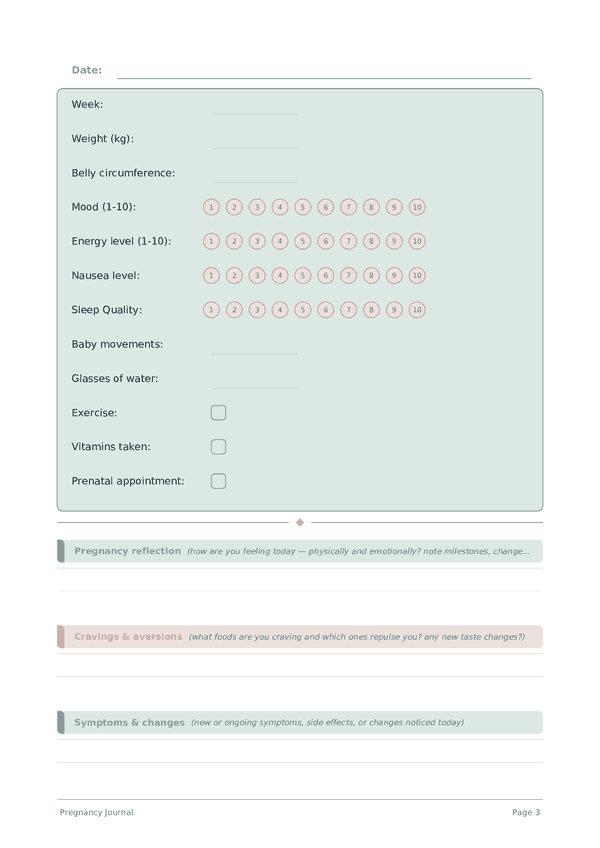
Here's what a typical entry looks like when filled in:
How to fill in each field
The top of each page has quick-fill fields (ratings, checkboxes, numbers). Below that is a lined section for writing. Here's what each field means:
Week
Record the pregnancy week number. This helps correlate symptoms and changes with developmental milestones.
Weight (kg)
Record your weight if you're tracking it. Weigh yourself at the same time each day for consistent data. Focus on weekly trends, not daily fluctuations.
Belly circumference
Measure around the widest part of your belly in centimeters or inches
Mood (1-10)
Rate your overall emotional state for the day. 1 means very low or depressed, 10 means exceptionally happy and positive. Don't overthink — go with your gut feeling.
Energy level (1-10)
Rate your physical and mental energy level. 1 means exhausted and drained, 10 means fully energized and alert. This helps you identify what activities boost or drain your energy.
Nausea level
How strong is your nausea today? Rate from 1 (barely there) to 10 (severe)
Sleep Quality
Rate how restful your sleep was. 1 means terrible and restless, 5 means deep and refreshing. Quality matters as much as quantity.
Baby movements
How many distinct baby movements did you feel today? Kicks and rolls count
Glasses of water
Track your daily water intake. Most people need 6–8 glasses. Ticking off glasses throughout the day helps you stay hydrated.
Exercise
Check off whether you exercised today. Even a 10-minute walk counts. The goal is building awareness of your activity patterns.
Vitamins taken
Did you take your prenatal vitamins today? Note any you skipped
Prenatal appointment
Any prenatal visit or scan today? Briefly note what was checked or discussed
Pregnancy reflection
How are you feeling today — physically and emotionally? Note milestones, changes, or moments worth remembering
Cravings & aversions
What foods are you craving and which ones repulse you? Any new taste changes?
Symptoms & changes
New or ongoing symptoms, side effects, or changes noticed today
Letter to baby
Write a few words to your baby — your hopes, dreams, or what happened today. A treasure they'll appreciate someday
Tips for success
When and how often to write
Write a brief daily entry covering symptoms, mood, and any notable changes. Do kick counts daily starting week 28, ideally at the same time each day when the baby is typically active. Record weight and blood pressure at each prenatal appointment. Weekly, take a moment to write about your emotional experience — these entries become a treasured record. Each trimester, review your full journal to see how far you have come and share relevant patterns with your healthcare provider.
Frequently Asked Questions
When should I start counting baby movements (kick counts)?
ACOG recommends formal kick counts from 28 weeks gestation; movement awareness from ~16–20 weeks (first-time mothers slightly later). The baby movements field is most clinically useful in the third trimester. ACOG's guidance: count time to 10 distinct movements once daily — usually under 2 hours. Reduced movement compared to your baseline warrants immediate contact with your obstetrician.
How much weight gain is normal during pregnancy?
Per ACOG and IOM (Institute of Medicine, 2009): 11.5–16 kg (25–35 lb) for normal pre-pregnancy BMI; 7–11.5 kg for overweight; 5–9 kg for obese; 12.5–18 kg for underweight. Gain accelerates in the second and third trimesters at ~0.4 kg per week. The weekly weight column helps your obstetrician spot deviations that may signal gestational diabetes, preeclampsia, or growth concerns.
What does the nausea level rating help track?
First-trimester nausea (NVP) affects ~70–80% of pregnancies per ACOG; ~3% develop hyperemesis gravidarum. Daily 0–10 ratings help your obstetrician tell typical NVP from hyperemesis, where ratings stay 7+ with weight loss and dehydration. NIH NICHD recommends documenting frequency, severity, and triggers — this template supports all three via the tracker and the symptoms-and-changes prompt.
Why log prenatal appointments separately?
ACOG's standard schedule is monthly visits through 28 weeks, every 2 weeks 28–36 weeks, weekly after 36 weeks — about 12–15 appointments. Checking prenatal appointment days creates a visible timeline of growth measurements, ultrasounds, and screening dates. This helps if you change providers, transfer care, or need to recall test timing during birth planning.
Is daily journaling safe during high-risk pregnancy?
Yes, and often encouraged. ACOG notes that detailed self-monitoring supports earlier detection of complications. Conditions like gestational diabetes, hypertension, or preeclampsia produce trackable warning signs — headache, swelling, vision changes, reduced movement — that the symptoms-and-changes prompt captures. Always follow your maternal-fetal medicine specialist's specific monitoring instructions; the journal supplements, not replaces, clinical follow-up.
What pregnancy symptoms warrant urgent medical attention?
ACOG and Mayo Clinic red flags: severe headache unresponsive to acetaminophen, vision changes, severe upper-abdominal pain, reduced or absent fetal movement (after 28 weeks), vaginal bleeding, leaking fluid, contractions before 37 weeks, severe swelling especially of face/hands, persistent vomiting with weight loss. Note these in symptoms-and-changes and contact your obstetrician or labor & delivery unit immediately. The journal documents history — it does not replace clinical evaluation.
How does the letter-to-baby section serve emotional health?
APA (2021) and NIH NIMH research show expressive writing during pregnancy reduces anxiety and supports maternal-fetal bonding. The letter-to-baby prompt creates a keepsake while serving a therapeutic function — putting feelings into narrative improves emotional regulation. About 10–20% of pregnancies involve clinical perinatal mood disorders per ACOG; persistent low mood warrants screening (EPDS) and clinician consultation.
When should belly measurements show concerning patterns?
Fundal height (belly circumference is a rough proxy) typically tracks gestational weeks ±2 cm from 20 weeks per ACOG. Significant deviations may indicate growth restriction (IUGR) or macrosomia. Your obstetrician measures formally at each visit; the journal's belly circumference field documents weekly change. Persistent shortfall or excess across two visits, especially after 24 weeks, prompts ultrasound evaluation.
You Might Also Like
Scroll to zoom, drag to move