Printable Productivity Journal
Track energy, focus, and daily output to build peak performance habits
A hybrid journal that combines quick daily metrics — energy, focus, motivation, and satisfaction — with structured writing prompts for priorities, wins, and reflection. Rate your performance at a glance, then dig deeper into what drove your results. Over time, discover the patterns behind your most productive days.
Customize fields
Toggle fields on or off. Click the pencil to rename, or add your own fields.
Benefits
How to Use
What is this journal?
A productivity journal is a daily system for tracking your energy, focus, and output while reflecting on what moved the needle and what got in the way. By combining quantitative tracking of key productivity indicators with written analysis of wins and distractions, you build a personalized understanding of your peak performance conditions.
This journal is for knowledge workers, entrepreneurs, students, and anyone whose output depends on managing energy and attention rather than simply putting in hours. It goes beyond task lists to examine the meta-layer of productivity — when you work best, what conditions enable flow, and which habits consistently lead to your best days.
Research on deliberate practice and performance psychology shows that top performers in every field share one habit: systematic self-review. By tracking not just what you did but how you felt doing it — your energy, focus, and satisfaction — you discover the personal productivity patterns that generic advice cannot provide.
Filled example
Here's what a typical entry looks like when filled in:
How to fill in each field
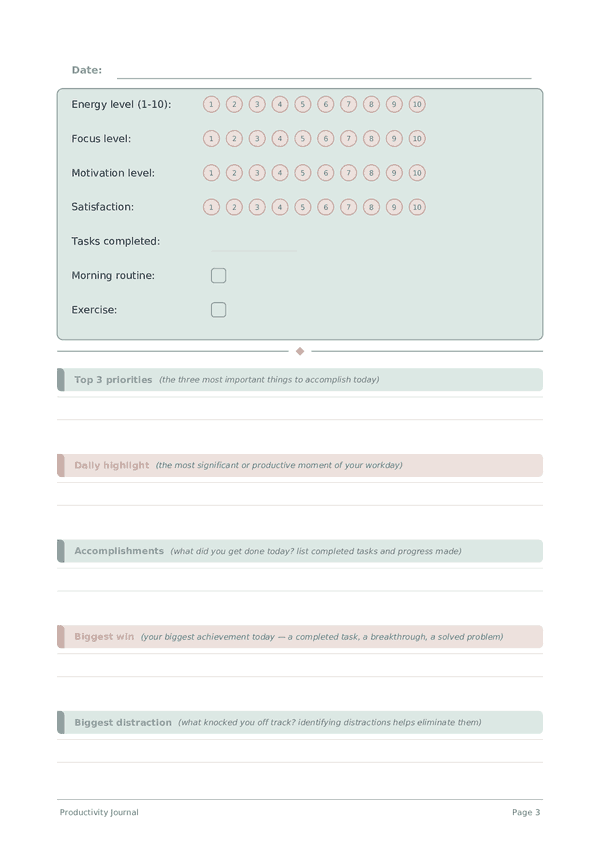
The top of each page has quick-fill fields (ratings, checkboxes, numbers). Below that is a lined section for writing. Here's what each field means:
Energy level (1-10)
Rate your physical and mental energy level. 1 means exhausted and drained, 10 means fully energized and alert. This helps you identify what activities boost or drain your energy.
Focus level
How well can you concentrate right now? Rate from 1 (scattered) to 10 (laser focus)
Motivation level
How motivated did you feel today? Rate from 1 (drained) to 10 (unstoppable)
Satisfaction
How satisfied are you with today's session? (1=frustrated, 5=very satisfied)
Tasks completed
How many tasks did you finish today? List your key wins
Morning routine
Did you complete your morning routine today? Note what you did or skipped
Exercise
Check off whether you exercised today. Even a 10-minute walk counts. The goal is building awareness of your activity patterns.
Top 3 priorities
The three most important things to accomplish today
Daily highlight
The most significant or productive moment of your workday
Accomplishments
What did you get done today? List completed tasks and progress made
Biggest win
Your biggest achievement today — a completed task, a breakthrough, a solved problem
Biggest distraction
What knocked you off track? Identifying distractions helps eliminate them
Plan for tomorrow
What are the most important tasks to tackle tomorrow?
Tips for success
When and how often to write
Fill in the tracker each morning (energy, priorities, intention) and each evening (focus, output, satisfaction, reflection). The morning section takes 3 minutes; the evening section takes 5\u20137 minutes. This bookend approach creates a feedback loop between intention and result. Review weekly every Sunday to spot which days were most productive and what conditions enabled them. Monthly, recalibrate your priorities based on the patterns you see.