Printable Reading Journal
Reflect on every book you read
A guided reading journal that combines quick tracking with thoughtful reflection. Rate each book, record your progress, and capture the quotes, insights, and takeaways that matter most. Transform passive reading into an active practice of learning and self-discovery.
Customize fields
Toggle fields on or off. Click the pencil to rename, or add your own fields.
Benefits
How to Use
What is this journal?
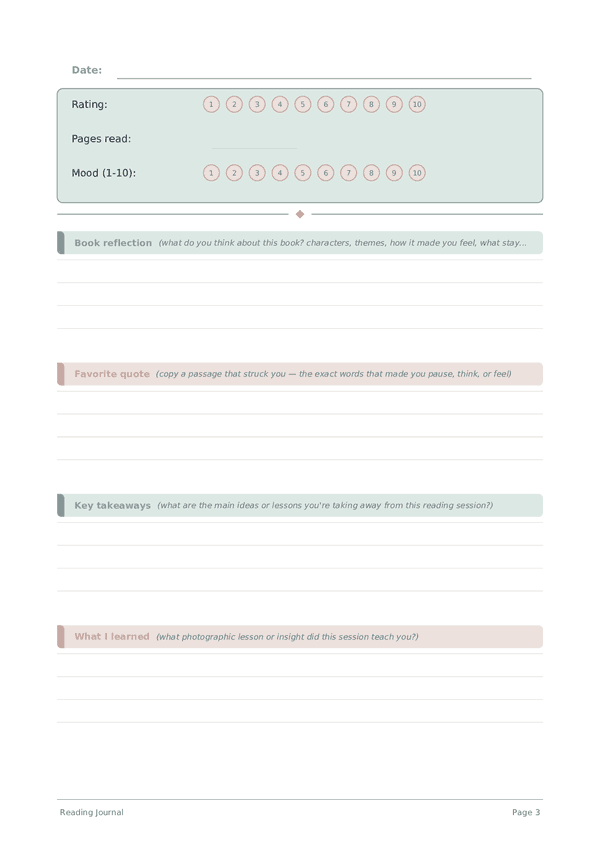
A Reading Journal is a hybrid companion for thoughtful readers who want to get more from every book. The top section tracks your rating, pages read, and current mood. The bottom section prompts you to reflect on what you read, capture key takeaways, save your favorite quote, note what you learned, and record whether you would recommend the book. It transforms passive reading into active learning.
Studies in cognitive science consistently show that writing about what you read dramatically improves retention and understanding. Without reflection, most of a book's insights fade within weeks. This journal creates a simple habit: after each reading session, spend a few minutes processing the material in your own words. Over time, you build a personal library of distilled wisdom that you can revisit anytime.
Keep this journal next to wherever you read. After each session, fill in the tracker — it takes seconds. Then write your reflection while the material is fresh: what stood out, what challenged your thinking, what you want to remember. The favorite quote section is especially valuable — curating the lines that resonate with you creates a personal anthology that reveals your evolving interests and values.
Filled example
Here's what a typical entry looks like when filled in:
How to fill in each field
The top of each page has quick-fill fields (ratings, checkboxes, numbers). Below that is a lined section for writing. Here's what each field means:
Rating
Overall rating of the experience
Pages read
How many pages did you read today? Even a few pages count — consistency matters
Mood (1-10)
Rate your overall emotional state for the day. 1 means very low or depressed, 10 means exceptionally happy and positive. Don't overthink — go with your gut feeling.
Book reflection
What do you think about this book? Characters, themes, how it made you feel, what stayed with you
Favorite quote
Copy a passage that struck you — the exact words that made you pause, think, or feel
Key takeaways
What are the main ideas or lessons you're taking away from this reading session?
What I learned
Write one new thing you learned today. It can be a fact, a skill, an insight about yourself, or a life lesson. Daily learning compounds into wisdom.
Would recommend
Would you recommend this book? To whom and why?
Tips for success
When and how often to write
Make a short entry every time you finish a reading session — even two lines are enough to capture what resonated. Write a full reflection within a day of finishing a book while details are still vivid. Once a month, scan your entries to notice trends: are you gravitating toward certain authors, themes, or moods? A quarterly review of your reading list helps you set intentional goals for the next period rather than drifting between random picks.